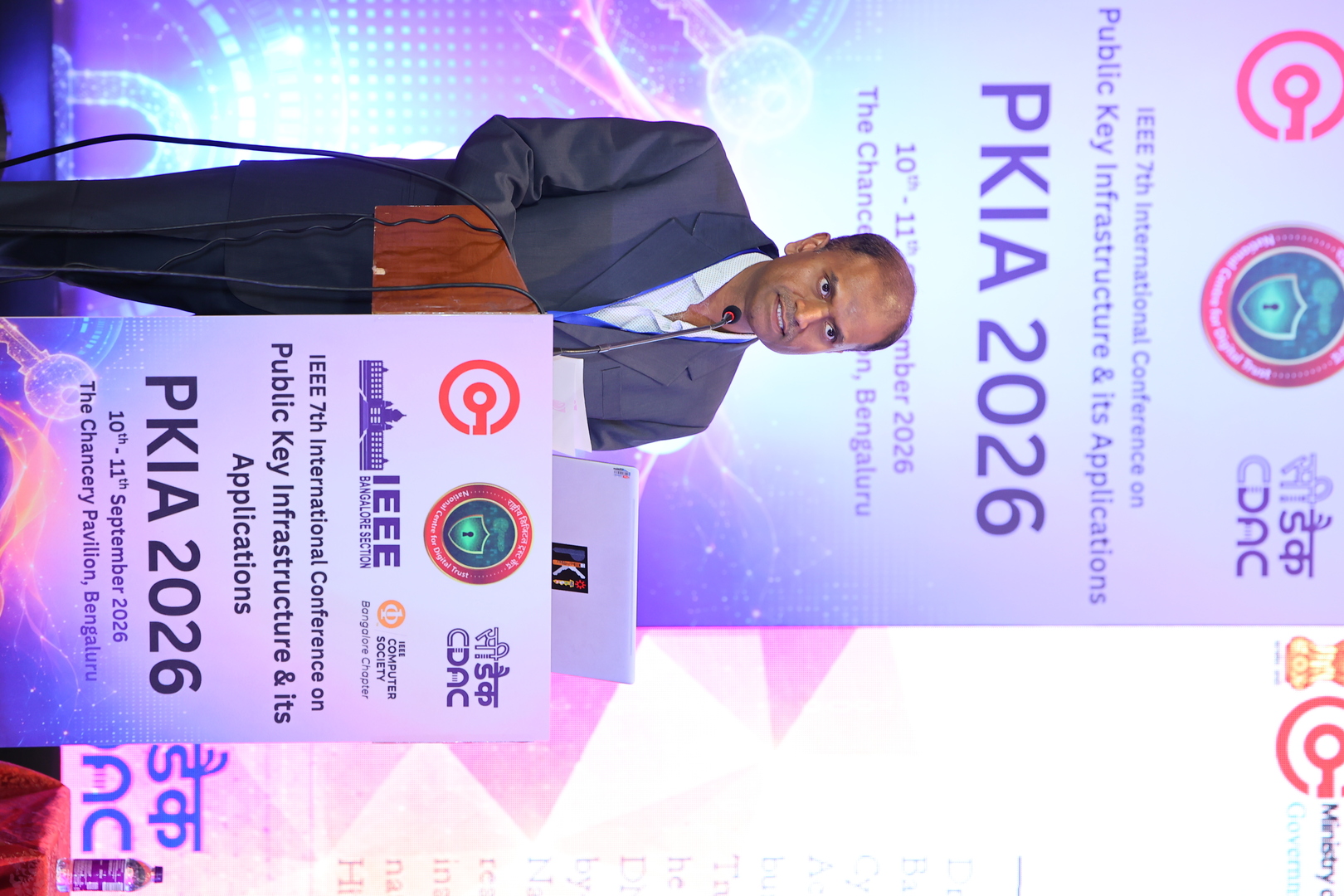
7th International Conference on

Public Key Infrastructure and its Applications (PKIA 2026)

A Joint Conference by IEEE Bangalore and IEEE CS Bangalore Chapter

September 10-11th, 2026

Bangalore, Karnataka, India

About PKIA 2026

The 7th International Conference on Public Key Infrastructure and its Applications (PKIA 2026) is a joint conference by IEEE Bangalore Section and IEEE CS (Computer Society) Bangalore Chapter. It will be a premium venue for bringing together all stakeholders of a Public Key Infrastructure Ecosystem. The objective is to provide a platform for presenting novel ideas from academia and industry on traditional and emerging topics and new paradigms in the areas of PKI, with a clear connection to real-world problems, systems or applications. Accepted papers will be submitted for possible inclusion into IEEE Xplore subject to meeting IEEE Xplore’s scope and quality requirements.

Call for Papers

Applications of PKI as a technology has grown by leaps and bounds in the recent years and is on the verge of becoming synonymous with trust in electronic transactions all over the world. The world of PKI has evolved as a robust and reliable system owing to the strong ecosystem - backed by the development in Cryptography, Protocols, Standards, Policy, Laws, Software libraries and hardware components. The objective is to provide a platform for exchanging of research concepts, brainstorming of emerging trends and best practices, showcasing of new and innovative PKI applications and presenting novel ideas from academia and industry with a clear connection to real-world problems, systems or applications. The conference therefore seeks submissions presenting innovative research and current developments in the areas of Public Key Infrastructures, Digital Certificates, Digital Signatures, Key Management, One-Time Signatures, Certificate-less secure communication, Time Stamping, PKI based Authentication etc. Submissions may focus on Modelling, Design, Analysis (incl. security proofs and attacks), Development (e.g. implementations), Deployment (e.g. system integration), and Maintenance (e.g. performance measurements, usability studies) of algorithms/ protocols/ standards/ implementations/ technologies / devices/ systems standing in relation with public key cryptography. Some topics of interest include but not limited to:

  • Advanced Cryptographic Methods for Digital Signing
  • Light Weight Cryptography and PKI
  • Security issues and Challenges in Crypto Tokens
  • PKI and FIDO
  • Policy and Legal support systems for PKI
  • Key Management Implementation and Issues
  • Critical Infrastructure Protection using PKI
  • Public Key Infrastructure Protection
  • Certificate Validation
  • Implementation of PKI Applications
  • Standard Libraries for PKI Applications
  • Quantum Cryptography
  • Post Quantum Cryptography
  • Standard Plug-ins for PKI enablement
  • PKI of IoT Security
  • Usability in PKI for ease of issuance of tokens
  • Human factors in PKI security
  • Dynamic Digital / Electronic Signatures
  • PKI for Securing Mobile APPs
  • Biometric and PKI enabled applications
  • PKI for Identity Management
  • PKI in e-Governance, e-Banking
  • Parallelized Cryptographic Implementations
  • Advances in Public Key Cryptography
  • Trust Models, Trust List etc
  • Blockchain and Digital Currency

The use of generative AI software tools is permitted subject to the following requirements:

  • The AI systems have not been used to plagiarize, misrepresent, or falsify content.
  • The resulting work, in its entirety, accurately represents the authors' original research and novel intellectual contributions, and is not primarily the result of the AI tool's generative capabilities.
  • The authors accept full responsibility for the veracity and correctness of all material in their work, including any content generated by AI tools.

Note that all submissions will be checked using suitable AI content detectors

Double-Blind Reviewing

  • The conference will employ a lightweight double-blind reviewing process. Submissions should not reveal the identity of the authors in any way. In particular, authors' names, affiliations, and email addresses should not appear anywhere in the submission. Nothing should be done in the name of anonymity that weakens the submission or makes the job of reviewing the paper more difficult. In particular, important references should not be omitted or anonymized. Use the third person to refer to the author's previous work, e.g., replace "as we have shown before" with "as shown before in [X]."
  • Authors should feel free to disseminate their ideas or draft versions of their paper as they normally would. For example, authors may post drafts of their papers on the web, submit them to arXiv, and give talks on their research ideas. Authors with further questions on double-blind reviewing are encouraged to contact the PC Co-Chairs by email at pki@cdac.in.

Papers should be a maximum of 8 pages in the IEEE conference proceedings format available HERE

Please submit your technical papers via Microsoft CMT for PKIA 2026 here. For Quantum Conclave paper submission please visit here

All accepted, registered and presented paper will be included to IEEE Xplore Digital Library.

Important Dates

(All the deadlines are in AoE)

Last Date for Submission: 30th April 2026 15th May 2026 31st May 2026 (Hard)

Notification of Acceptance: 31st July 2026

Camera-Ready Submission: 23rd August 2026

Acknowledgement

The Microsoft CMT service was used for managing the peer-reviewing process for this conference. This service was provided for free by Microsoft and they bore all expenses, including costs for Azure cloud services as well as for software development and support.

Registration

All the fees are excluding GST. Additional GST@18% applicable

Author Registration Fee :

Student IEEE Member: ₹10,000
Student Non-Member: ₹12,000
IEEE Member: ₹14,000
Non-Member: ₹18,000

Foreign Author Registration Fee :

Student IEEE Member: $250
Student Non-Member: $300
IEEE Member: $400
Non-Member: $500


Camera-Ready Submission Instructions:

Please find it here

Participant Registration is free of charge. Please click here to complete your registration.
C A L L
F O R
P A P E R S

Program

All timings are in IST (Indian Standard Time).

Day 1 Day 2

Day 1: Thursday, September 10, 2026

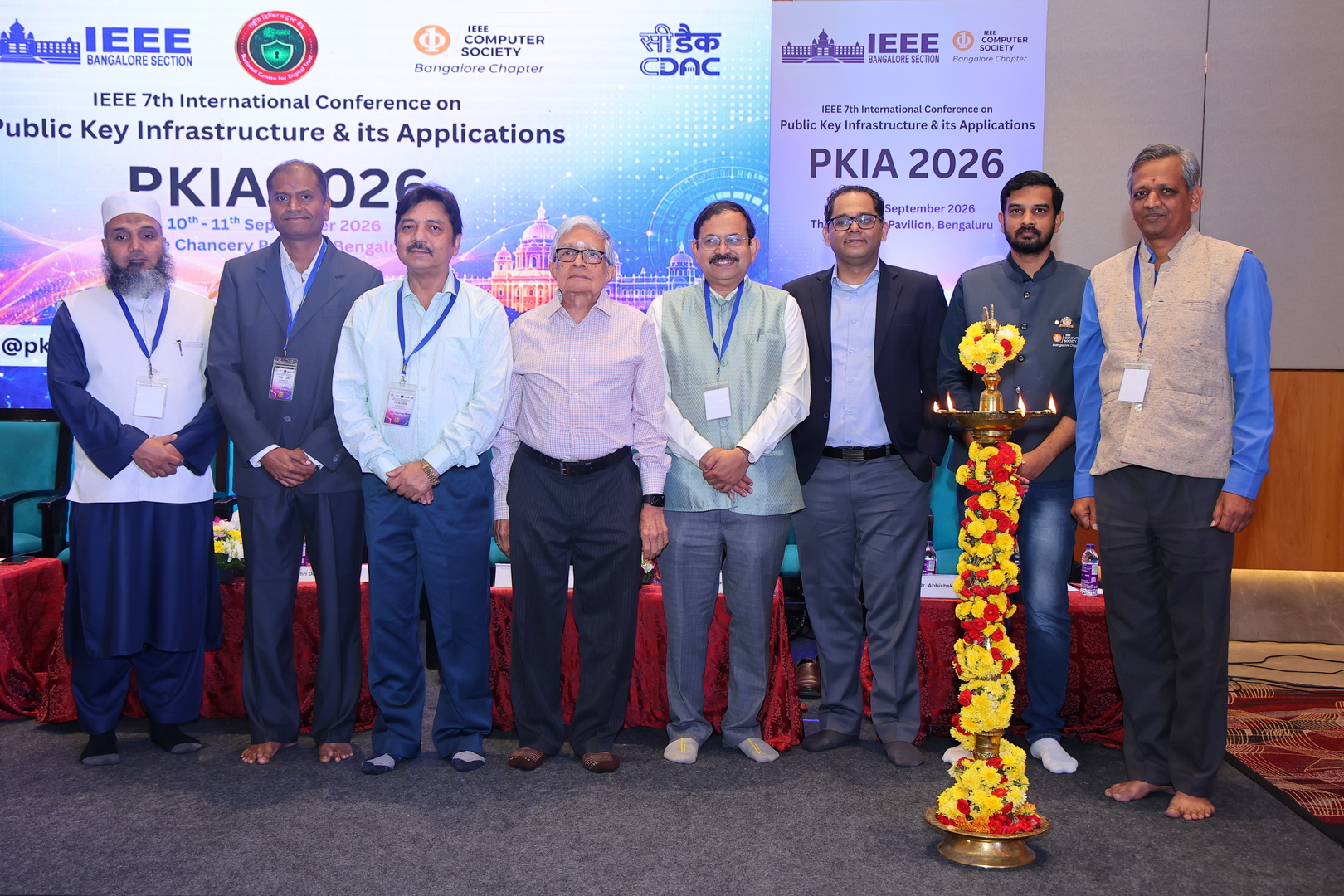
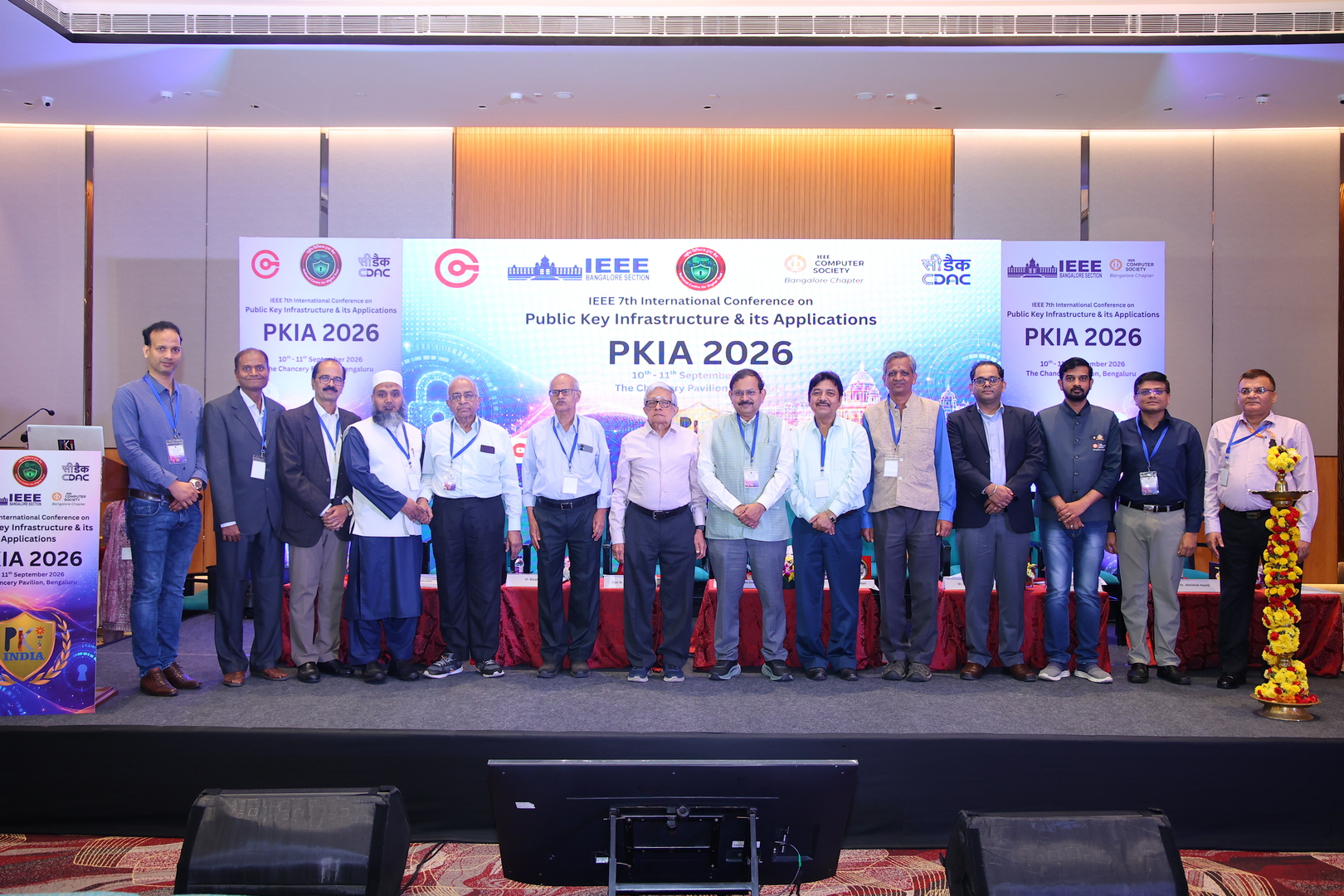
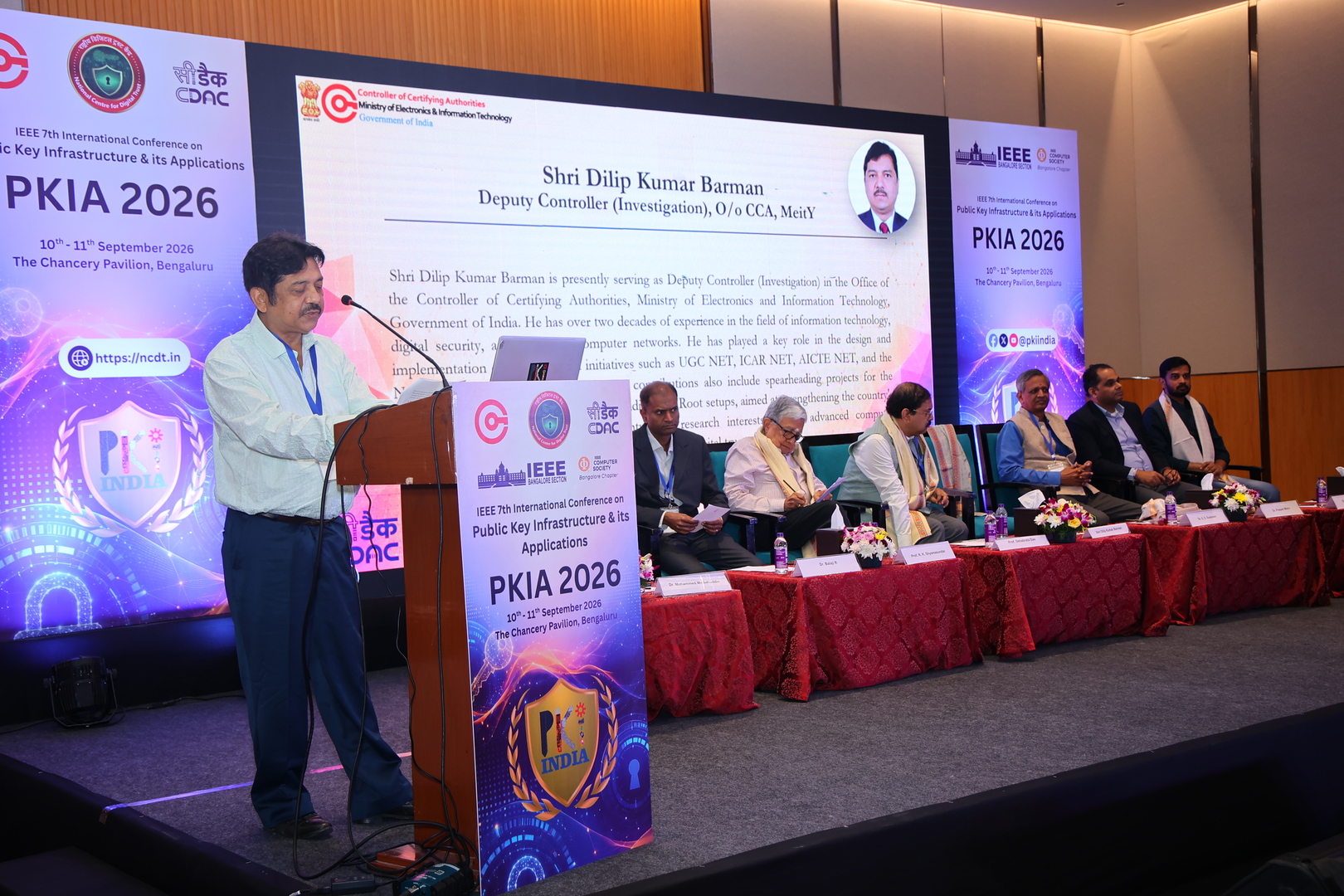
Inauguration (10:00 - 11:00)

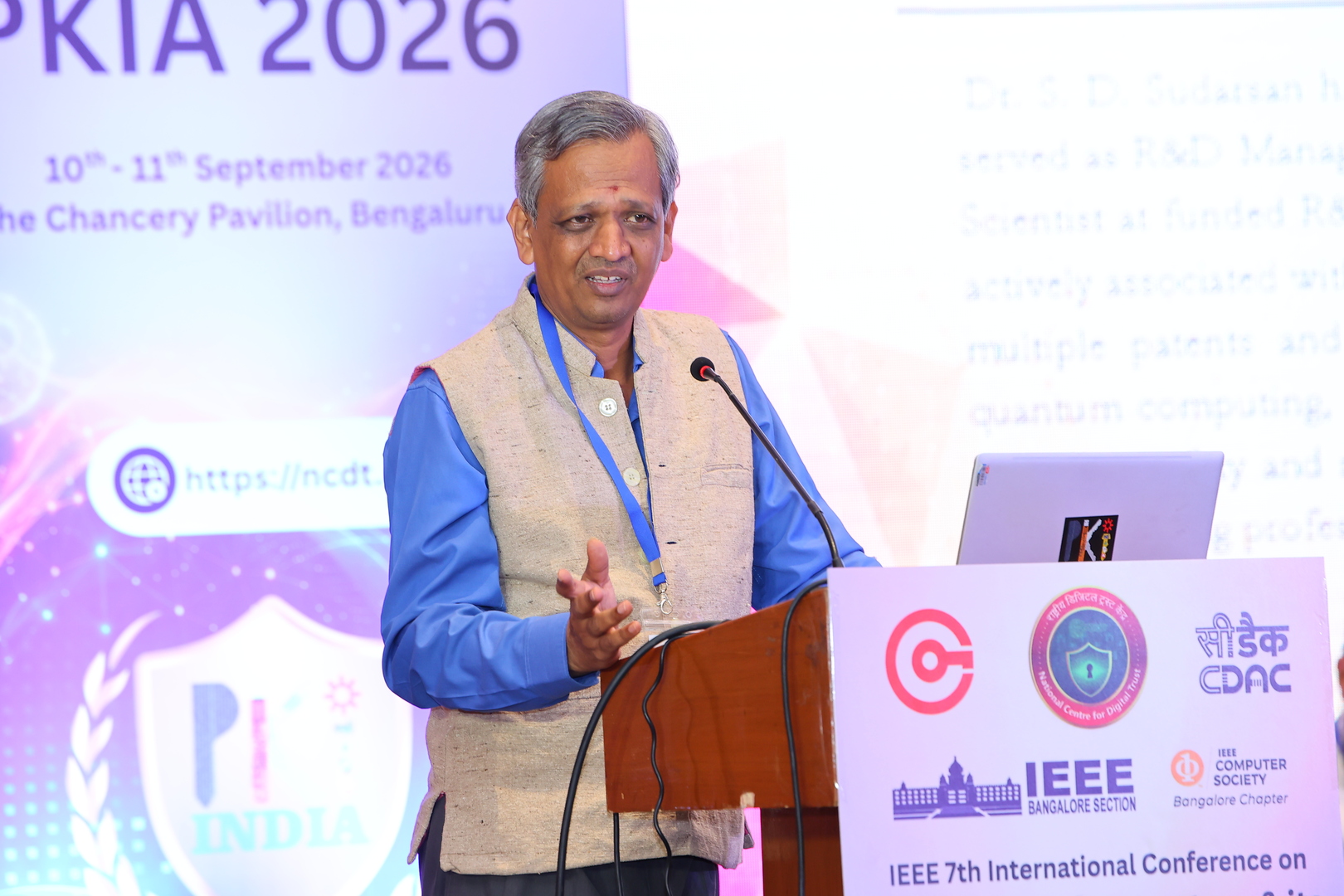
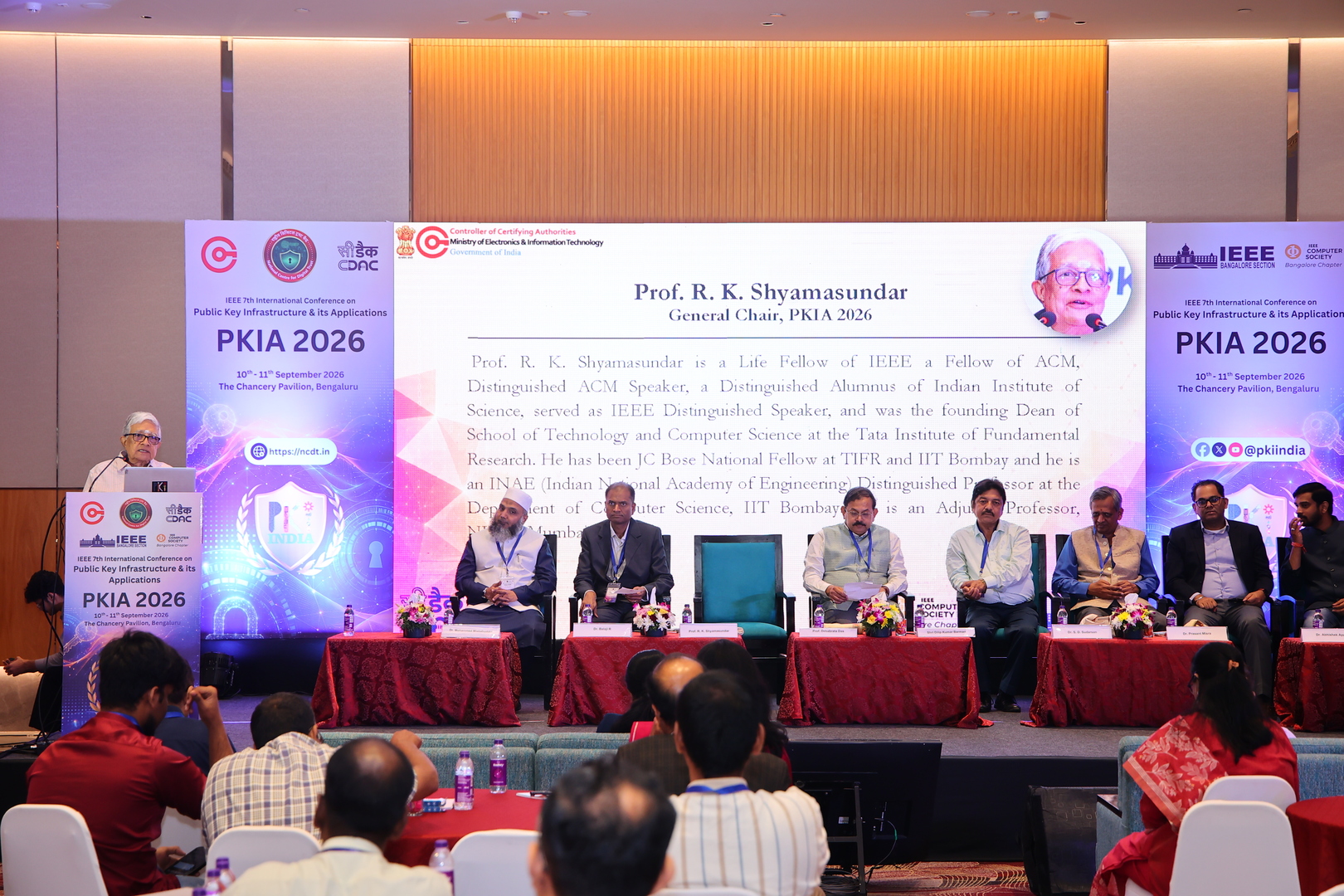
  • Welcome Address: Dr. S. D. Sudarsan, General Chair, PKIA 2026
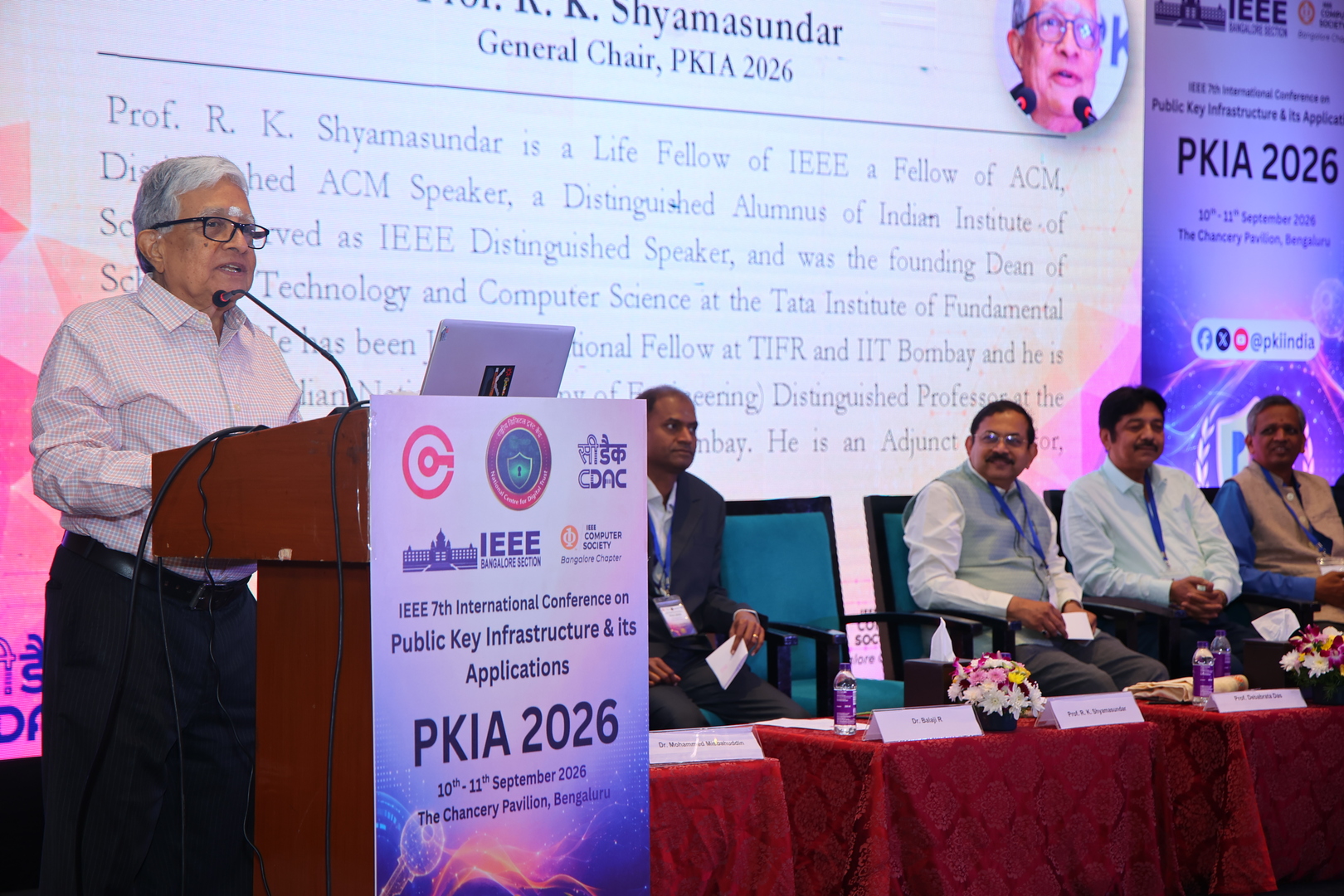
  • Introduction to PKIA 2026: Prof. R. K Shyamasundar, General Chair, PKIA 2026
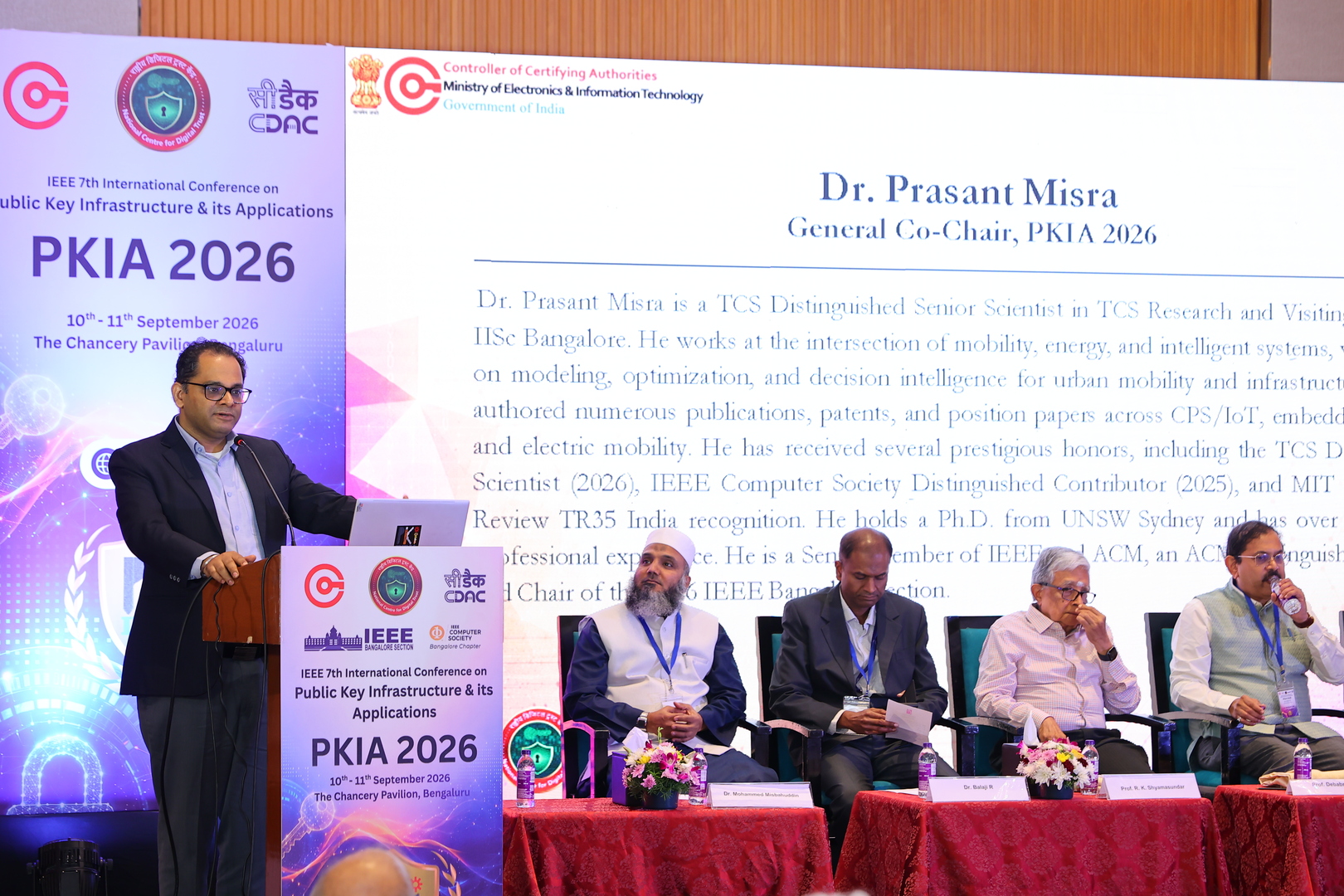
  • Address by General Co-Chair: Dr. Prasant Misra, Chair, IEEE Bangalore Chapter
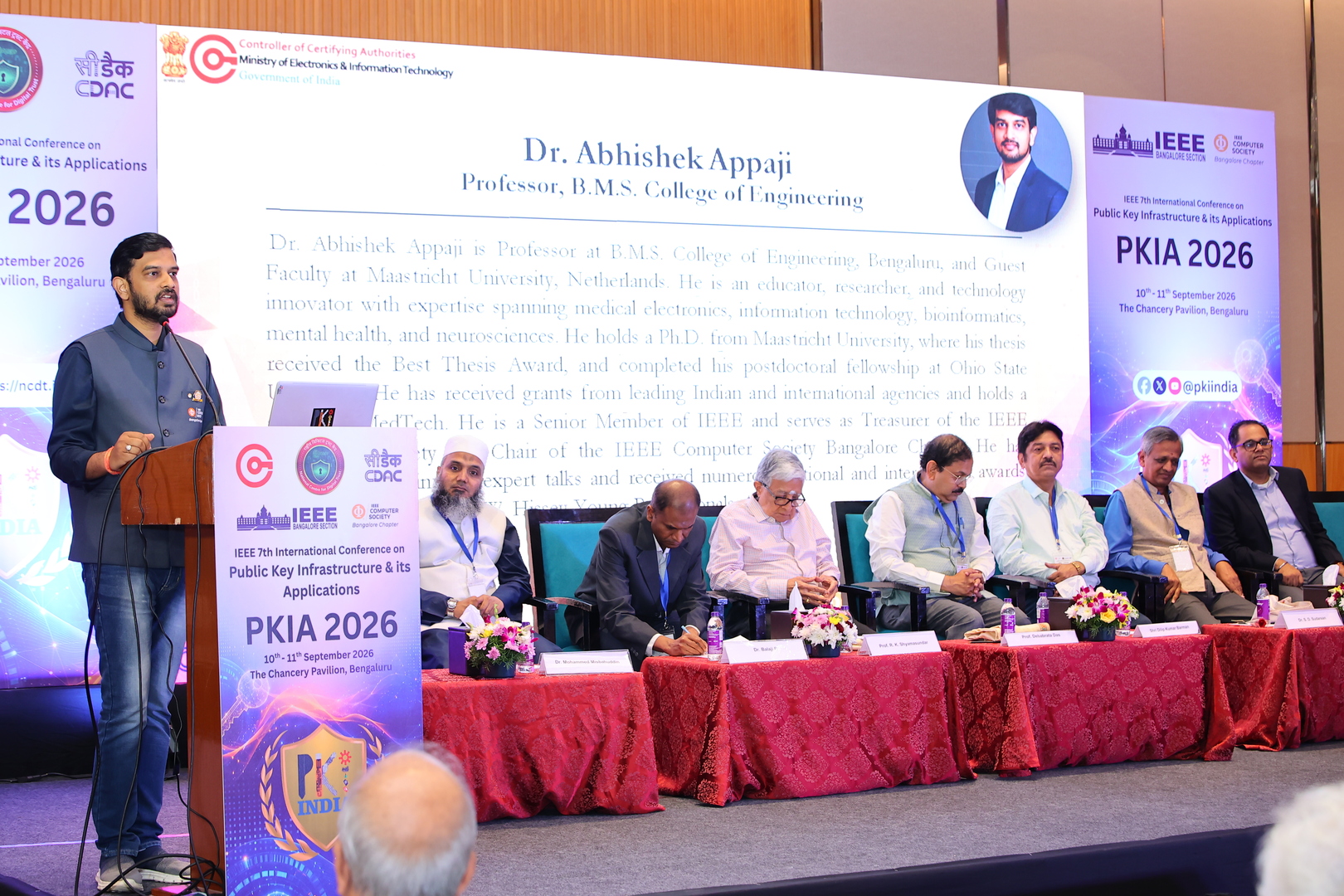
  • Address by General Co-Chair: Dr. Abhishek Appaji, Chair, IEEE CS Bangalore Chapter
  • Address by Chief Guest: Dr. Sanjay Bahl, Controller of Certifying Authorities and Director General, CERT-In
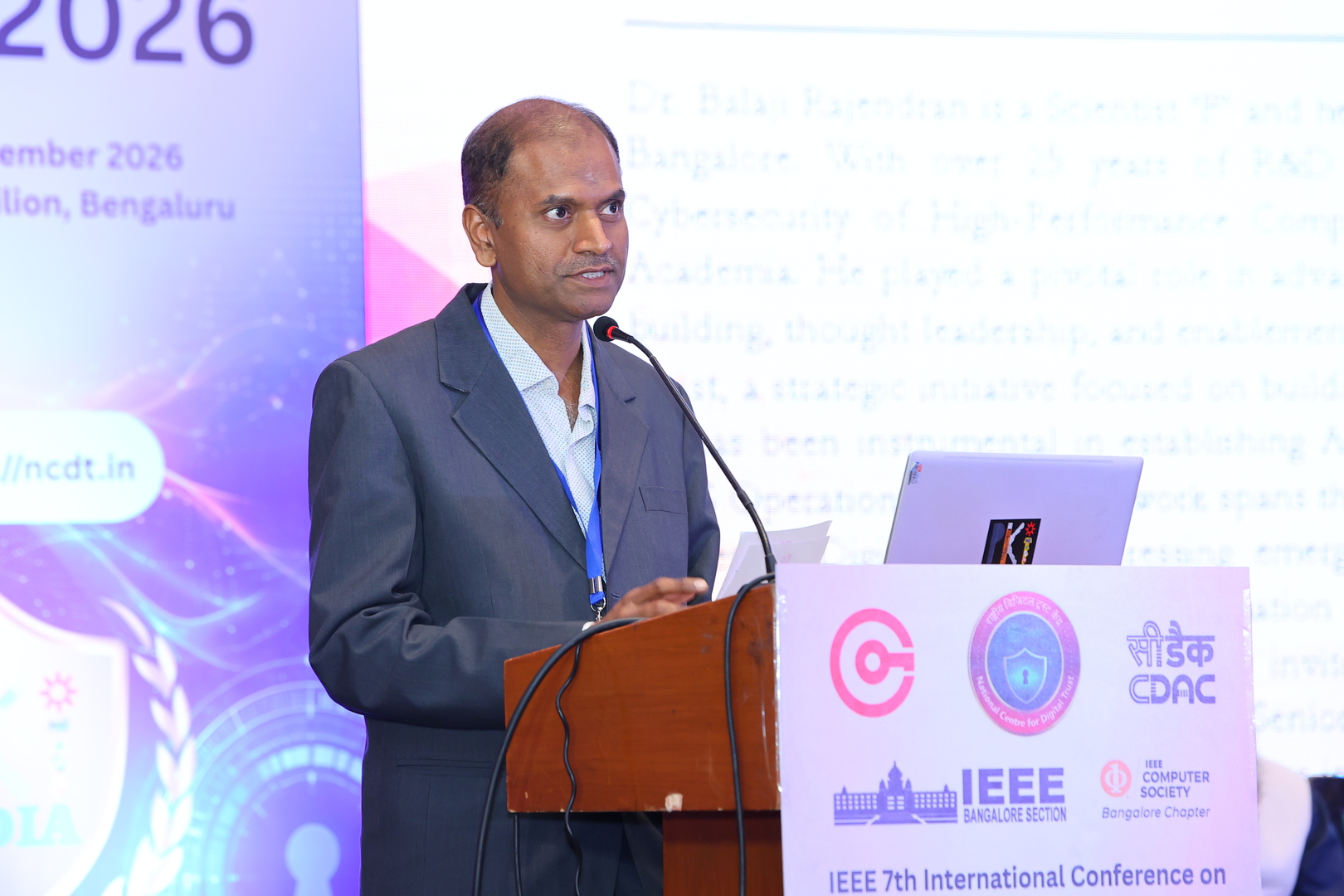
  • Vote of Thanks: Dr. Balaji R., Scientist 'F', C-DAC, Bengaluru

High Tea and Exhibition Inaugural (11:00 - 11:30)

Invited Talk - 1 (11:30 - 12:15)

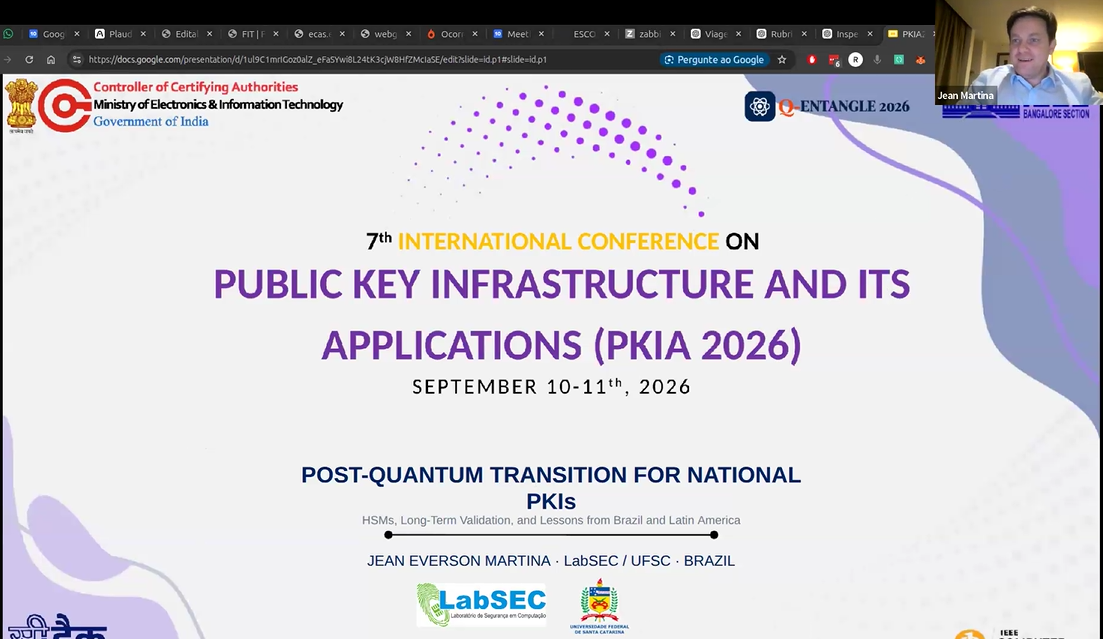
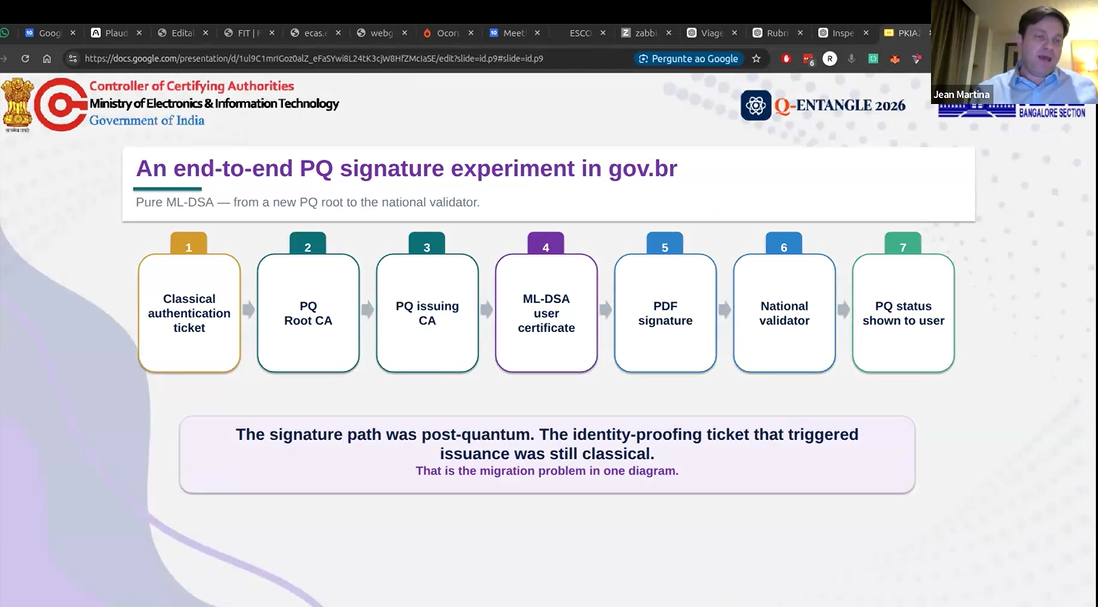
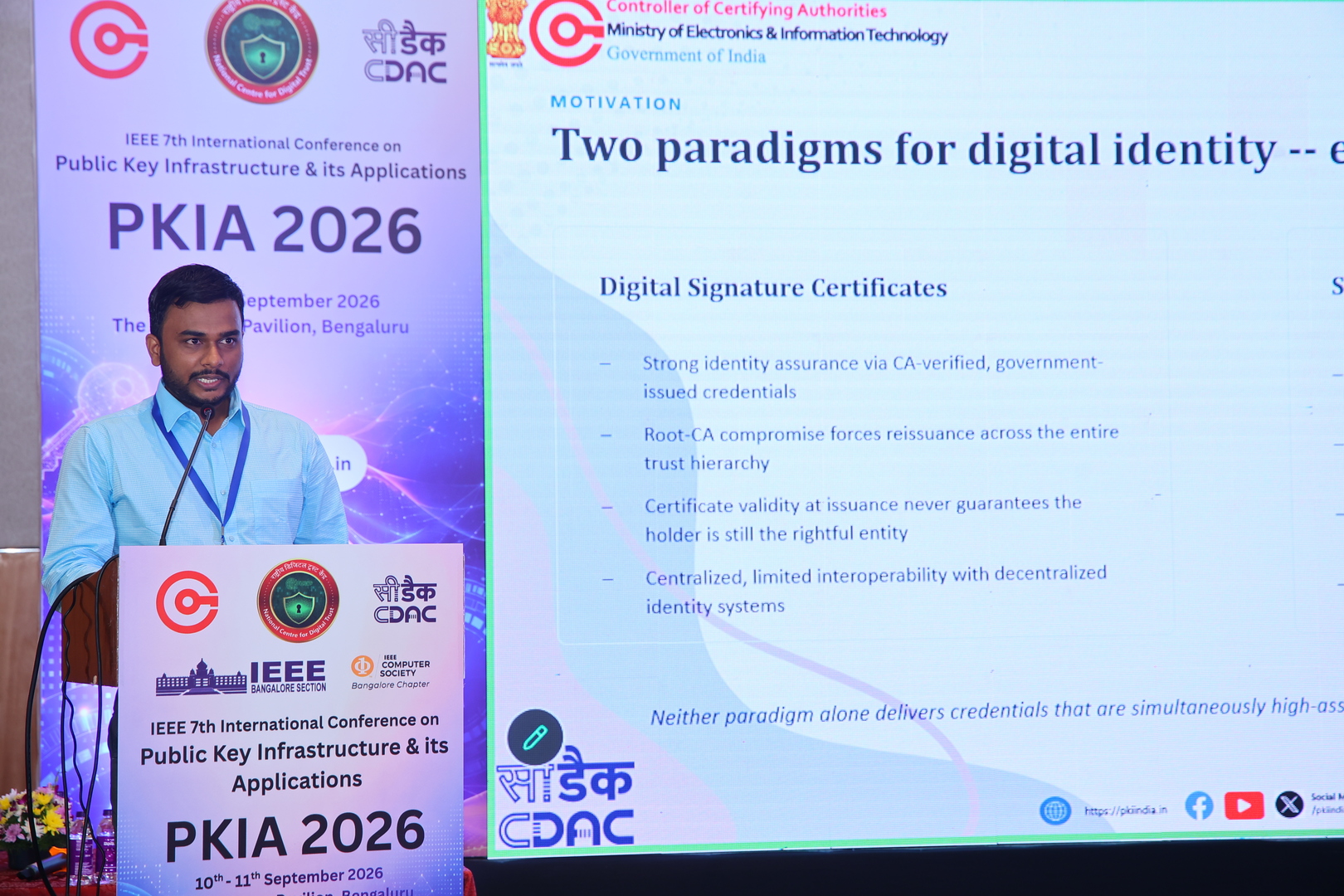
  • Title: Post-Quantum Transition for National PKIs: HSMs, Long-Term Validation, and Lessons from Brazil and Latin America
  • Speaker: Jean Everson Martina LinkedIn
    Prof. Computer Science, Federal University of Santa Catarina, Brazil
  • Bio: Jean Everson Martina is a Professor of Computer Science at the Federal University of Santa Catarina, Brazil, and a researcher at the Computer Security Laboratory, LabSEC. His work focuses on applied cryptography, digital trust infrastructures, public key infrastructure, electronic signatures, digital identity, verifiable credentials, blockchain, long-term validation, and post-quantum cryptography. He has contributed to several Brazilian national initiatives involving digital signatures, digital documents, trust services, and government digital infrastructures, working in cooperation with public institutions and industry. He also participates in international cooperation and standardization activities related to digital trust and cross-border interoperability.

Invited Talk - 2 (12:15 - 12:45)

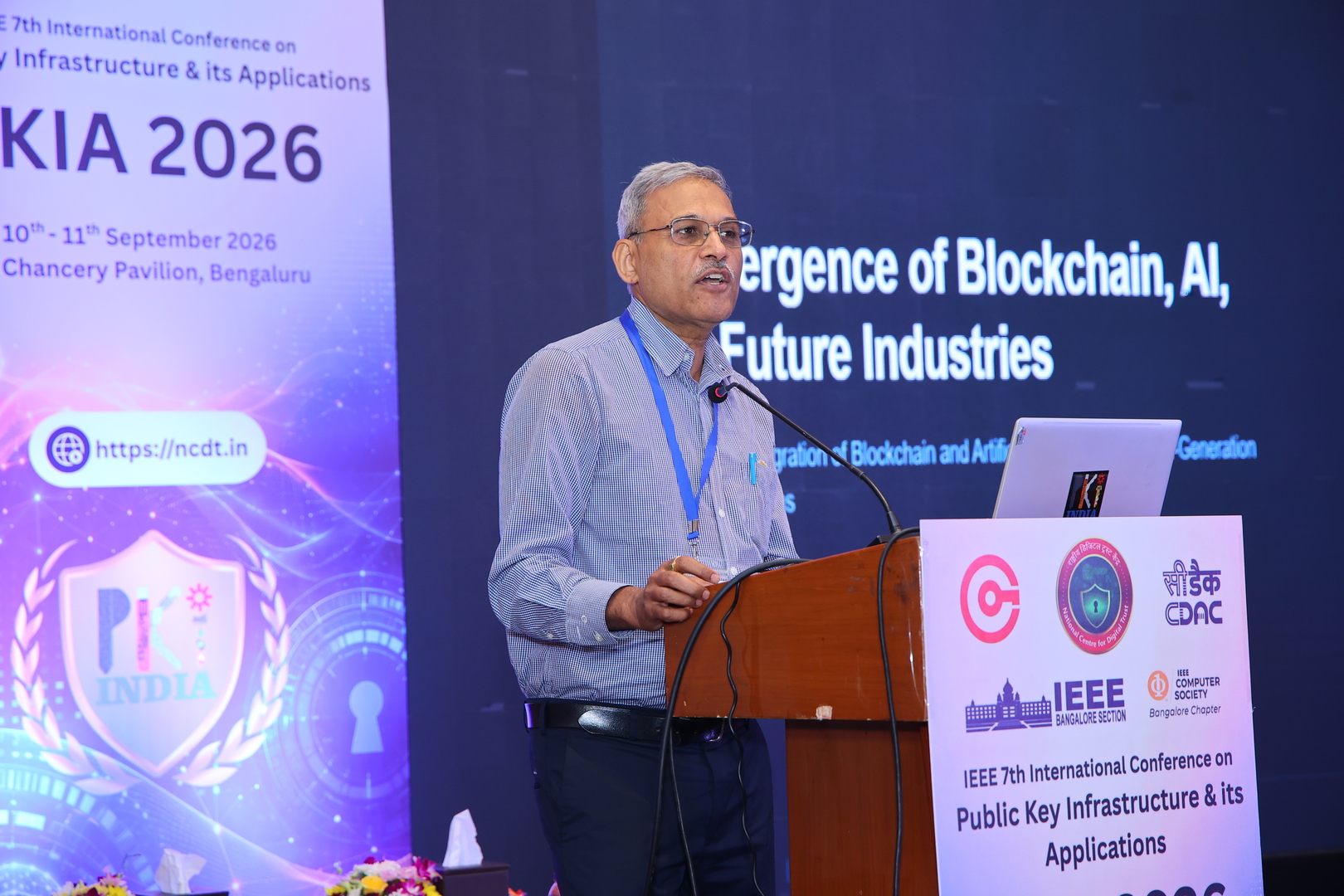
  • Title: Convergence of Blockchain, AI, and Future Industries
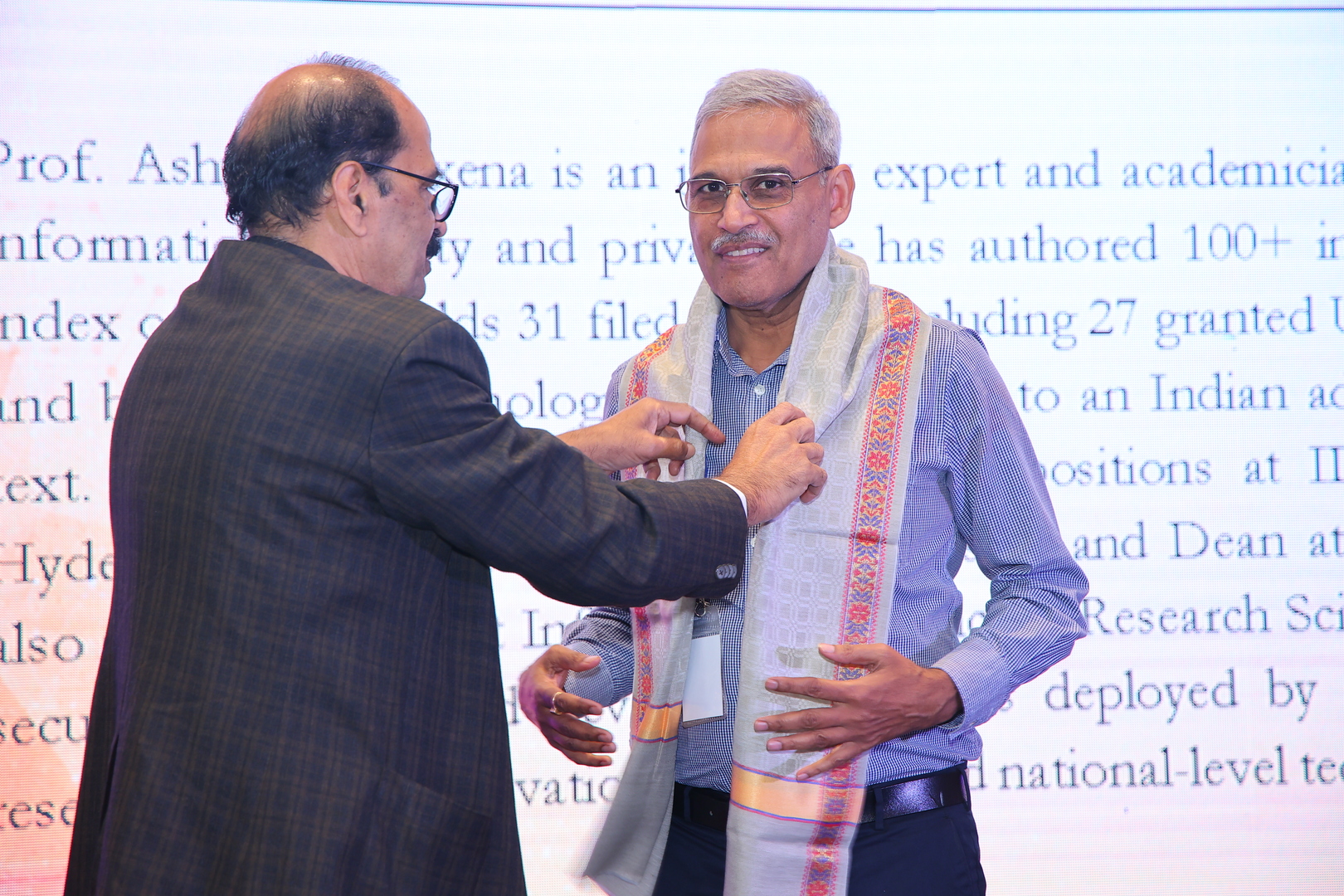
  • Speaker: Prof. Ashutosh Saxena
    Prof and Dean, CMR Technical Campus, Hyderabad
  • Bio: Prof. Ashutosh Saxena (PhD 1997 in AI from DAVV title: Utility of Genetic Algorithm and Neural Network for Cell Placement-A Special Case for VLSI Standard Cell Placement) is an industry expert and academician with over two decades of experience, 100+ international publications with Scopus h-index of 17, along with 31 filled patents out of which 27 are now US granted patents. Authored two books, one on “PKI: Concept, Design and Deployment” (Tata McGraw Hill Publications 2004) and second on “Blockchain Technology: Concepts and Applications”, (Wiley Publications 2020). He also had a credit to adapt one book titled “Information Security: Principles and Practice, An Indian Adaptation by Mark Stamp; (Wiley Publications 2023). His research interest is in the areas of information security and privacy. Worked as Associate Professor at the IDRBT (established by Reserve Bank of India), Hyderabad, (1998-2006) on many national level projects. Joined Infosys (2006-16) and worked as Principal Research Scientist & Associate Vice President, at Infosys Labs, Hyderabad where he led security research as part of the Security Center of Excellence, Infosys Center for Advanced Technologies, conceived security solutions that have already been deployed to many clients. He has been a member of the review board for many international journals, conferences and committees. He also served as Adjunct Faculty at NIT Warangal for one year, worked as Professor (CS) at CRRAO-AIMSCS, University of Hyderabad Campus, Hyderabad, and now as Prof and Dean CMR Technical Campus, Hyderabad.
  • Abstract: As digital transformation accelerates, individual technologies are hitting structural boundaries: Artificial Intelligence faces data privacy and monopolisation crises, while Blockchain seeks scalable, real-world utility beyond speculation. This talk tries to explore the cutting-edge convergence of these two paradigm-shifting technologies and their combined impact on legacy industries. We will examine how decentralized architecture provides an immutable layer of truth for AI models—ensuring data provenance, securing decentralized infrastructure, and enabling autonomous AI agents to conduct secure economic transactions via smart contracts. Attendees will discover how this technical synergy is creating privacy-preserving diagnostic tools in healthcare, streamlining autonomous supply chain logistics, and democratising real estate through algorithmic tokenization.


Invited Talk - 3 (12:45 - 13:15)

  • Title: TBA
  • Speaker: TBA
  • Bio: TBA
  • Abstract: TBA

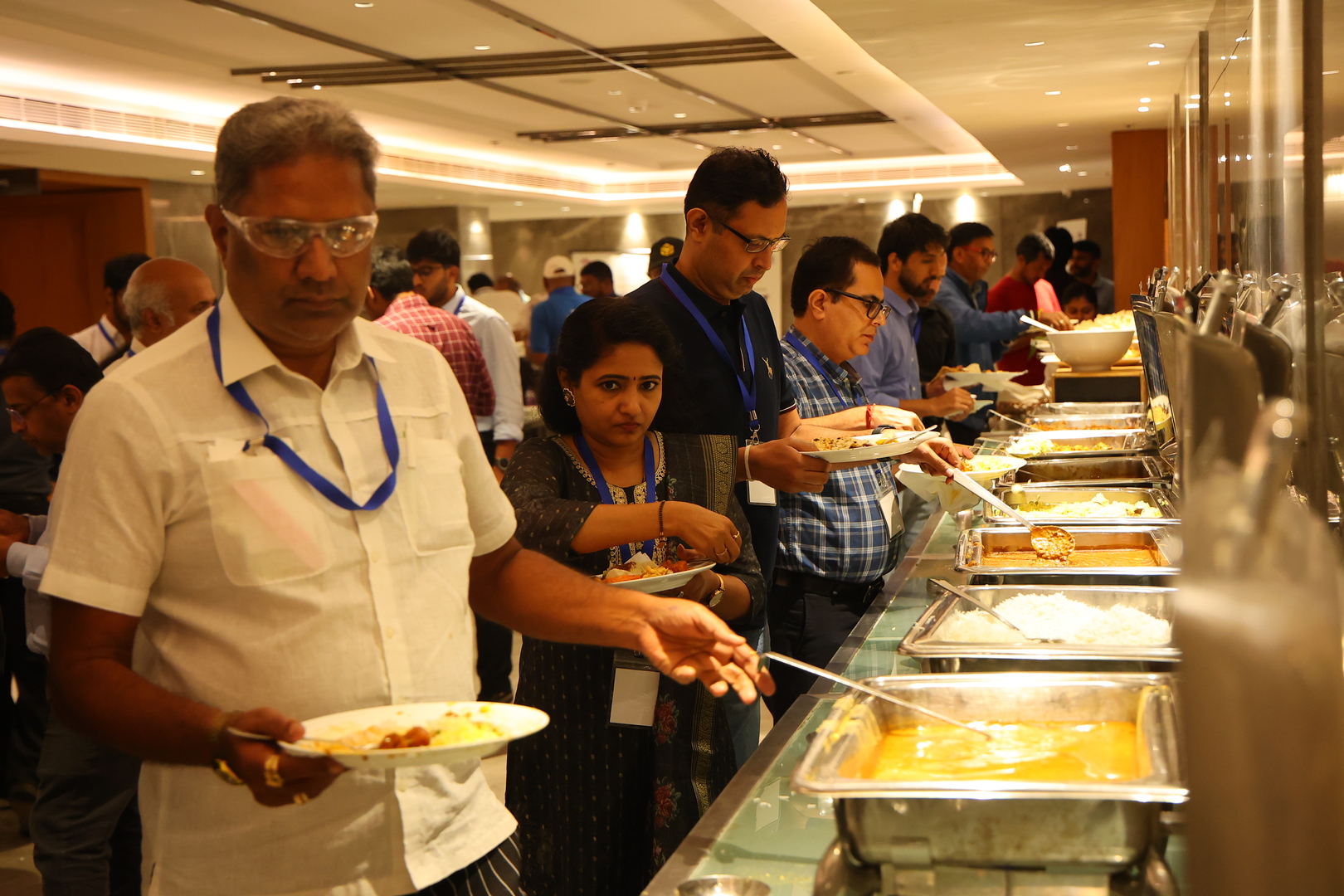
Lunch and Visit to Exhibition Stall (13:15 - 14:30)

Invited Talk - 4 (14:30 - 15:00)

  • Title: Isogeny-based cryptography made easy
  • Speaker: Dr. Sikhar Patranabis LinkedIn
    Staff research scientist at IBM Research
  • Bio: Sikhar Patranabis is a cryptographer and a staff research scientist at IBM Research India. He is a member of the Foundational Cryptography group within IBM Research. His research interests are in theoretical and applied cryptography, with a recent focus on quantum-safe cryptography and succinctly verifiable, privacy-enhancing cryptographic techniques. Prior to joining IBM, he was a staff researcher at VISA Research USA and a postdoctoral researcher at ETH Zurich, Switzerland. He received his B.Tech and PhD from IIT Kharagpur. His research has appeared at reputed crypto/security venues, such as the Journal of Cryptology (JoC), Crypto, Eurocrypt, Asiacrypt, IEEE S&P, ACM CCS, USENIX Security, NDSS, etc. He is a young associate of the Indian Academy of Sciences (IASc) and the Indian National Academy of Engineering (INAE). His research has been recognized by an IACR best early-career paper award at ASIACRYPT 2022, an IBM PhD fellowship, and a Qualcomm Research Innovation Fellowship. He has served on multiple program committees and editorial boards of top conferences and journals in crypto/security. He is also actively involved in various outreach activities organized by ACM India.
  • Abstract: Isogenies have emerged as a viable alternative to lattices for post-quantum cryptography over the past 20 years. However, due to the uniquely complex underlying mathematical features and security/efficiency properties, the landscape of isogeny-based cryptography has remained somewhat limited and inaccessible to the wider cryptographic community. Additionally, building new cryptographic applications from isogenies has been a potentially tedious and time-consuming task. In this talk, he will present an overview of two frameworks for isogeny-based cryptography, namely “cryptographic group actions” and “cryptographic forensic categories”. These frameworks enable viewing isogeny-based cryptography through the lens of abstract and easy-to-understand algebraic structures combined with simple cryptographic hardness assumptions. He will showcase some applications of these frameworks in: (i) enabling simplified expositions of well-known cryptographic constructions from isogenies (e.g., CSIDH-based public-key encryption and the SQIsign family of digital signatures), and (ii) realizing new (plausibly) post-quantum instances of advanced cryptographic primitives from isogenies. He hope to demonstrate the simplicity and usability of these frameworks for isogeny non-experts. Along the way, He will also talk about some hard problems that form the basis of isogeny-based cryptography, and their classical/quantum hardness as of today. No prior background in either cryptography or quantum computing will be necessary to follow the talk.

Invited Talk - 5 (15:00 - 15:30)

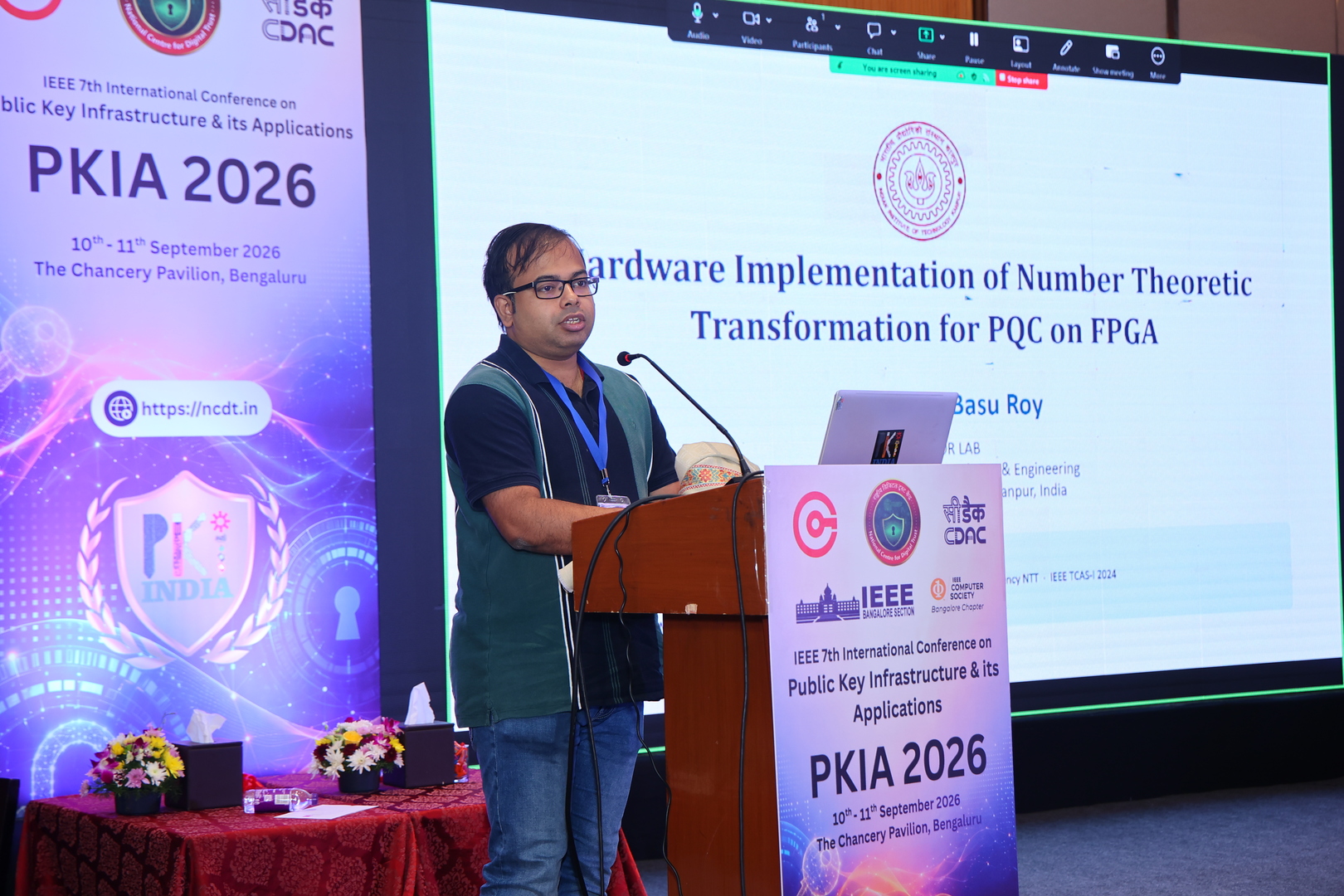
  • Title: Hardware implementation of Number Theoretic Transformation for PQC on FPGA
  • Speaker: Dr. Debapriya Basu Roy LinkedIn
    Assistant Professor at CSE, IIT Kanpur
  • Bio: Dr. Debapriya Basu Roy received his PhD degree from IIT Kharagpur and was a post-doctoral fellow with the Technical University of Munich. He is currently an Assistant Professor with the Department of Computer Science and Engineering, Indian Institute of Technology Kanpur. His research interests include applied cryptography, hardware security, post-quantum cryptography, side channel analysis and digital VLSI. Some of his notable contributions in the domain of hardware security are efficient implementation of elliptic curve cryptography, side-channel leakage quantification and implementation of post-quantum cryptography on FPGAs.

Tea Break and Stall Visit (15:30 - 15:45)

Paper Presentation Session 1 (15:45 - 16:45)
Theme: TBA
Session Chair: TBA

    • 15:45 - 16:00
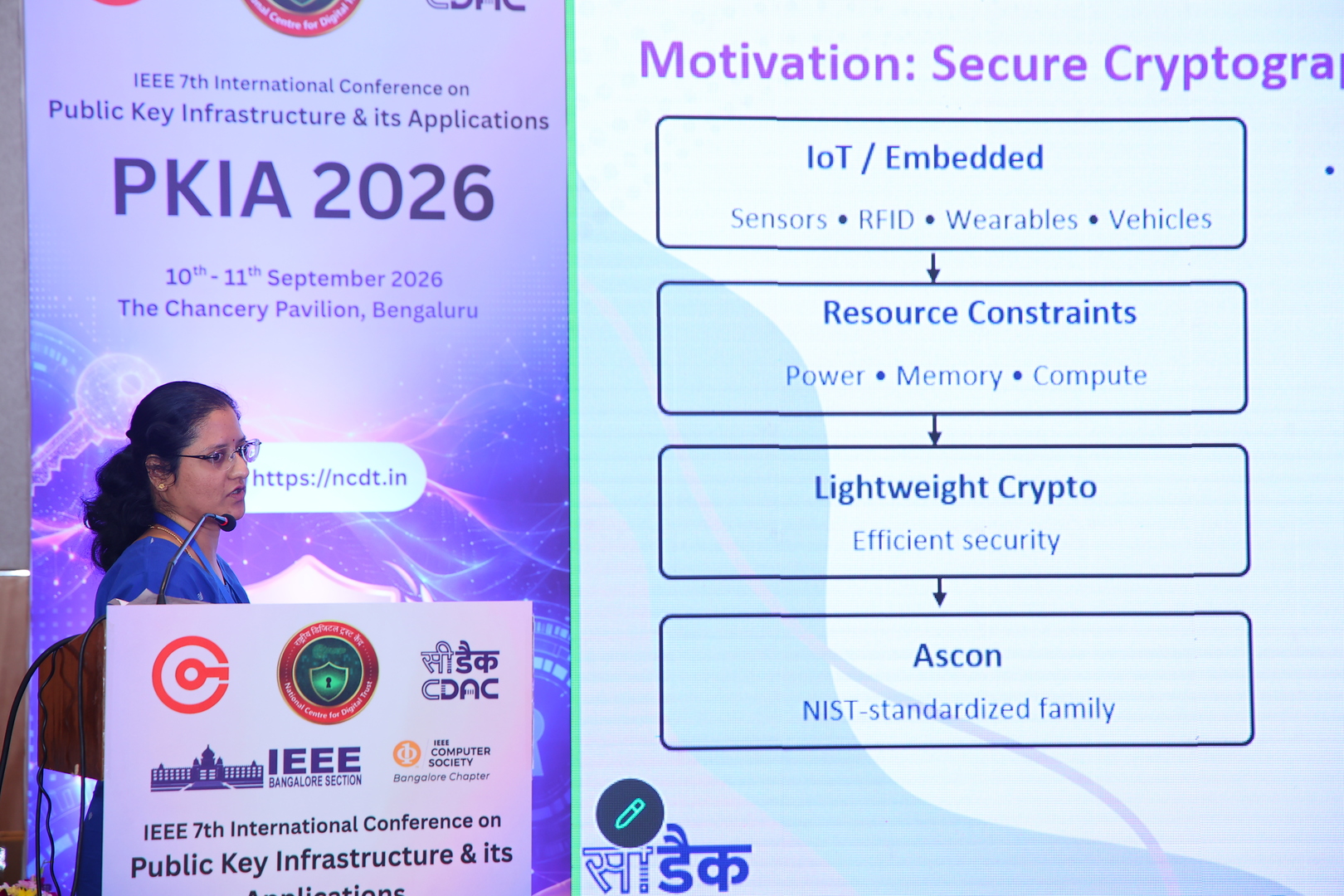
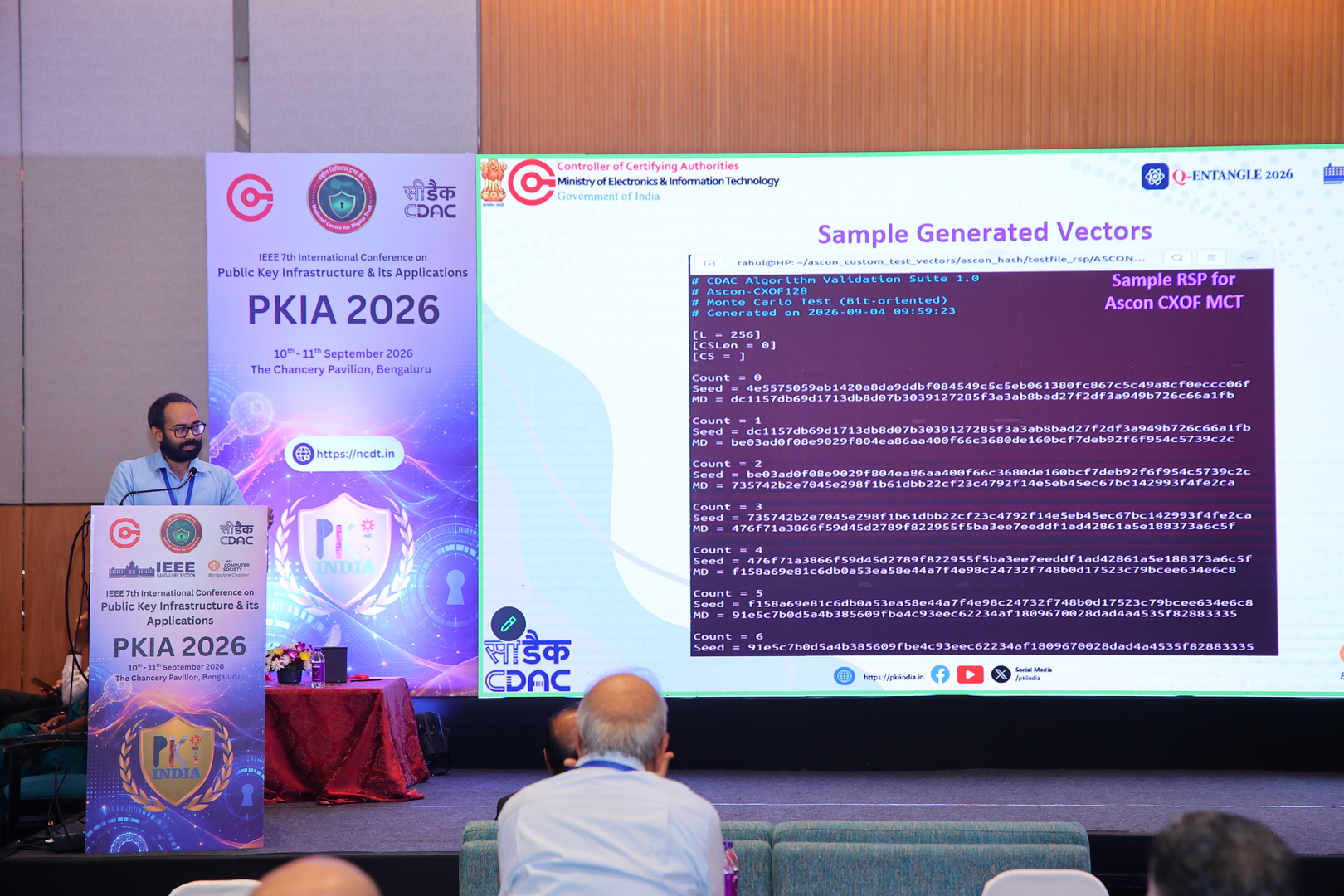
      Title: A NIST SP 800-232 Compliant Validation Suite for Unified ASCON Test Vector Generator
      Author: Abey Jacob

    • 16:00 - 16:15
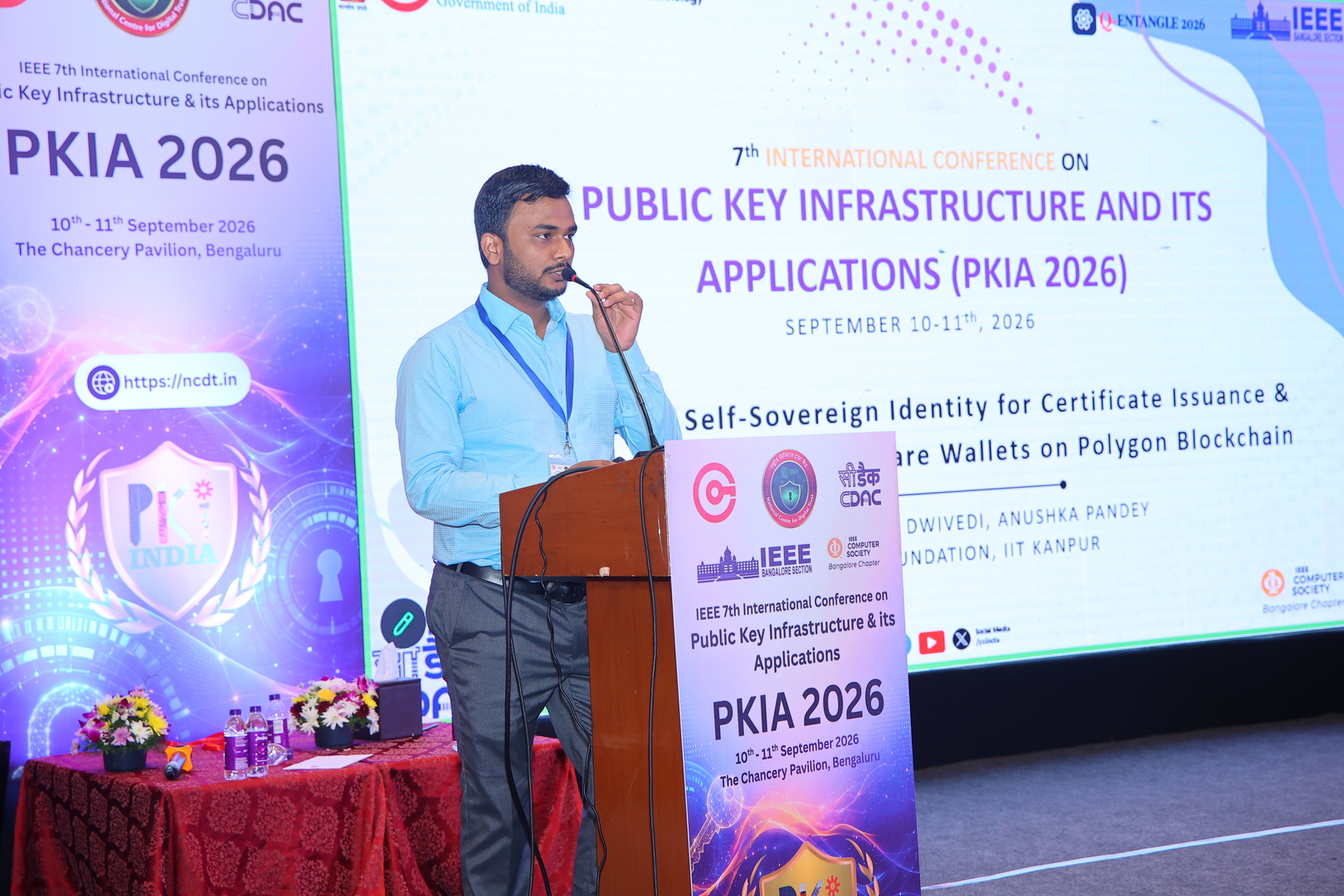
      Title: PKI-Anchored Self-Sovereign Identity for Certificate Issuance and Verification Using DSC Hardware Wallets on Polygon Blockchain
      Authors: Shrawan Kumar, Ras Dwivedi and Anushka Pandey

    • 16:15 - 16:30
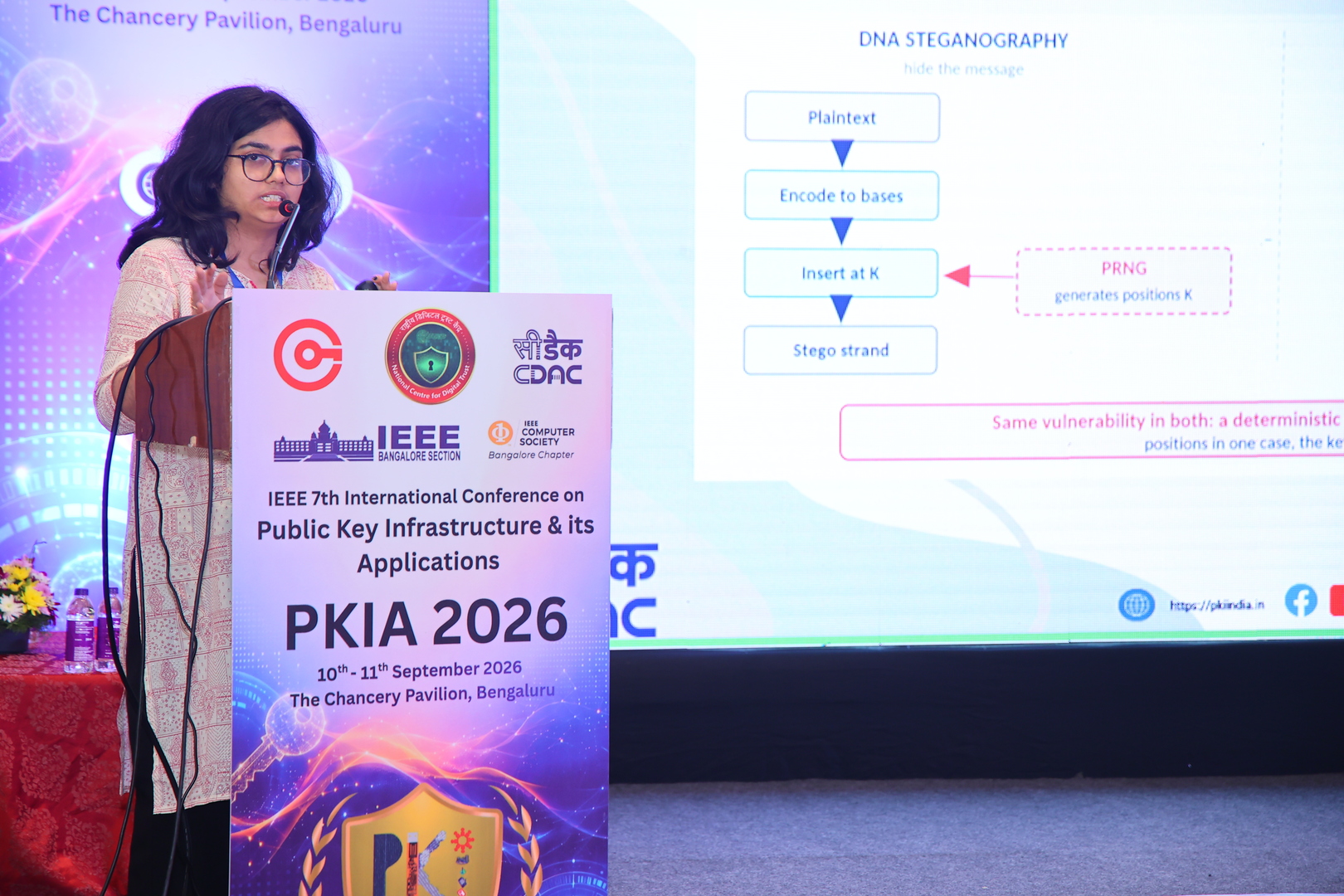
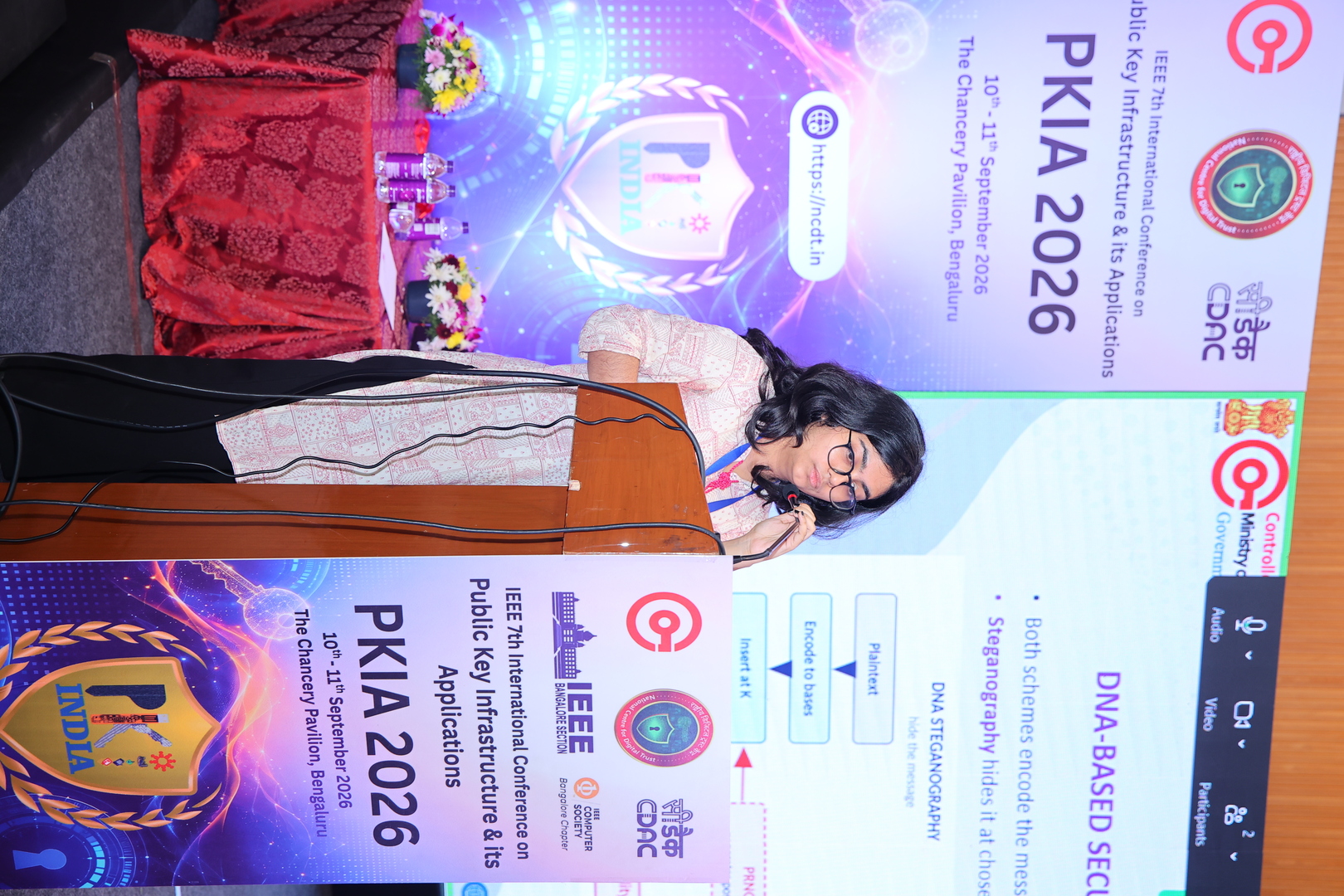
      Title: A Quantum Attack Pipeline on DNA-based Encryption: PRNG Vulnerabilities and QRNG based Defenses
      Author: Anjali Tiwari

    • 16:30 - 16:45
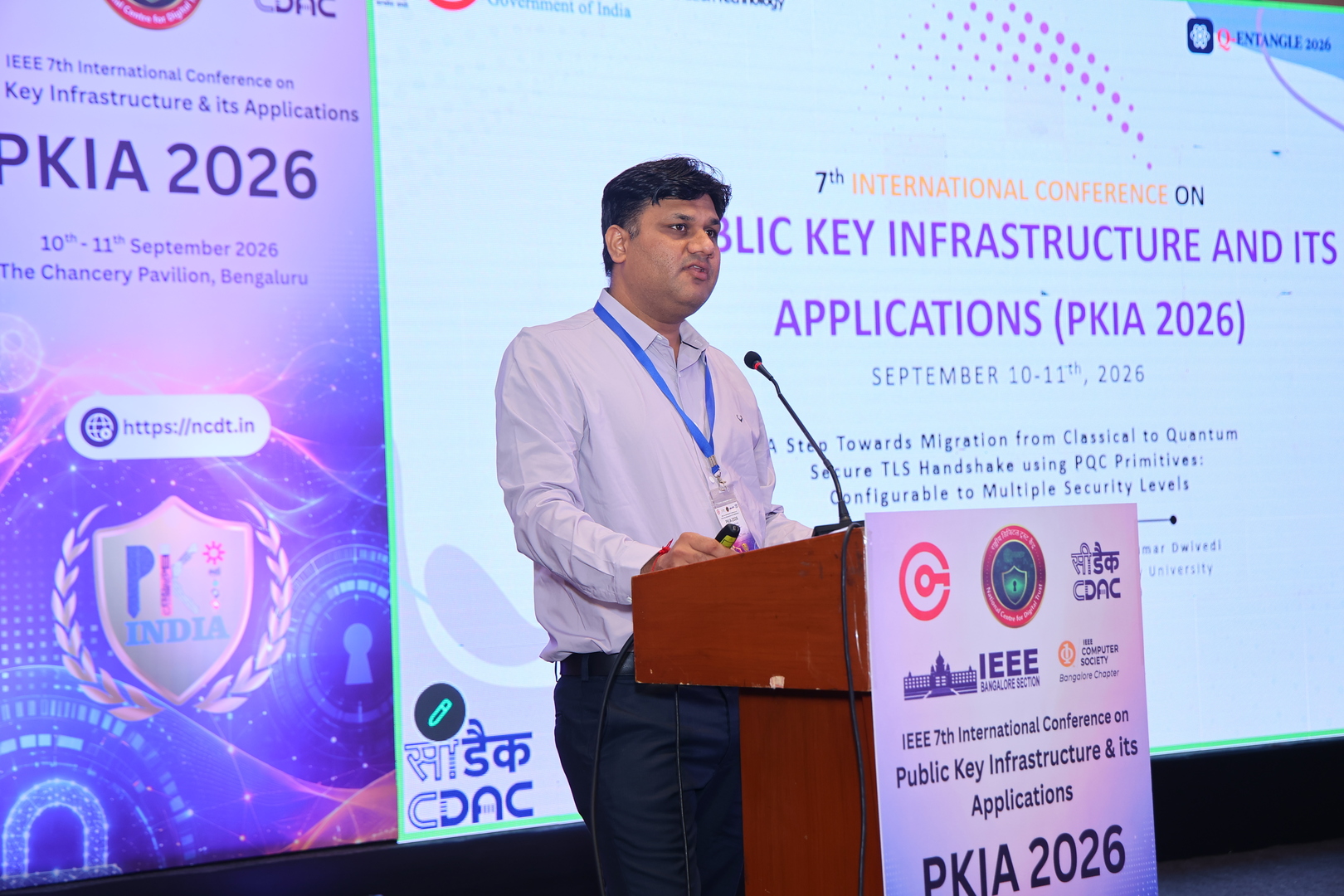
      Title: A Step Towards Migration from Classical to Quantum Secure TLS Handshake using PQC Primitives: Configurable to Multiple Security Levels
      Authors: Yagna Patel, Utkarsh Tiwari and Sanjeev Dwivedi

Invited Talk - 6 (16:45 - 17:15)

  • Title: TBA
  • Speaker: TBA
  • Bio: TBA

Invited Talk 7 (17:15 - 17:45)

  • Title: TBA
  • Speaker: TBA
  • Bio: TBA

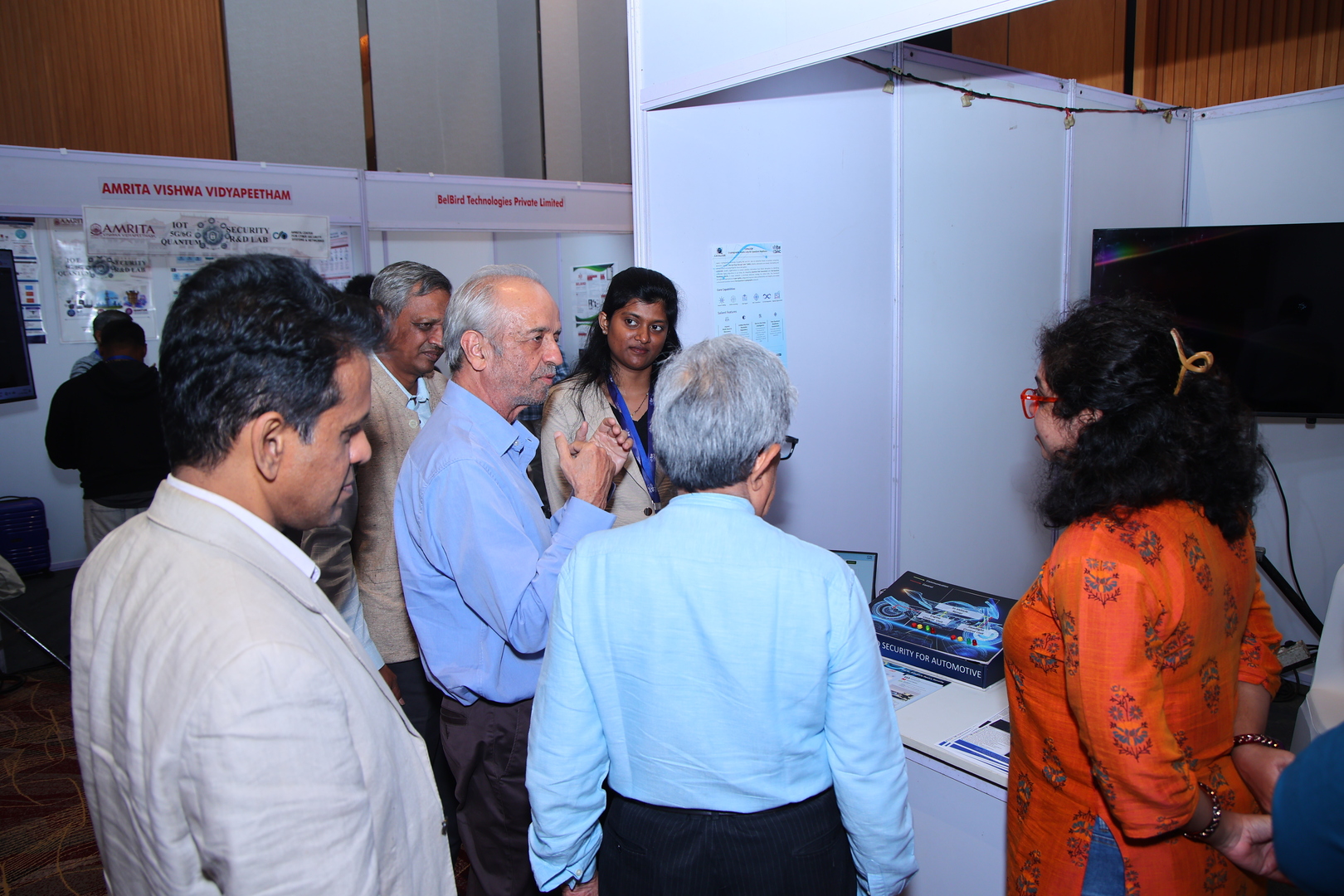
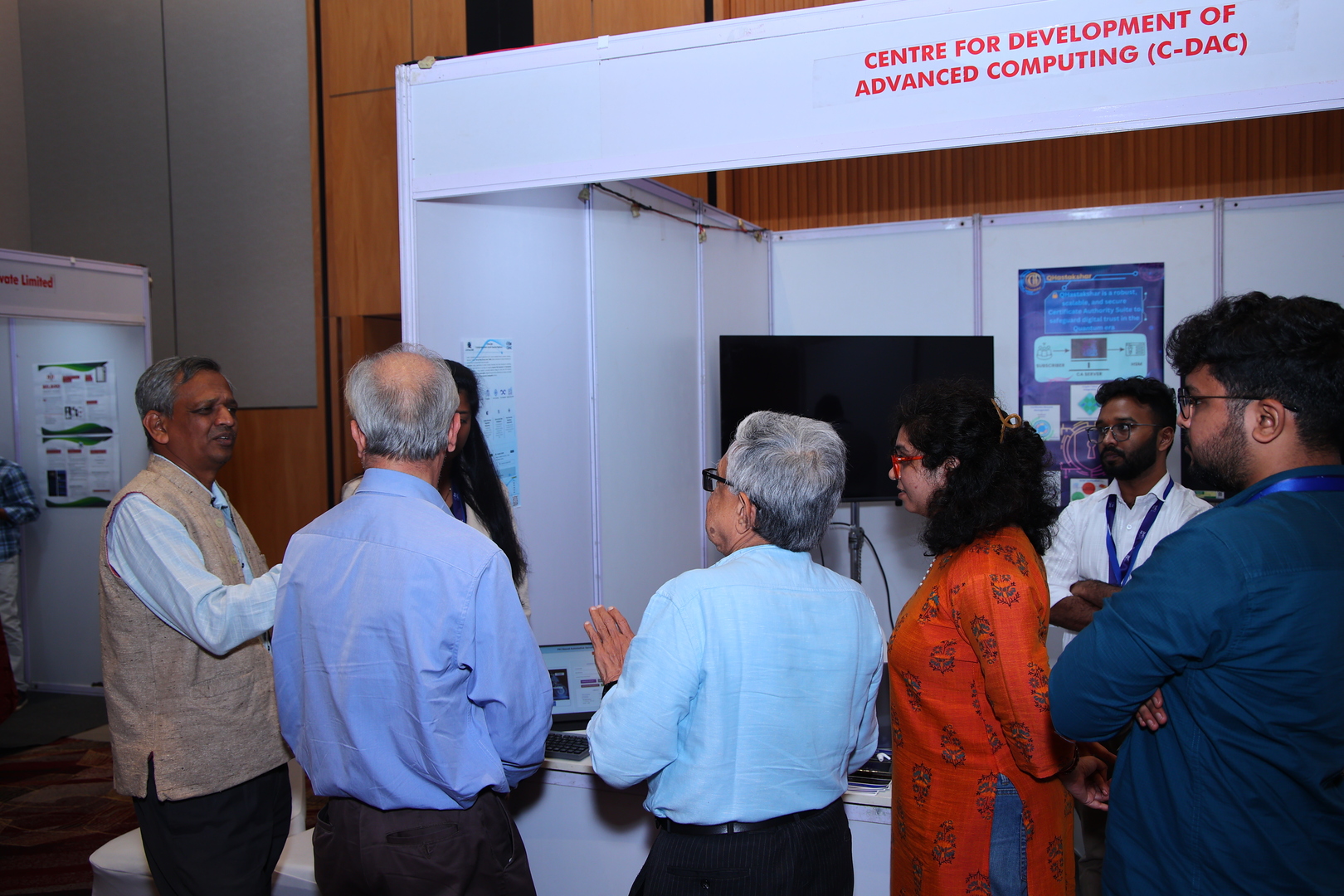
Visit to Exhibition Stall (17:45 - 18:30)


Day 2: Friday, September 11, 2026

Paper Presentation Session 2 (09:30 - 10:15)
Theme: TBA
Session Chair: TBA

    • 09:30 - 09:45
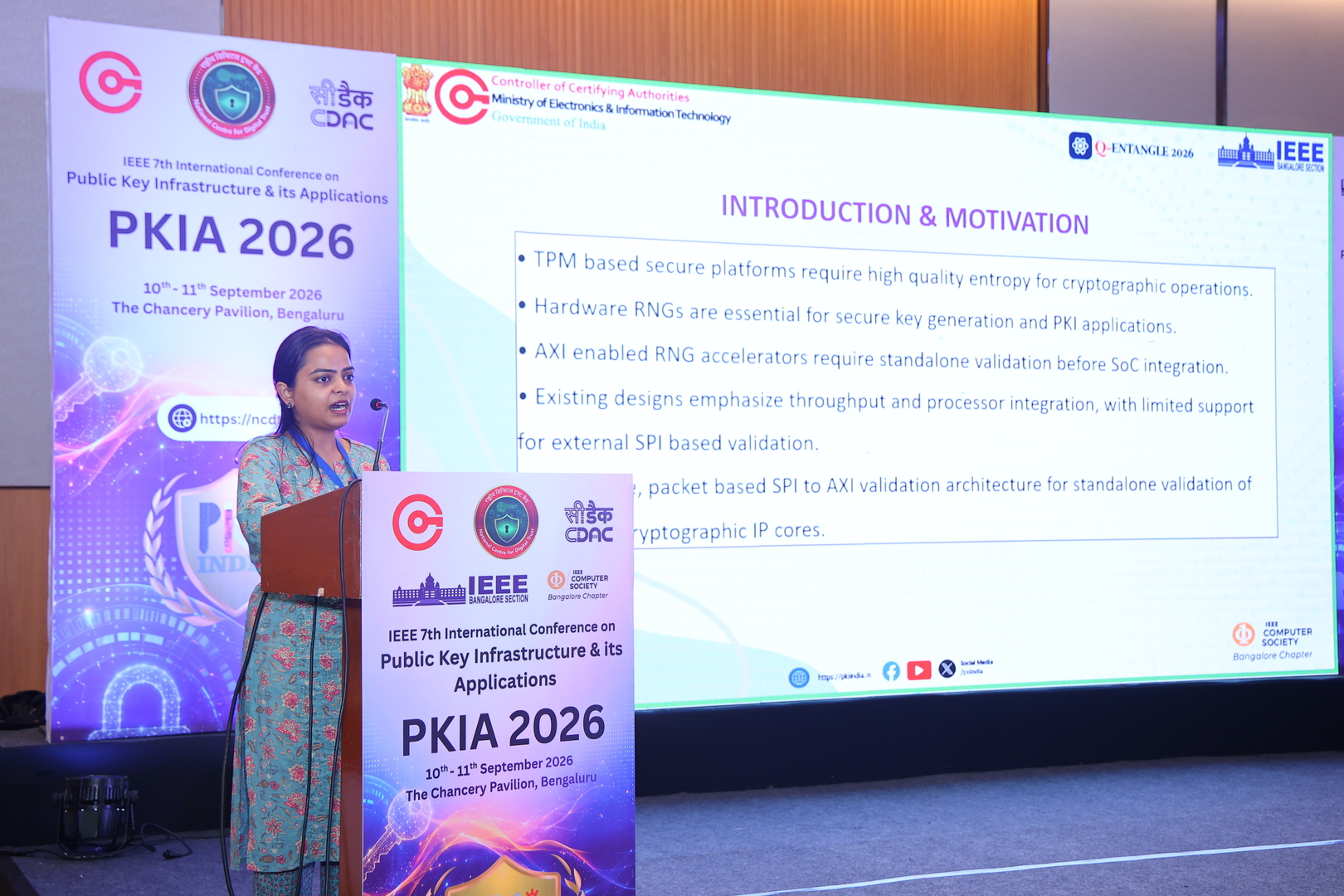
      Title: BHARAT-TPM: Design and ASIC Implementation of an SPI Based AXI Enabled RNG Accelerator
      Authors: Aneesh R, Mahima Agarwal, Soumya G Hosmani, Rajasekar K, Vivian Desalphine, Hari Babu P and S D Sudarsan

    • 09:45 - 10:00
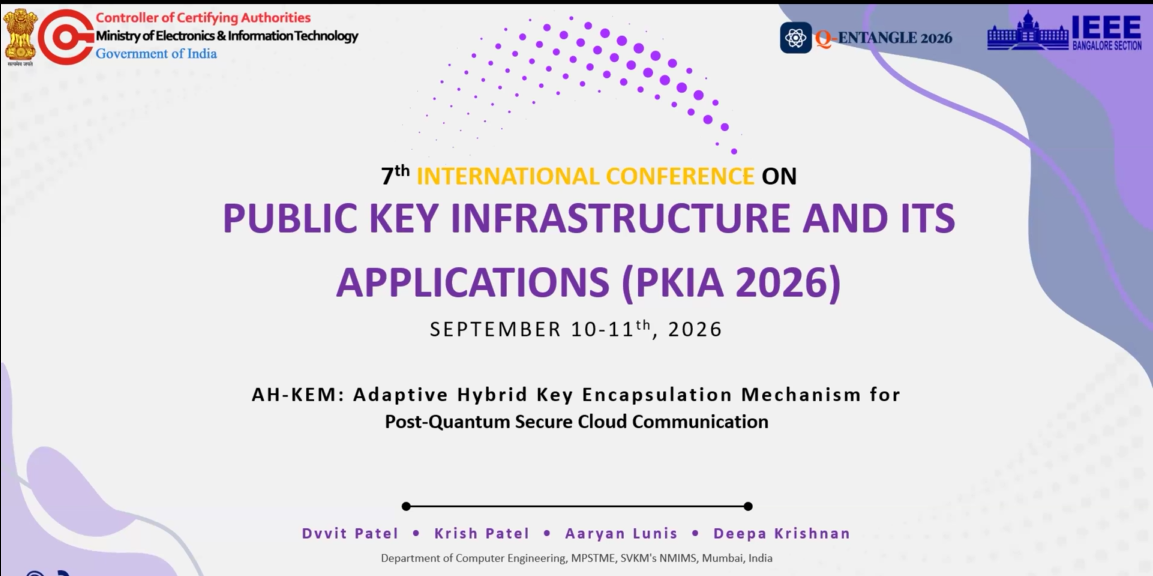
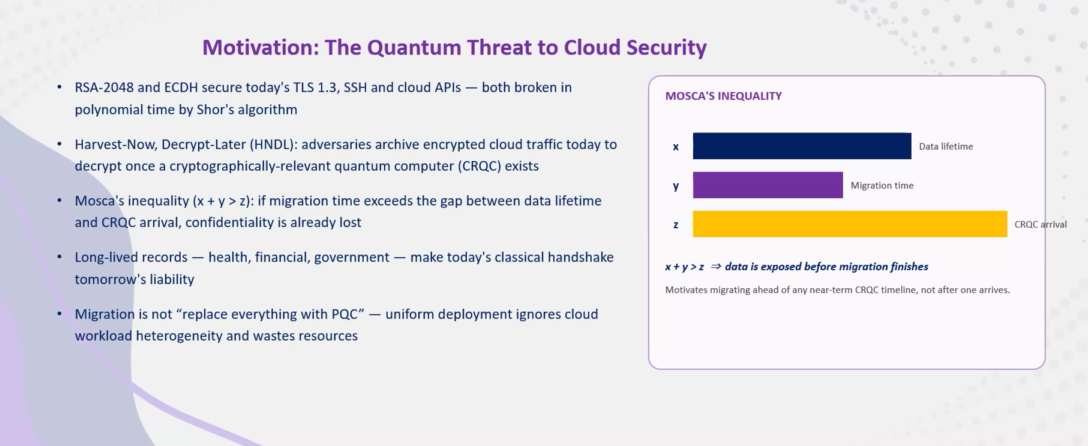
      Title: AH-KEM: Adaptive Hybrid Key Encapsulation Mechanism for Post-Quantumn Secure Cloud Communication
      Authors: Dvvit Patel, Krish Patel, Aaryan Lunis and Deepa Krishnan

    • 10:00 - 10:15
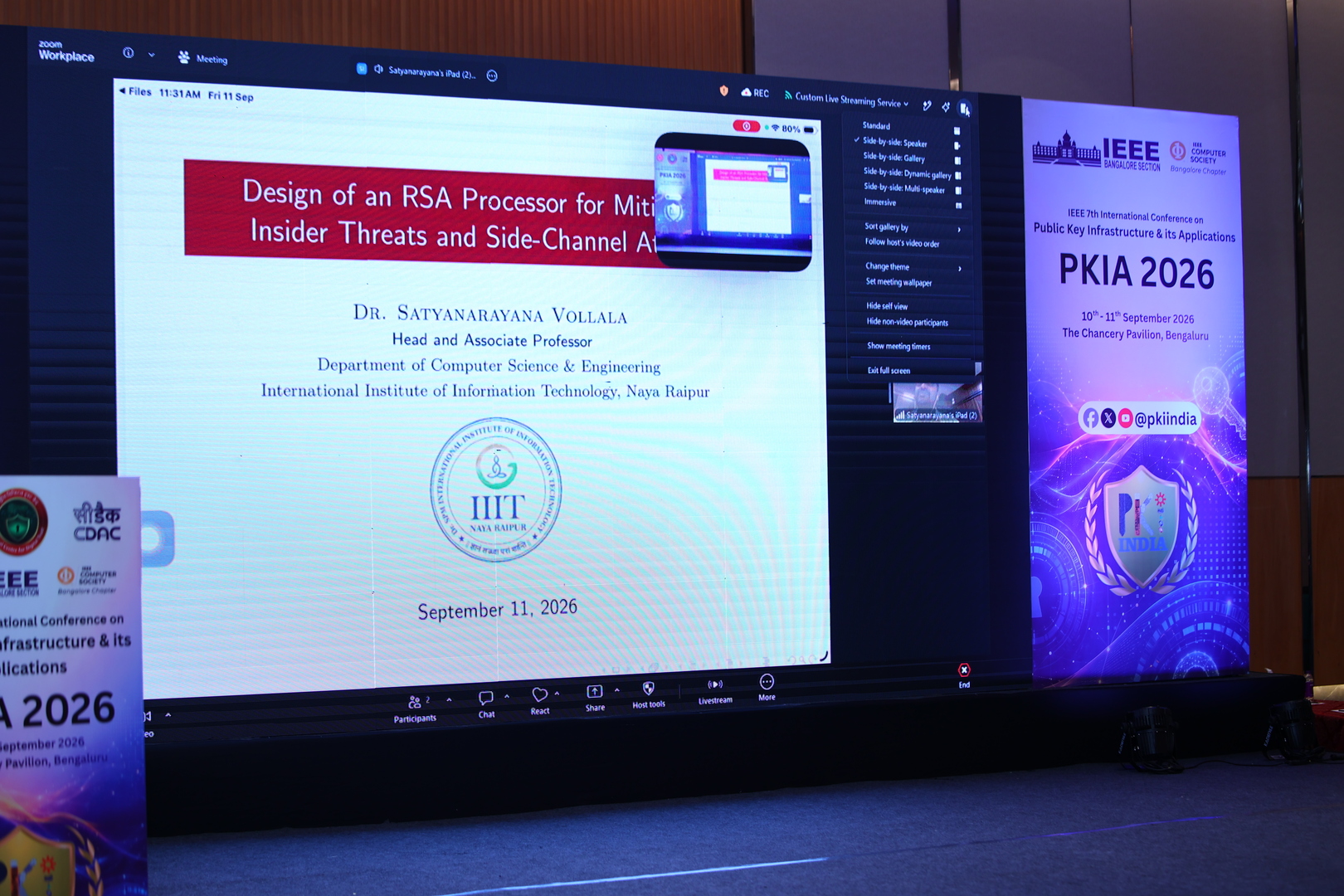
      Title: An AI-Assisted Framework for Post-Quantum Cryptography Bill of Materials Discovery
      Authors: Debasish Deb, Varun Grover, Prachi Gupta and Padmalav Sahoo

Invited Talk - 8 (10:15 - 11:00)

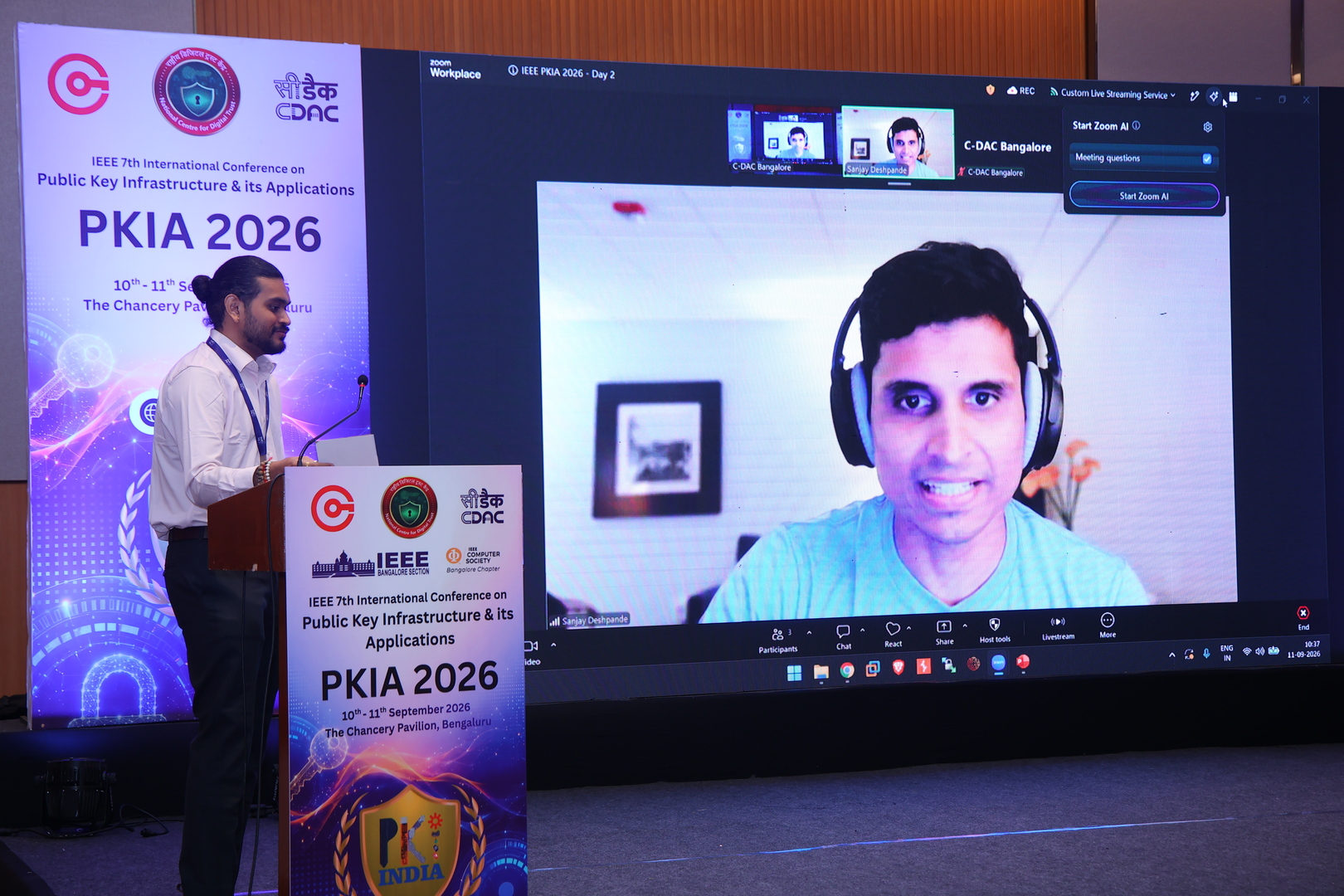
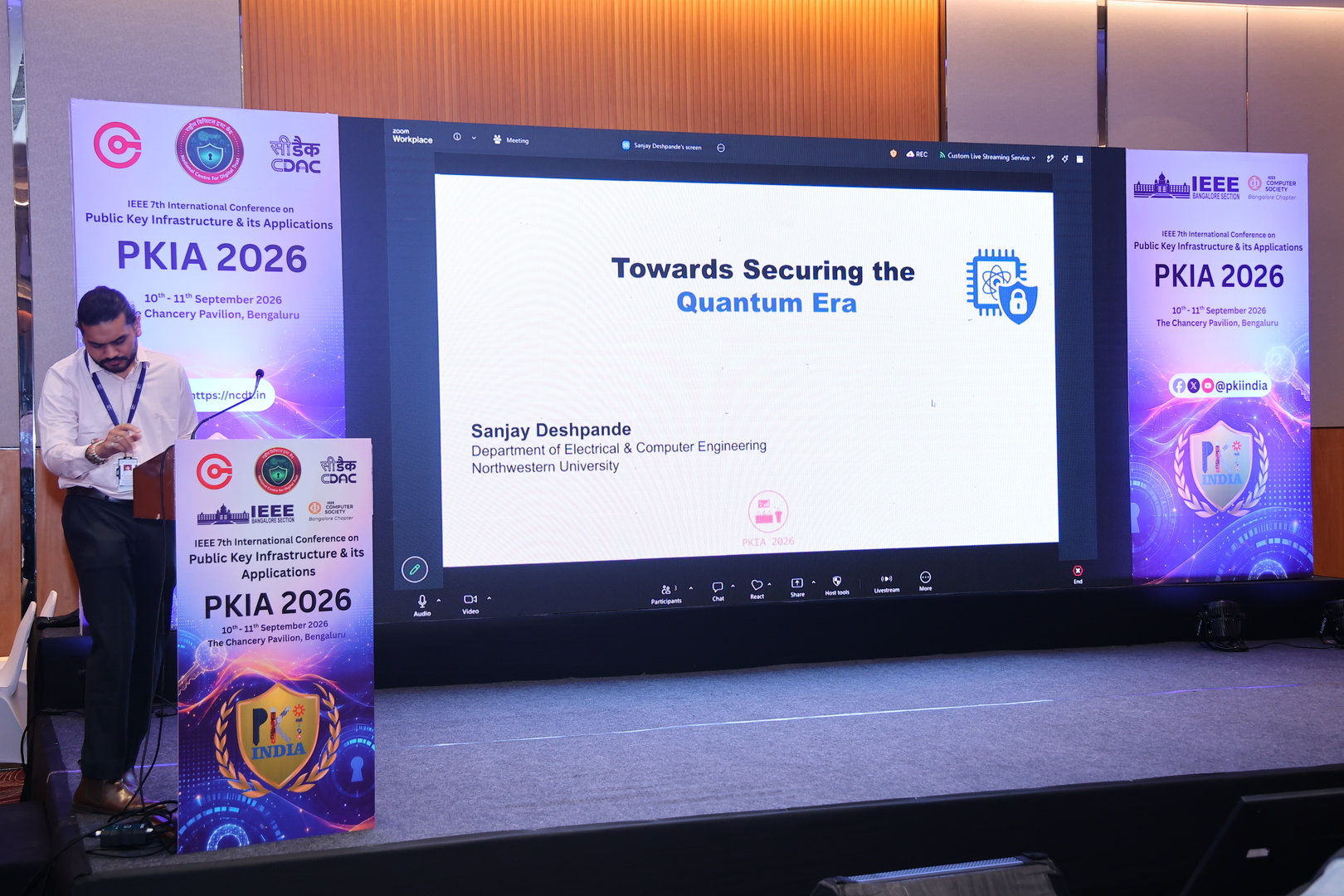
  • Title: Towards Securing the Quantum Era
  • Speaker: Dr. Sanjay Deshpande LinkedIn
    Postdoctoral Scholar, Northwestern University
  • Bio: Sanjay Deshpande is a Postdoctoral Scholar at Northwestern University, specializing in efficient and secure post-quantum cryptography implementations and quantum computer cybersecurity. He earned his Ph.D. in Electrical Engineering from Yale University and has held research positions at Microsoft Research, SandboxAQ, and the Technology Innovation Institute.
  • Abstract: The rapid advancement of quantum computing promises groundbreaking developments across many fields, but it also threatens the pre-quantum cryptographic systems we currently rely on. The race is on to transition to quantum-safe cryptography before quantum computers reach a critical threshold. At the heart of this global effort lies Post-Quantum Cryptography (PQC), a new generation of algorithms believed to be secure against both quantum and classical attacks. This talk explores the challenges and innovations in the transition to PQC, focusing on the role of hardware and software implementation and evaluation in ensuring both performance and security. It takes a deep dive into the Hamming Quasi-Cyclic (HQC) algorithm, selected for standardization by NIST in 2025, and examines how HQC performs under practical constraints and potential side-channel threats. Complementing this effort to safeguard classical data against quantum attacks, the talk also turns to the security of the quantum computers themselves. It shows how today's cloud-based quantum systems can be susceptible to low-level vulnerabilities and proposes novel methods of protection. Together, these threads offer a holistic approach to security in the quantum era.

Tea Break and Stall Visit (11:00 - 11:30)

Invited Talk - 9 (11:30 - 12:00)

  • Title: TBA
  • Speaker: TBA
  • Bio: TBA

Paper Presentation Session 3 (12:00 - 12:45)
Theme: TBA
Session Chair: TBA

    • 12:00 - 12:15
      Title: A Trust-Aware Post-Quantum Framework for Secure Distributed AI Model Verification
      Author: Bikramjit Saha

    • 12:15 - 12:30
      Title: Design and Comparative Evaluation of a Hybrid Post-Quantum Key Exchange Protocol for Quantum-Resistant Onion Routing Networks
      Authors: Subhash Kumar and Kishor Kolhe

    • 12:30 - 12:45
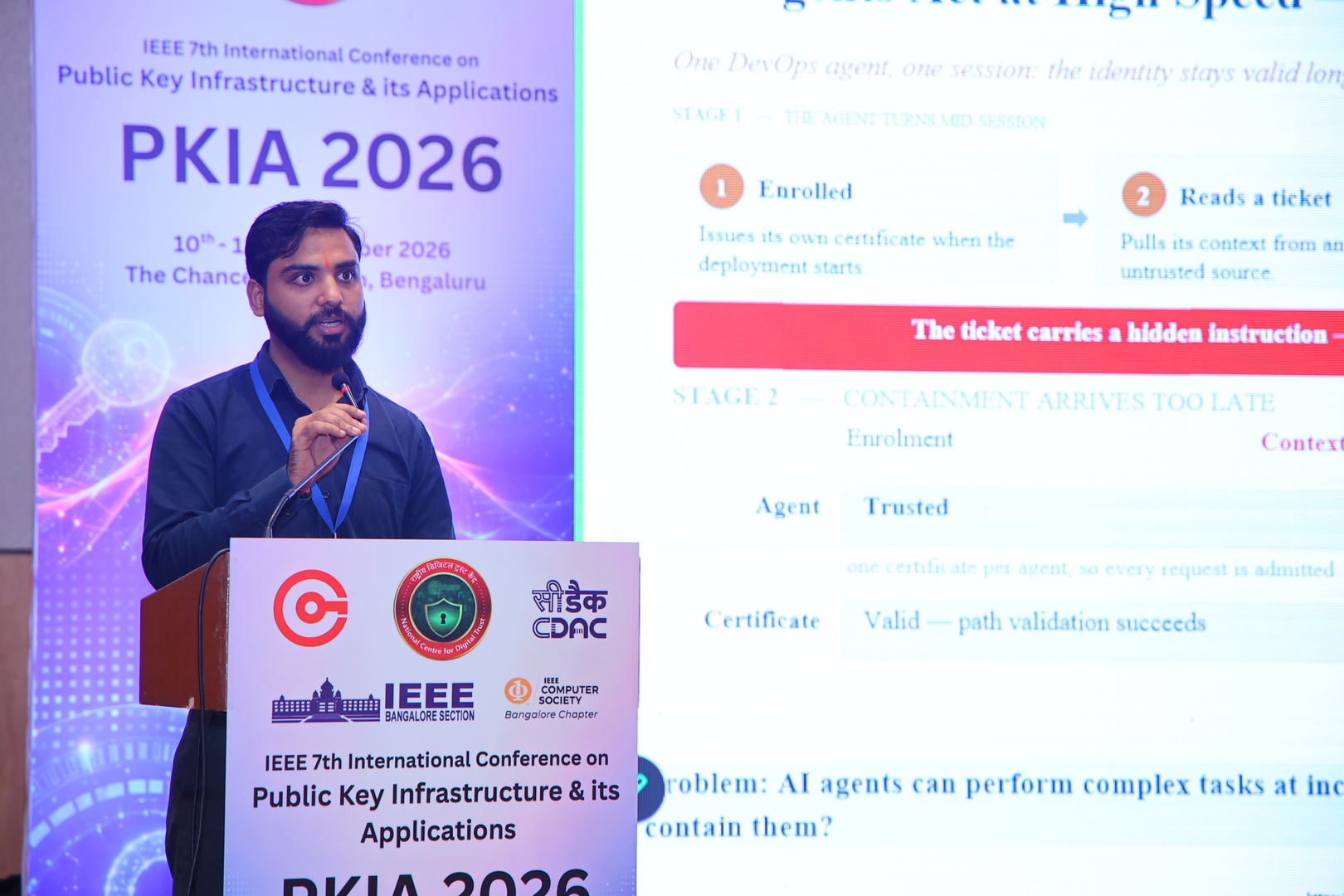
      Title: A Crypto-Agile PKI Revocation Framework for Real-Time Containment of Malicious AI Agents
      Authors: Abhishek Dhiman, Ramesh Naidu, Shreya Murgunde and S D Sudarsan

Invited Talk - 10 (12:45 - 13:15)

  • Title: TBA
  • Speaker: TBA
  • Bio: TBA

Invited Talk - 11 (13:15 - 13:45)

  • Title: TBA
  • Speaker: TBA
  • Bio: TBA
  • Abstract: TBA

Lunch and Visit to Exhibition Stall (13:45 - 14:30)

Invited Talk - 12 (14:30 - 14:50)

  • Title: TBA
  • Speaker: TBA
  • Bio: TBA

Invited Talk - 13 (14:50 - 15:10)

  • Title: TBA
  • Speaker: TBA
  • Bio: TBA

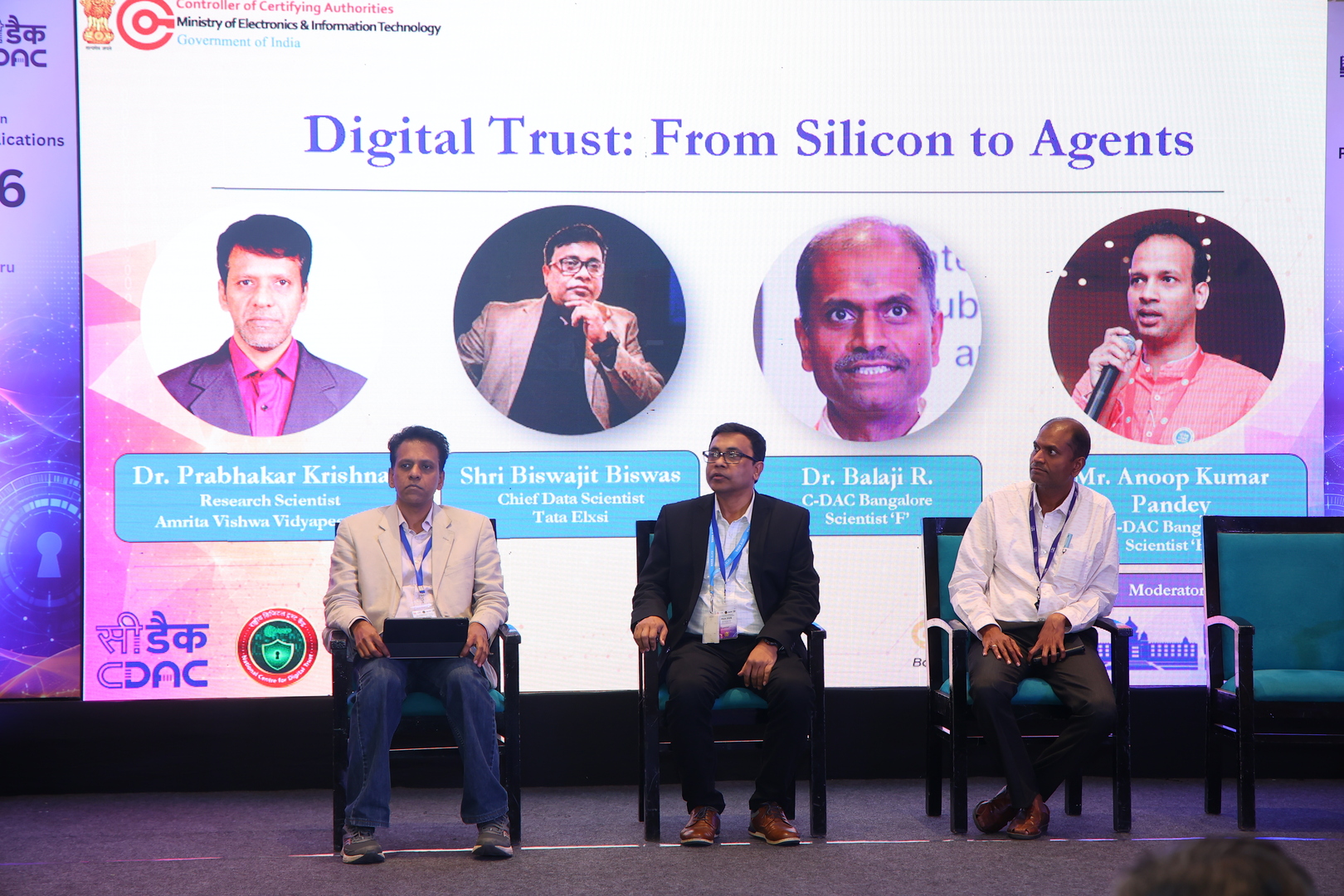
Panel Discussion (15:10 - 15:40)

  • Title: TBA
  • Panel Members: TBA

Invited Talk - 14 (15:40 - 16:00)

  • Title: TBA
  • Speaker: TBA
  • Bio: TBA

Tea Break and Stall Visit (16:00 - 16:15)

Valedictory Session (16:15-16:30)

  • Announcement - Best Papers
  • Address by Chief Guest
  • Felicitations
  • Closing Remarks

The Committee

Patron

  • Dr. Sanjay Bahl, Controller of Certifying Authorities and Director General, CERT-In
  • Shri Magesh Ethirajan, Director General, C-DAC Bangalore

General Chair

  • Prof. R. K. Shyamasundar, IIT Bombay
  • Dr. S. D. Sudarsan, Executive Director, C-DAC Bangalore

General Co-Chair

  • Dr. Prasant Misra, Senior Scientist, TCS Research
  • Dr. Abhishek Appaji, Chair, IEEE CS Bangalore Chapter

Technical Program Committee

  • Dr. P. V. Anandamohan, Fellow IEEE (Chair)
  • Dr. Balaji R, Scientist 'F', C-DAC Bangalore (Co-Chair)
  • Dr. Apoorva Patel, Professor, IISc Bangalore
  • Prof. C. E. Veni Madhavan, IISc Bangalore
  • Dr. Nelaturu Sarat Chandra Babu, C-DAC
  • Prof. Ashutosh Saxena, Dean (R&D), CMRTC
  • Ms. Lakshmi Eshwari P R, C-DAC Hyderabad
  • Dr. Selva Kumar S, Associate Professor, BMSCE
  • Dr. Venkata Tulasiramu Ponnada, Collins Aerospace
  • Dr. Appala Naidu Tentu, Associate Professor, CR Rao Advanced Institute of Mathematics
  • Dr. Kunwar Singh, Associate Professor, NIT Trichy
  • Shri David Selvakumar, C-DAC Bangalore
  • Dr. Janaki Chintalapati, C-DAC Bangalore
  • Dr. R C Saritha, C-DAC Bangalore
  • Ms. Suganya Annadurai, SETS
  • Dr. Abey Jacob, C-DAC Bangalore
  • Dr. Kunal Abhishek, C-DAC Patna
  • Dr. Siva Hemanth Kolla, Sandia National Laboratories
  • Dr. Supraja, Visa Inc
  • Dr. Vishal Rathod, Zen Exim Pvt Ltd
  • Dr. Arpita Maitra, TCG CREST
  • Dr. Sangita Majumdar, C-DAC Bangalore
  • Dr. Ganesh Hegde, REVA University
  • Dr. Upendra Kumar Kagola, REVA University
  • Shri Ramesh Laveti, C-DAC Bangalore
  • Shri Gopinath P, C-DAC Bangalore
  • Ms. Surabhi Dwivedi, C-DAC Bangalore

Organizing Committee

  • Dr. Mohammed Misbahuddin, Scientist 'F', C-DAC Bangalore (Chair)
  • Mr. Gopal M M V, Manager (Marketing), C-DAC Bangalore
  • Mr. Jitendra Kumar, Scientist E, C-DAC Bangalore
  • Mr. Gopinath P, Scientist E, C-DAC Bangalore
  • Ms. Lavanya Palani, Scientist E, C-DAC Bangalore
  • Ms. Snehal Balwant Parbat, Project Engineer, C-DAC Bangalore
  • Mr. Vishal Kumar Vaisya, Project Engineer, C-DAC Bangalore
  • Ms. Vaijayanti Pande, Project Engineer, C-DAC Bangalore

Publication Committee

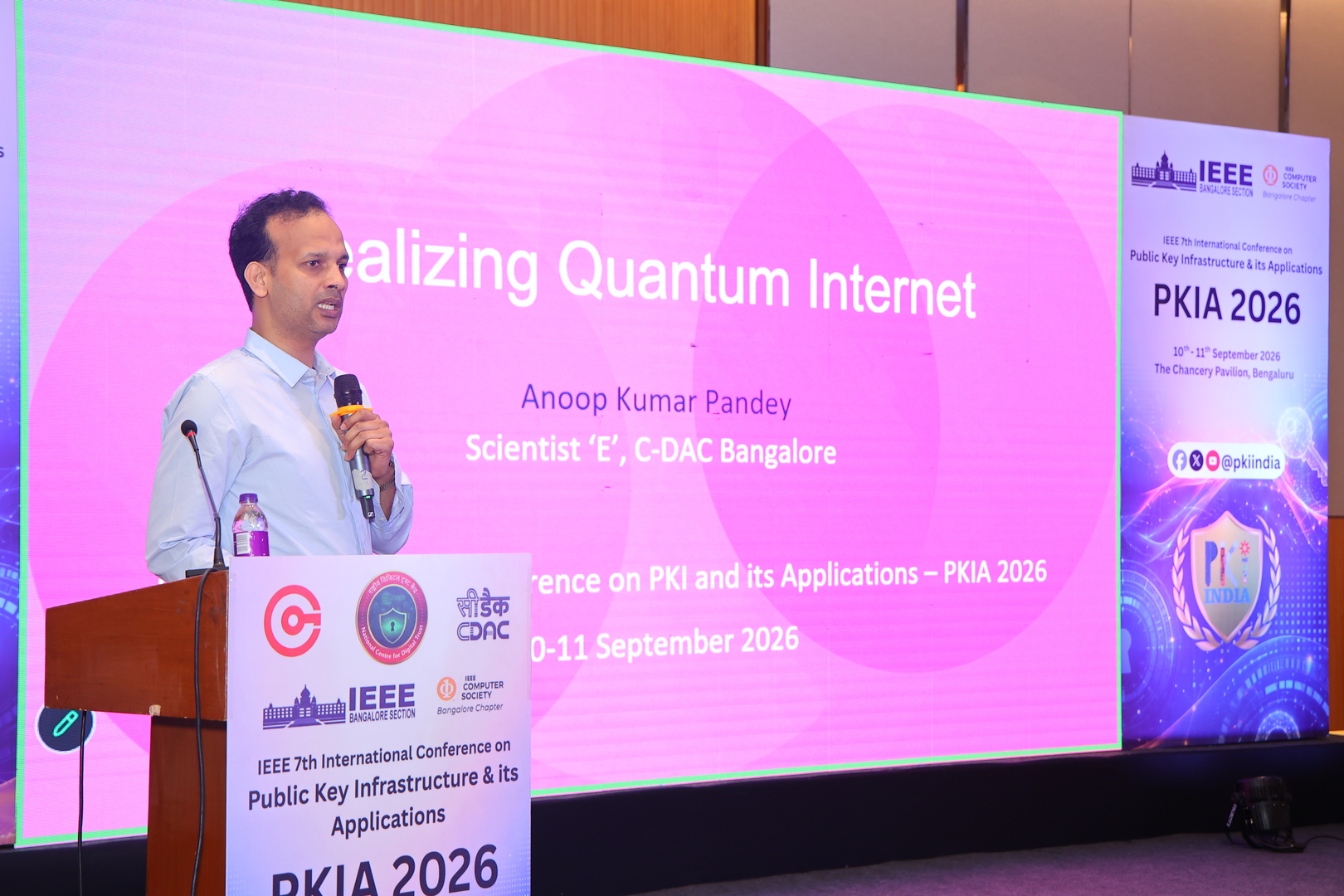
  • Shri Anoop Kumar Pandey, Scientist 'E', C-DAC Bangalore (Chair)
  • Mr. Manish Apotikar, Project Associate, C-DAC Bangalore

Web Committee

  • Mr. Harsh Vardhan Singh, Project Engineer, C-DAC Bangalore

Venue

Date: 10-11th September 2026

Location: The Chancery Pavilion, 135, Residency Road, Bengaluru, Karnataka 560025, India

Partners

The Controller of Certifying Authorities (CCA) has been appointed by the Central Government under section 17 of the Act for the purpose of IT Act. The office of the CCA aims at promoting the growth of e-Commerce and e-Governance through the wide use of digital signatures. The CAs issues Digital Signature Certificates to the subscribers. The CCA certifies the public keys of CAs using its own private key, which enables user in the cyberspace to verify that a given certificate is issued by a licenced CA. For this purpose it operates, the Root Certifying Authority of India (RCAI). More information can be found here

Center for Development of Advanced Computing (C-DAC) is the premier R&D organization of the Ministry of Electronics and Information Technology (MeitY), for carrying out R&D in IT, Electronics and associated areas. C-DAC has today emerged as premier R&D organization in IT&E (Information Technlogies and Electronics) in the country working on strengthening national technological capabilities in the context of global developments. More information can be found here

Contact us

Contact Info

  • Centre for Development of Advanced Computing, #68, Electronic City, Bangalore - 560100 Karnataka(India)
  • pki[at]cdac[dot]in
  • +91-8028523300