7th International Conference on

Public Key Infrastructure and its Applications (PKIA 2026)

A Joint Conference by IEEE Bangalore and IEEE CS Bangalore Chapter

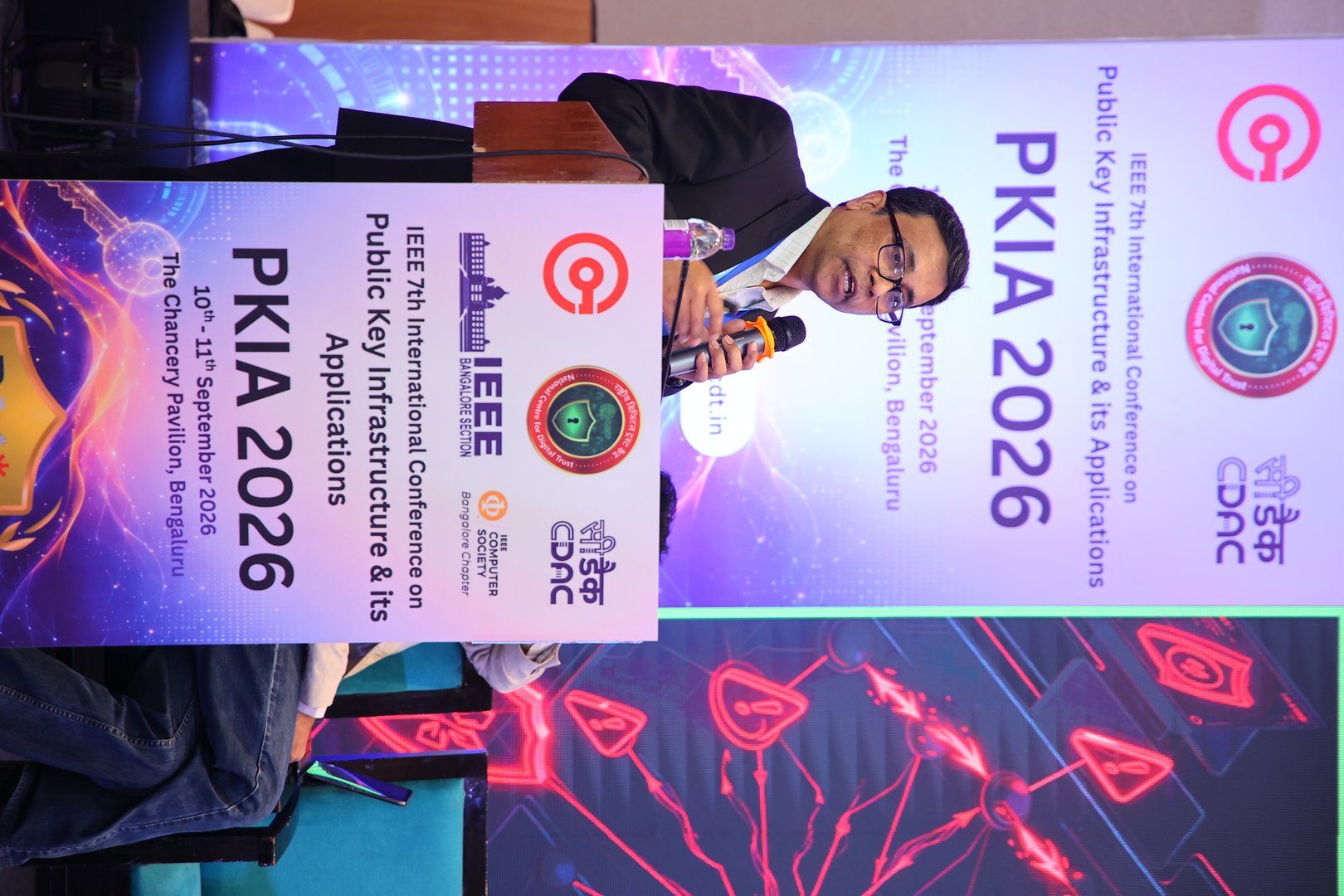
September 10-11th, 2026

Bangalore, Karnataka, India

About PKIA 2026

The 7th International Conference on Public Key Infrastructure and its Applications (PKIA 2026) is a joint conference by IEEE Bangalore Section and IEEE CS (Computer Society) Bangalore Chapter. It will be a premium venue for bringing together all stakeholders of a Public Key Infrastructure Ecosystem. The objective is to provide a platform for presenting novel ideas from academia and industry on traditional and emerging topics and new paradigms in the areas of PKI, with a clear connection to real-world problems, systems or applications. Accepted papers will be submitted for possible inclusion into IEEE Xplore subject to meeting IEEE Xplore's scope and quality requirements.

Call for Papers

Applications of PKI as a technology has grown by leaps and bounds in the recent years and is on the verge of becoming synonymous with trust in electronic transactions all over the world. The world of PKI has evolved as a robust and reliable system owing to the strong ecosystem - backed by the development in Cryptography, Protocols, Standards, Policy, Laws, Software libraries and hardware components. The objective is to provide a platform for exchanging of research concepts, brainstorming of emerging trends and best practices, showcasing of new and innovative PKI applications and presenting novel ideas from academia and industry with a clear connection to real-world problems, systems or applications. The conference therefore seeks submissions presenting innovative research and current developments in the areas of Public Key Infrastructures, Digital Certificates, Digital Signatures, Key Management, One-Time Signatures, Certificate-less secure communication, Time Stamping, PKI based Authentication etc. Submissions may focus on Modelling, Design, Analysis (incl. security proofs and attacks), Development (e.g. implementations), Deployment (e.g. system integration), and Maintenance (e.g. performance measurements, usability studies) of algorithms/ protocols/ standards/ implementations/ technologies / devices/ systems standing in relation with public key cryptography. Some topics of interest include but not limited to:

  • Advanced Cryptographic Methods for Digital Signing
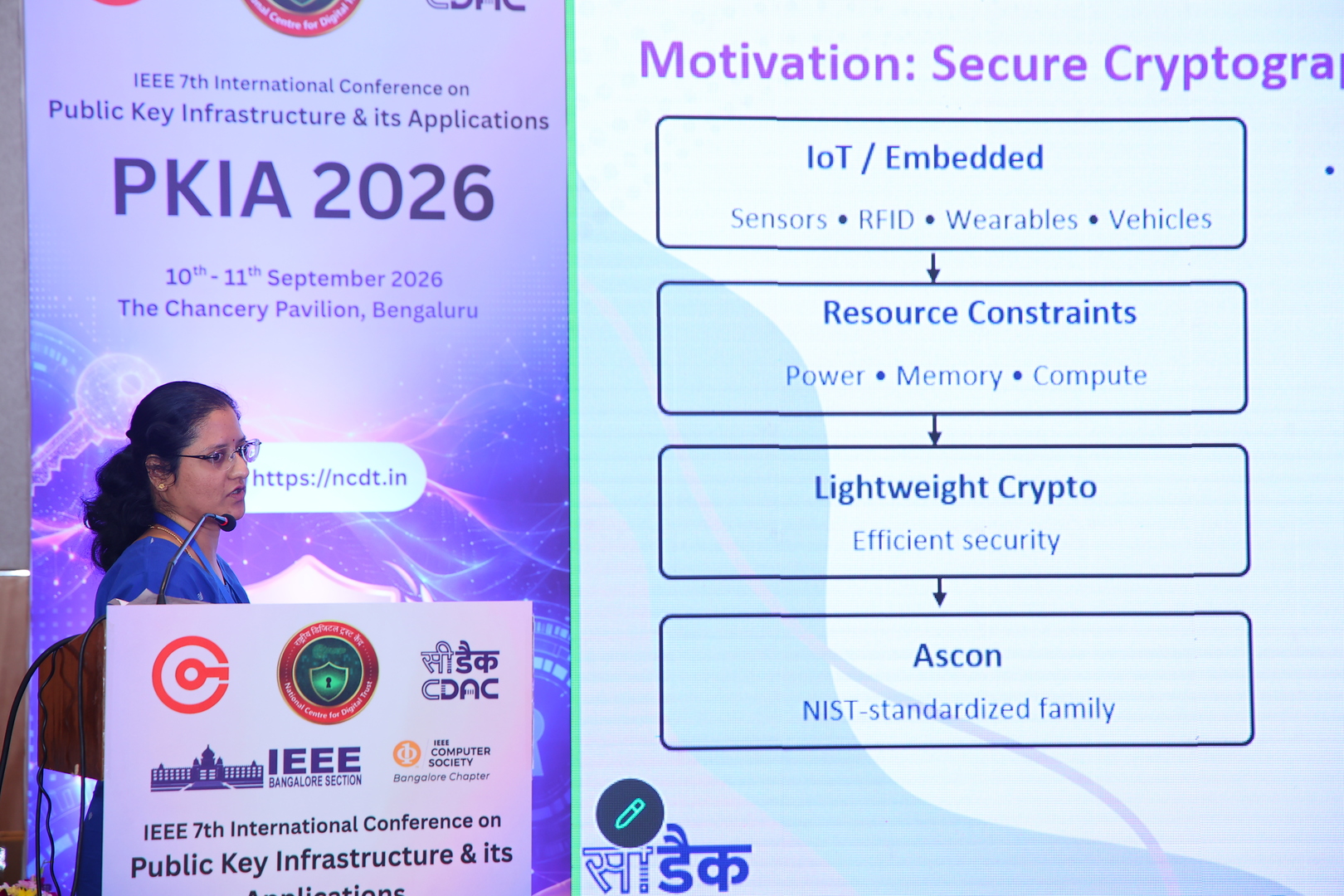
  • Light Weight Cryptography and PKI
  • Security issues and Challenges in Crypto Tokens
  • PKI and FIDO
  • Policy and Legal support systems for PKI
  • Key Management Implementation and Issues
  • Critical Infrastructure Protection using PKI
  • Public Key Infrastructure Protection
  • Certificate Validation
  • Implementation of PKI Applications
  • Standard Libraries for PKI Applications
  • Quantum Cryptography
  • Post Quantum Cryptography
  • Standard Plug-ins for PKI enablement
  • PKI of IoT Security
  • Usability in PKI for ease of issuance of tokens
  • Human factors in PKI security
  • Dynamic Digital / Electronic Signatures
  • PKI for Securing Mobile APPs
  • Biometric and PKI enabled applications
  • PKI for Identity Management
  • PKI in e-Governance, e-Banking
  • Parallelized Cryptographic Implementations
  • Advances in Public Key Cryptography
  • Trust Models, Trust List etc
  • Blockchain and Digital Currency

The use of generative AI software tools is permitted subject to the following requirements:

  • The AI systems have not been used to plagiarize, misrepresent, or falsify content.
  • The resulting work, in its entirety, accurately represents the authors' original research and novel intellectual contributions, and is not primarily the result of the AI tool's generative capabilities.
  • The authors accept full responsibility for the veracity and correctness of all material in their work, including any content generated by AI tools.

Note that all submissions will be checked using suitable AI content detectors

Double-Blind Reviewing

  • The conference will employ a lightweight double-blind reviewing process. Submissions should not reveal the identity of the authors in any way. In particular, authors' names, affiliations, and email addresses should not appear anywhere in the submission. Nothing should be done in the name of anonymity that weakens the submission or makes the job of reviewing the paper more difficult. In particular, important references should not be omitted or anonymized. Use the third person to refer to the author's previous work, e.g., replace "as we have shown before" with "as shown before in [X]."
  • Authors should feel free to disseminate their ideas or draft versions of their paper as they normally would. For example, authors may post drafts of their papers on the web, submit them to arXiv, and give talks on their research ideas. Authors with further questions on double-blind reviewing are encouraged to contact the PC Co-Chairs by email at pki@cdac.in.

Papers should be a maximum of 8 pages in the IEEE conference proceedings format available HERE

Please submit your technical papers via Microsoft CMT for PKIA 2026 here. For Quantum Conclave paper submission please visit here

All accepted, registered and presented paper will be included to IEEE Xplore Digital Library.

Important Dates

(All the deadlines are in AoE)

Last Date for Submission: 30th April 2026 15th May 2026 31st May 2026 (Hard)

Notification of Acceptance: 31st July 2026

Camera-Ready Submission: 23rd August 2026

Acknowledgement

The Microsoft CMT service was used for managing the peer-reviewing process for this conference. This service was provided for free by Microsoft and they bore all expenses, including costs for Azure cloud services as well as for software development and support.

Registration

All the fees are excluding GST. Additional GST@18% applicable

Author Registration Fee:

Student IEEE Member: ₹10,000
Student Non-Member: ₹12,000
IEEE Member: ₹14,000
Non-Member: ₹18,000

Foreign Author Registration Fee:

Student IEEE Member: $250
Student Non-Member: $300
IEEE Member: $400
Non-Member: $500


Camera-Ready Submission Instructions:

Please find it here

Author Presentation Template:

Please find the presentation template here

Participant Registration is free of charge. Please click here to complete your registration.
C A L L
F O R
P A P E R S

Program

All timings are in IST (Indian Standard Time).

Day 1 Day 2

Day 1: Thursday, September 10, 2026

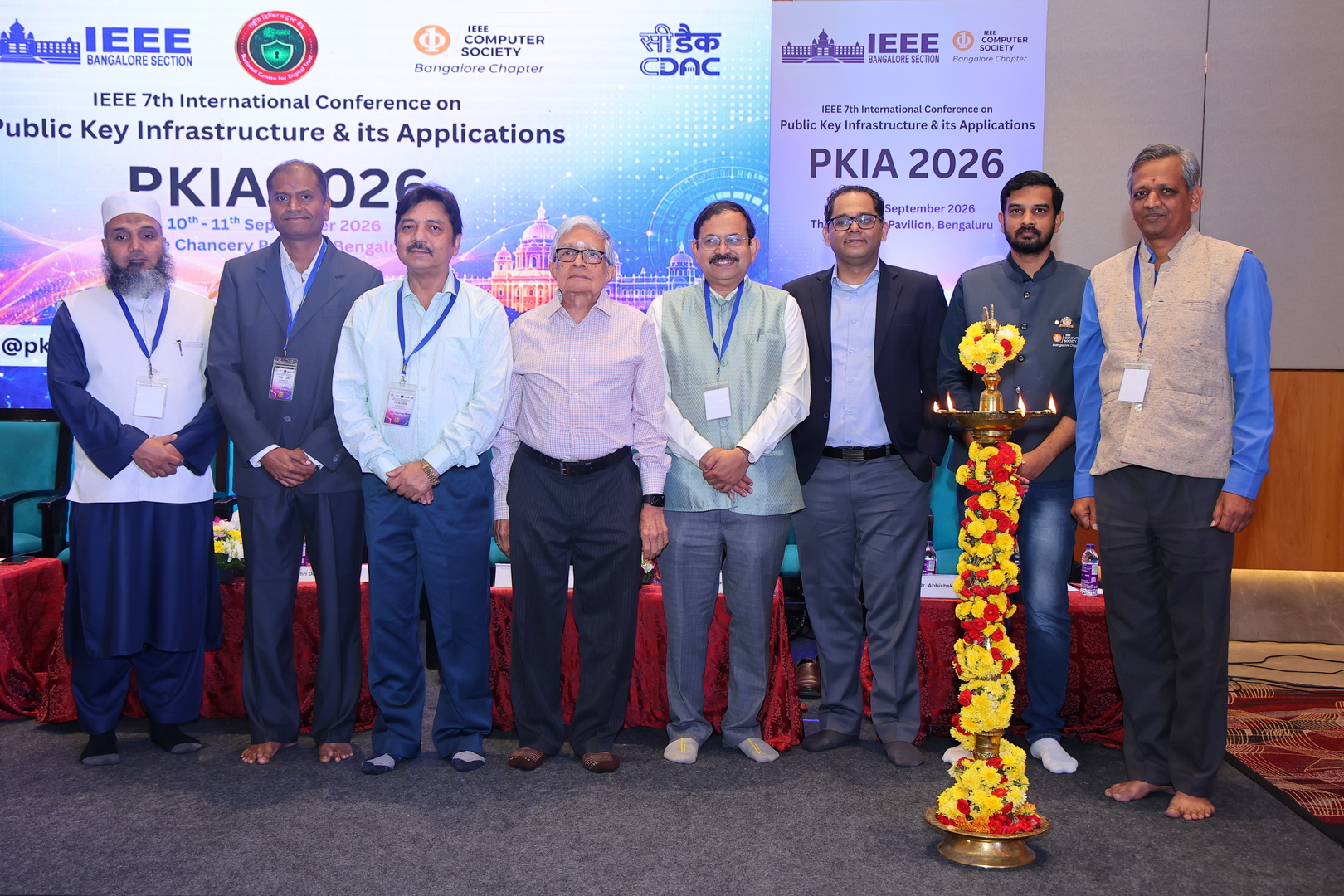
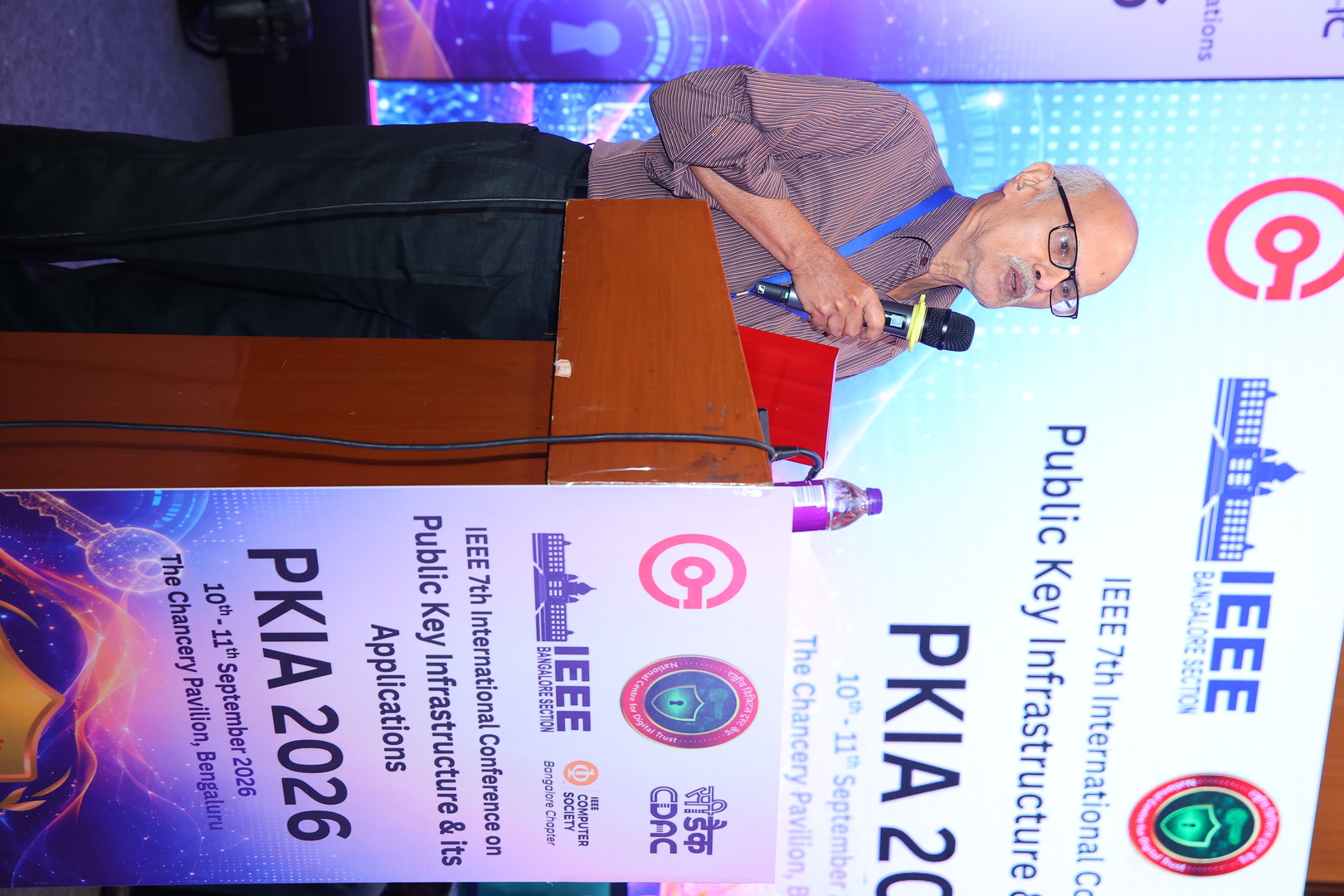
Inauguration (10:00 - 11:00)

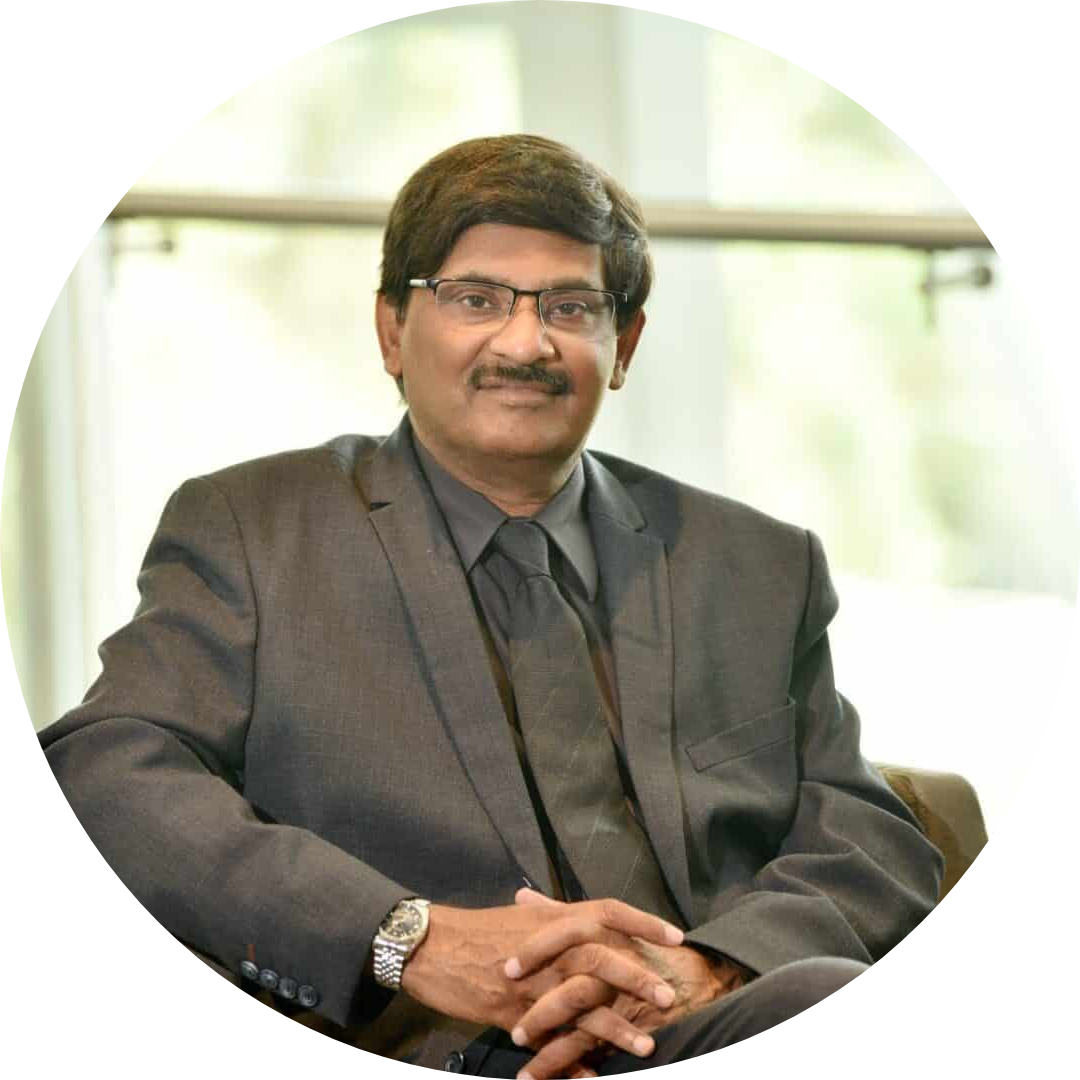
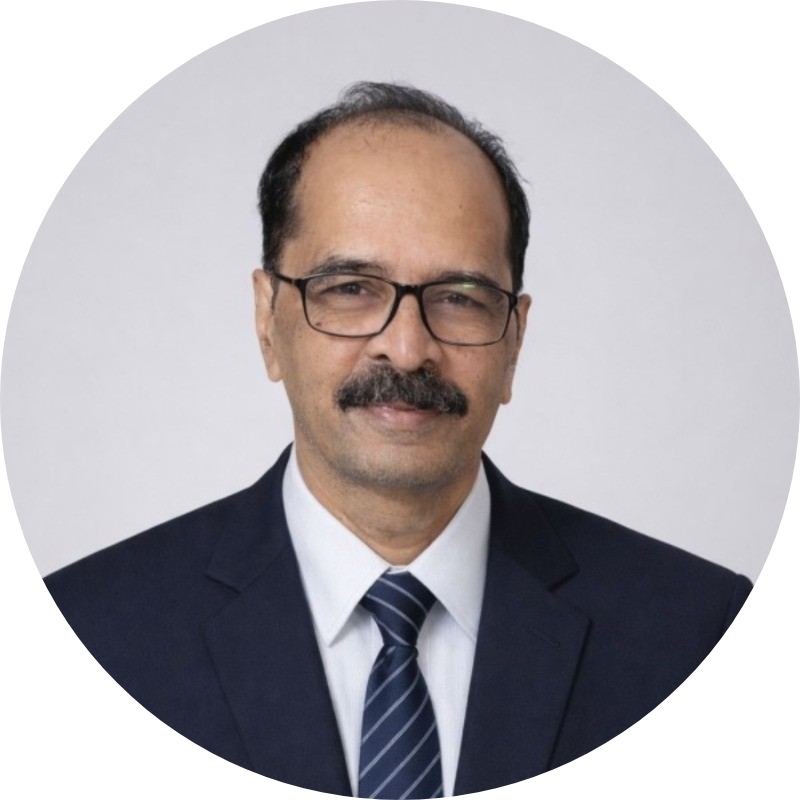
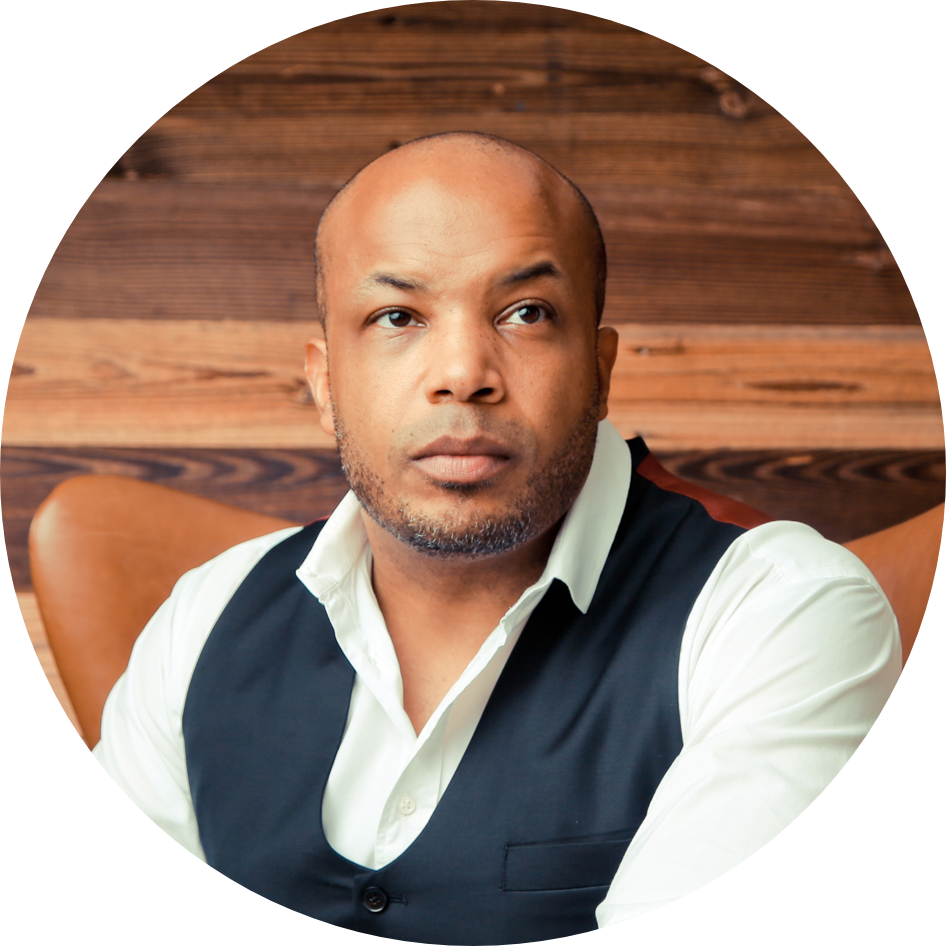
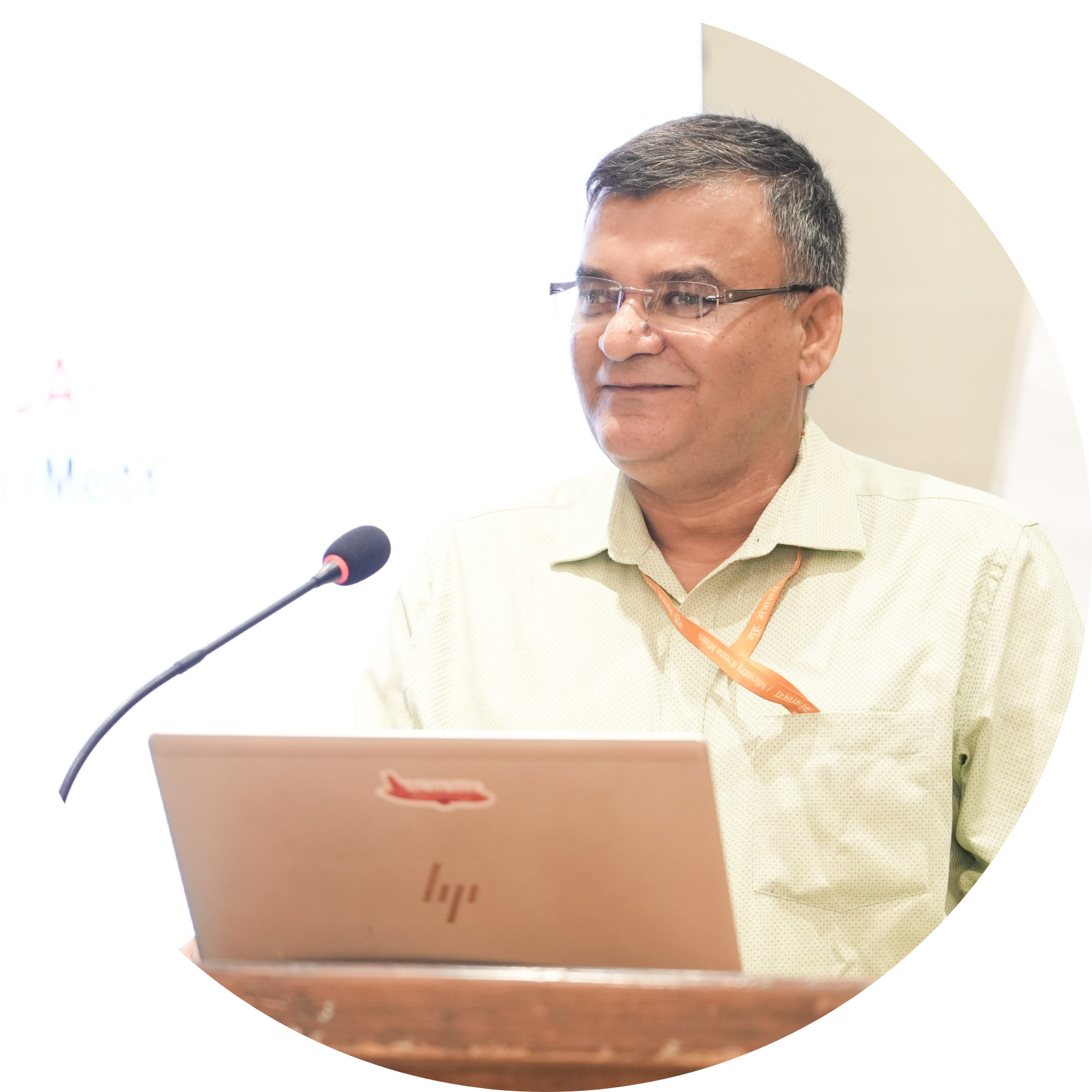
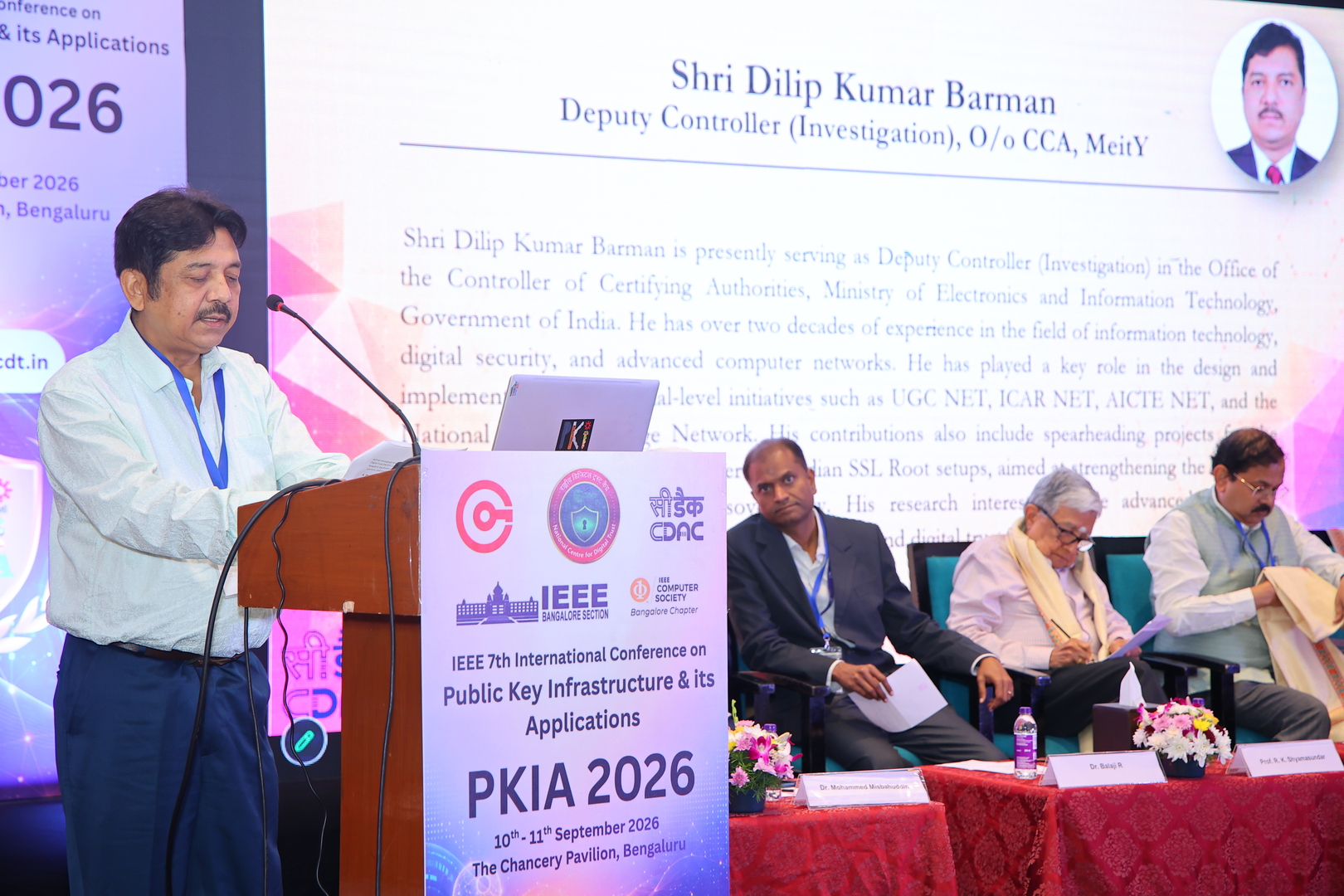
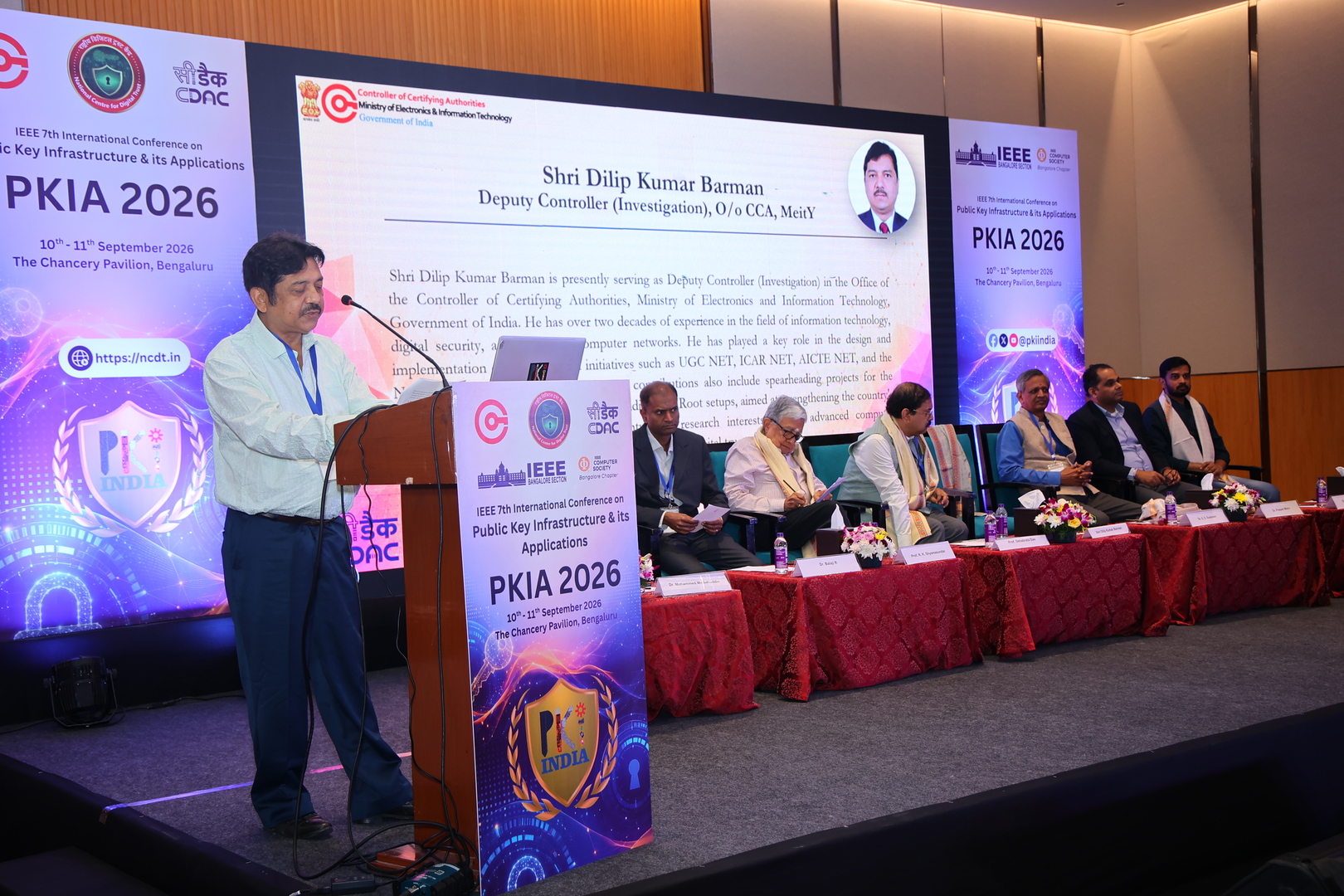
  • Welcome Address: Shri Dilip Barman, Deputy Controller (Investigation) O/o CCA, MeitY
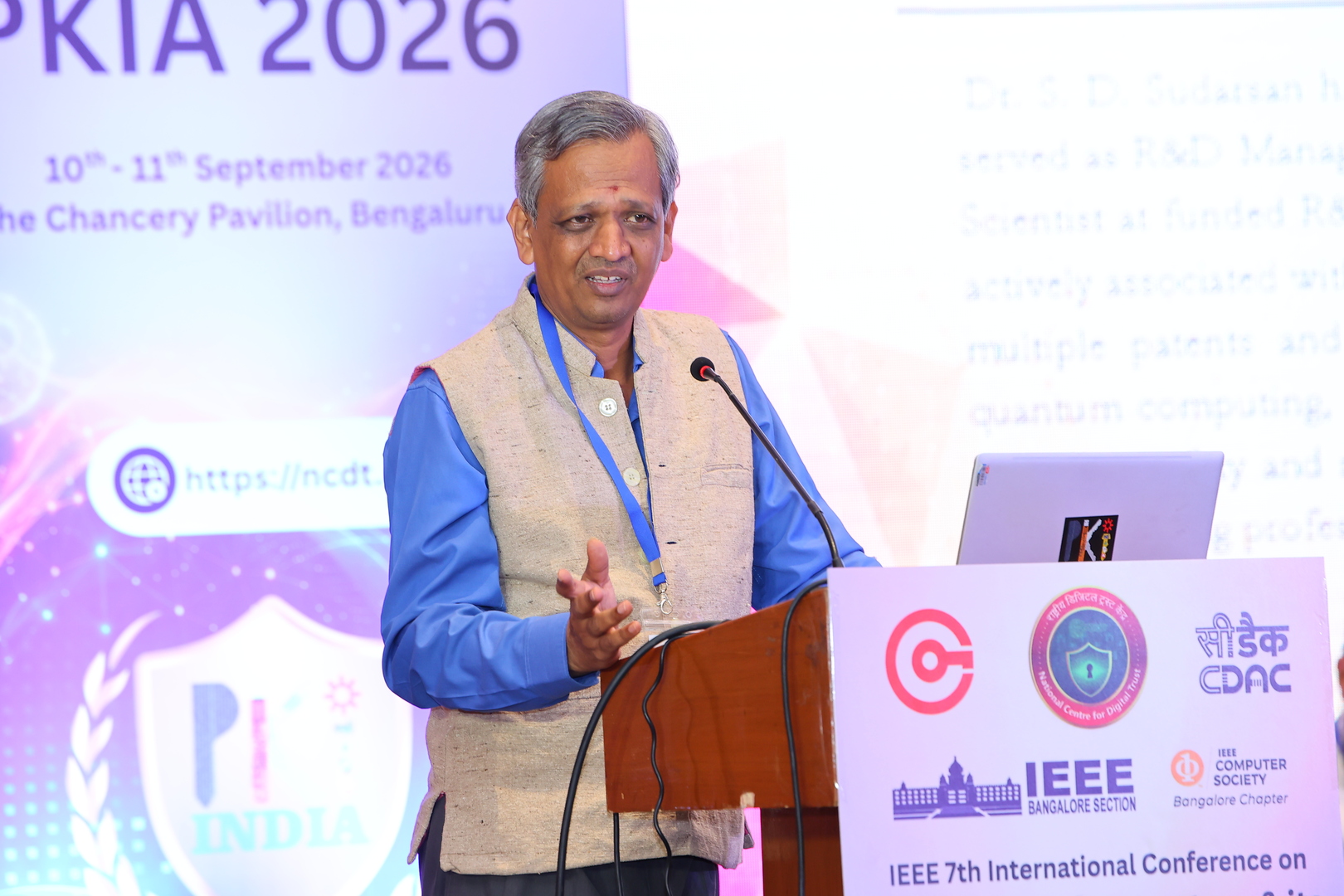
  • Address by General Chair: Dr. S. D. Sudarsan, Executive Director, C-DAC Bangalore
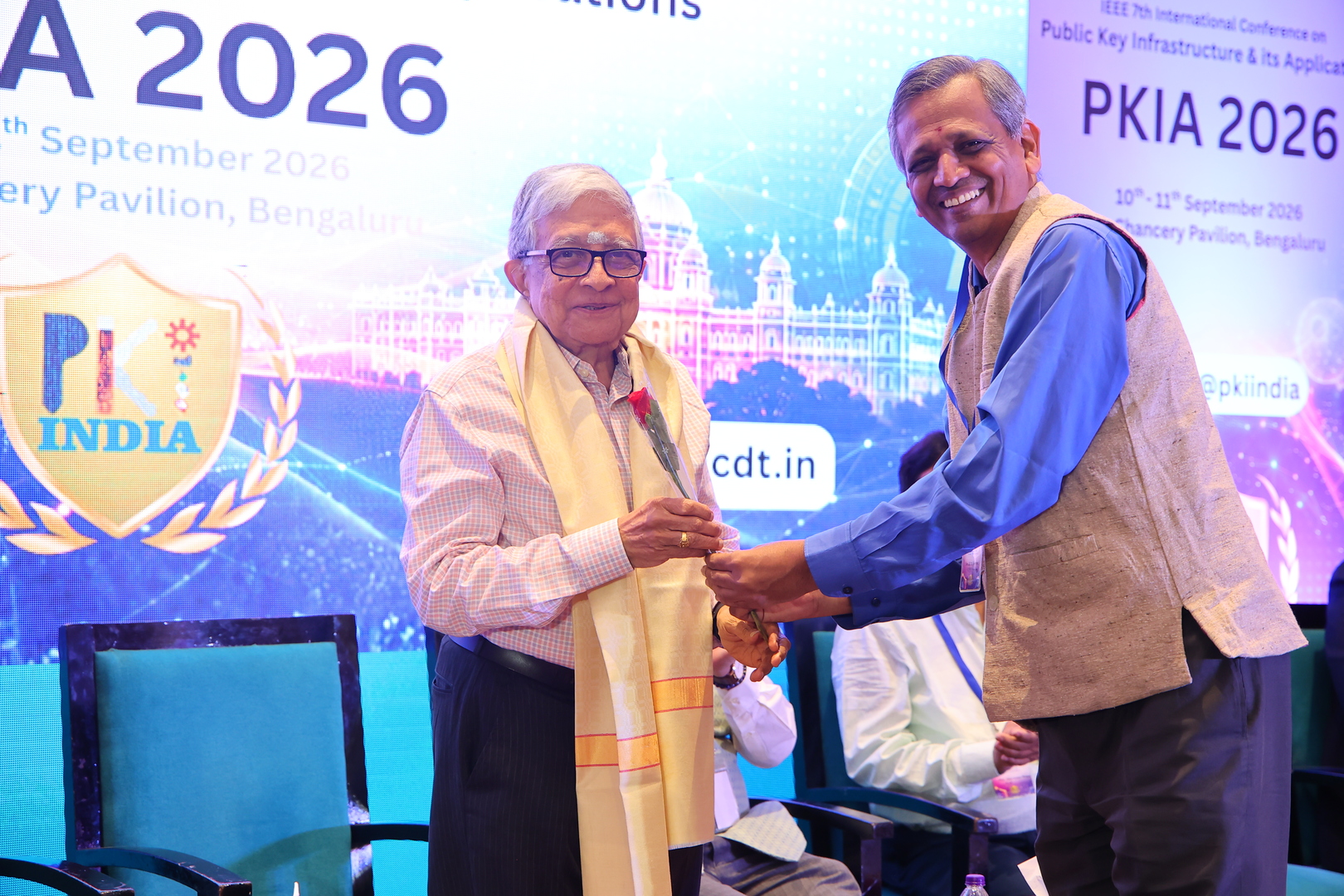
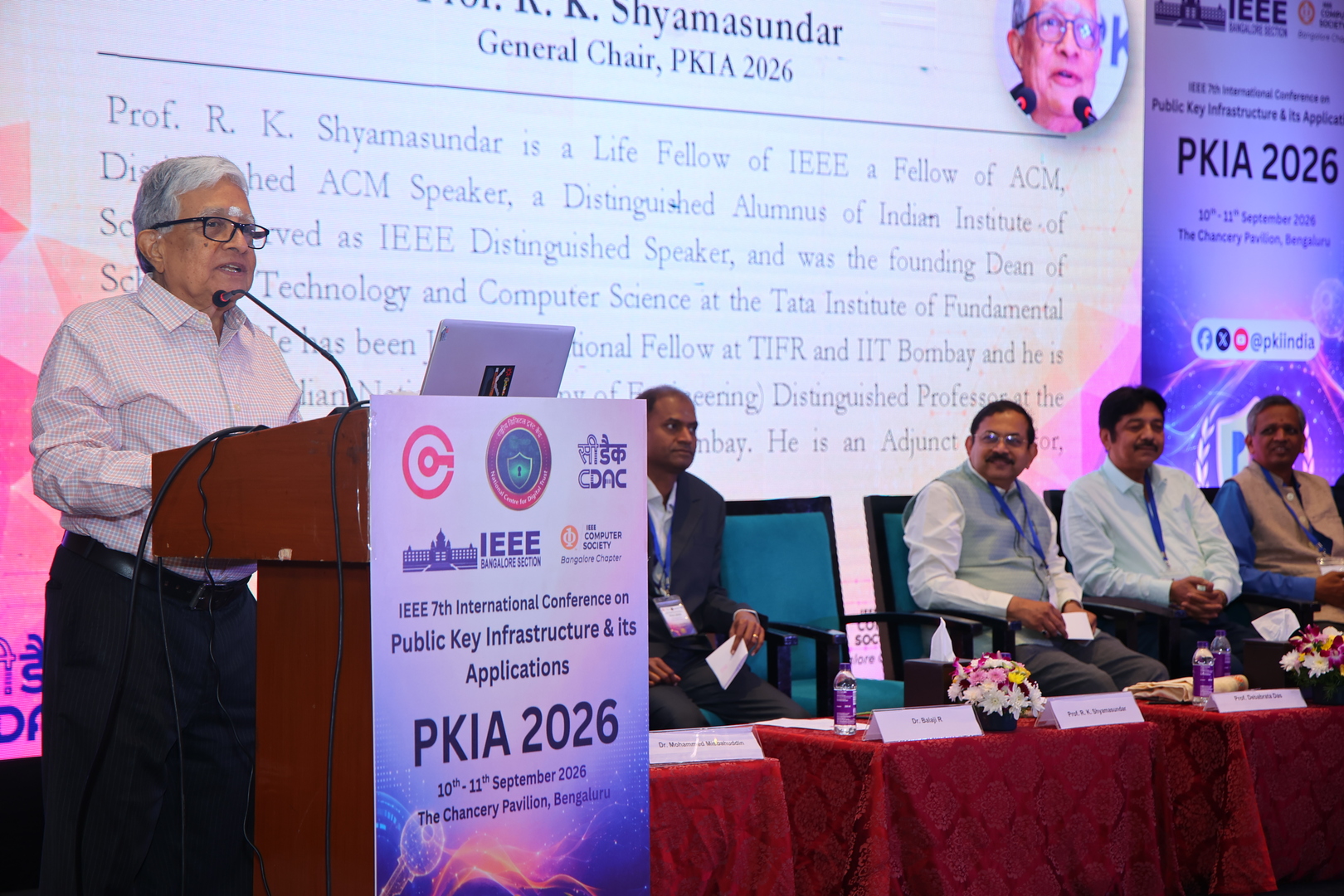
  • Introduction to PKIA 2026: Prof. R. K Shyamasundar, General Chair, PKIA 2026
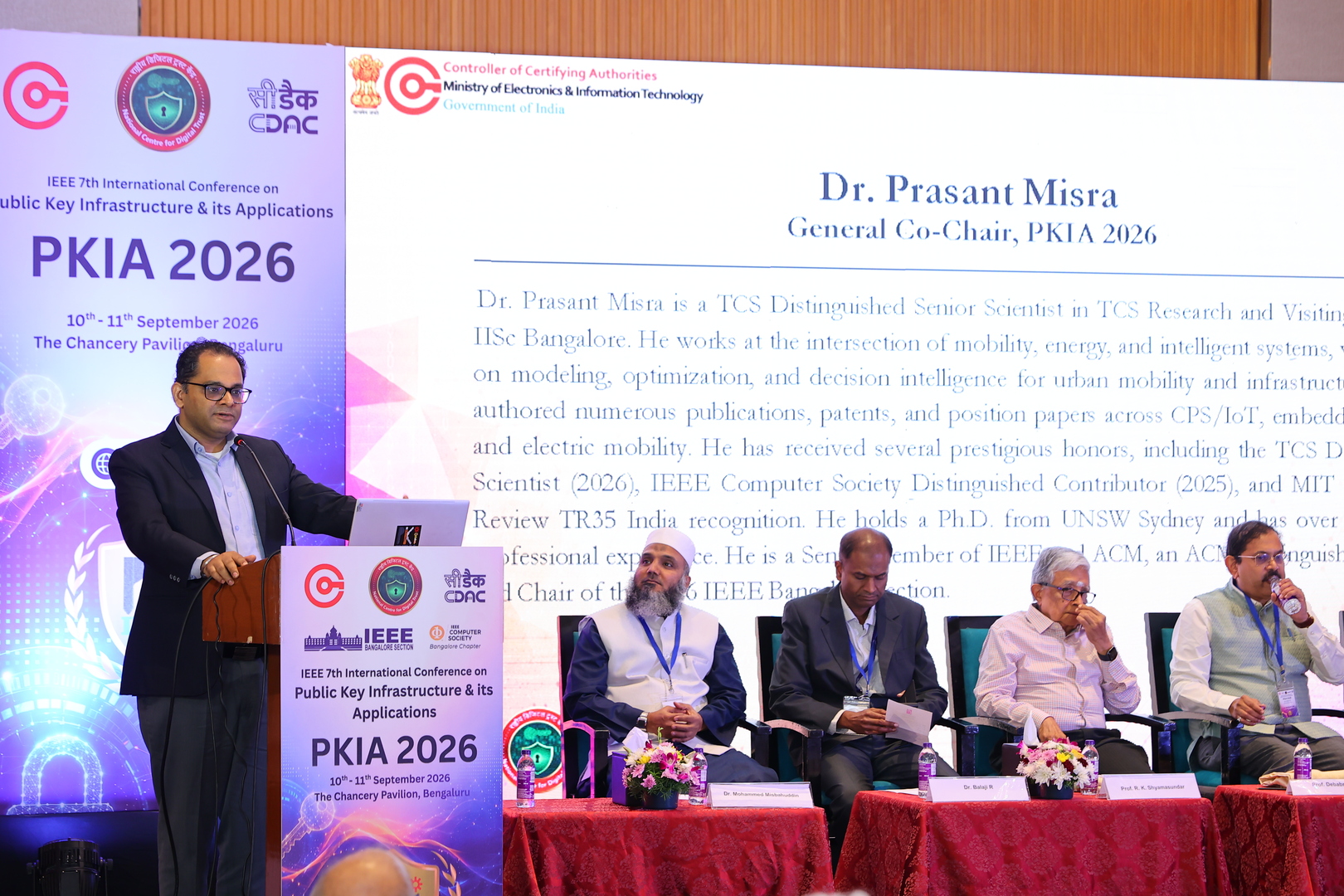
  • Address by General Co-Chair: Dr. Prasant Misra, Chair, IEEE Bangalore Chapter
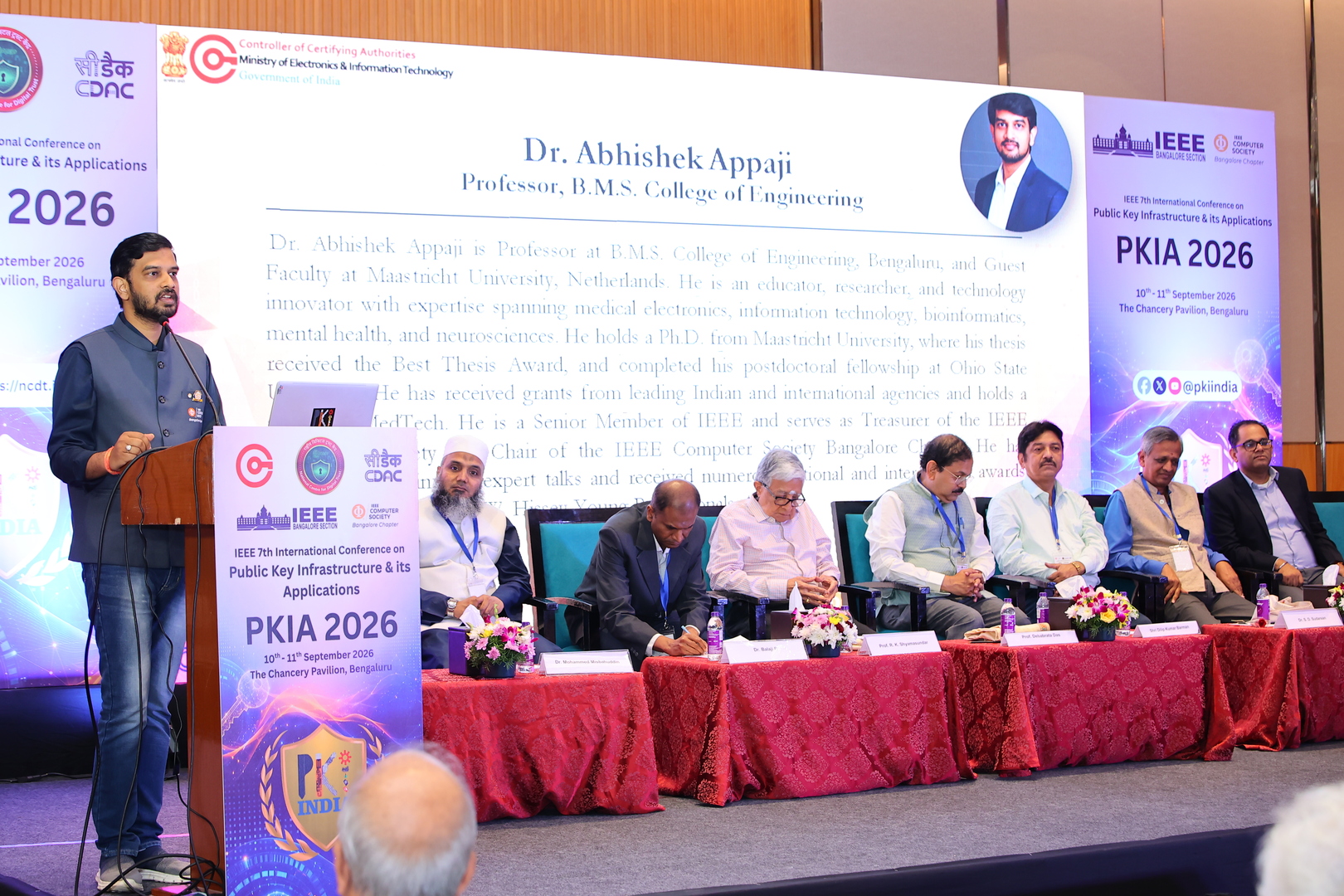
  • Address by General Co-Chair: Dr. Abhishek Appaji, Chair, IEEE CS Bangalore Chapter
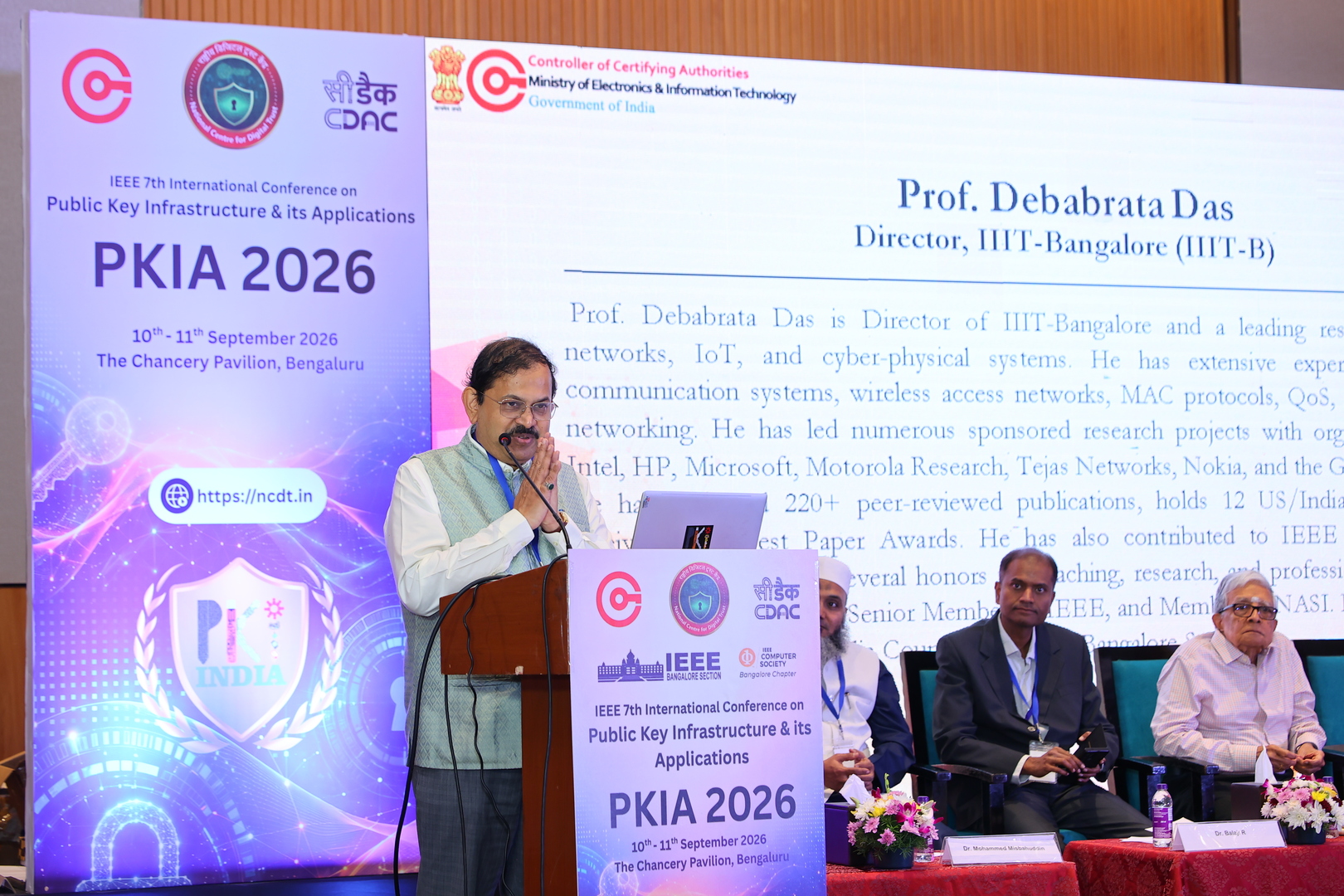
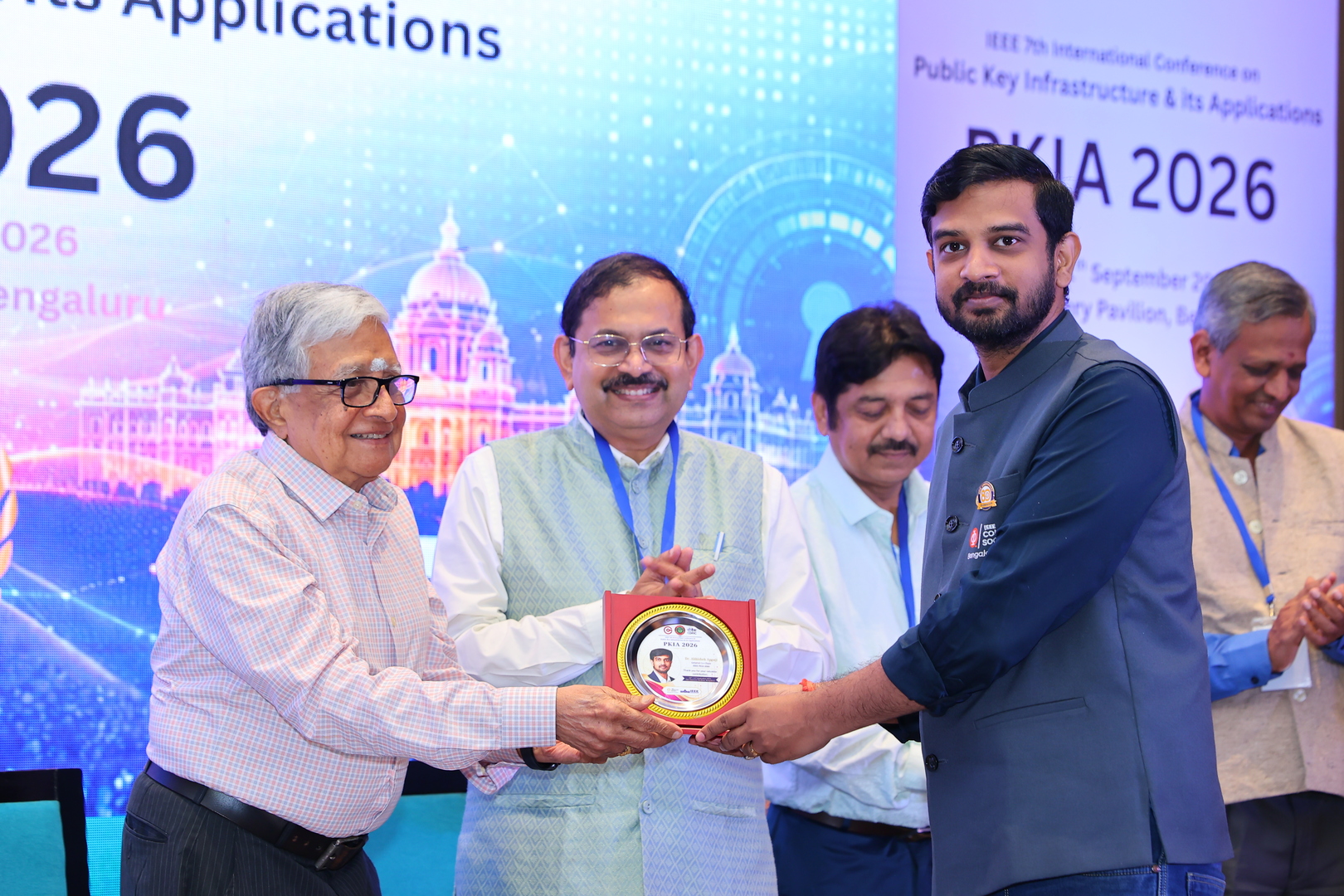
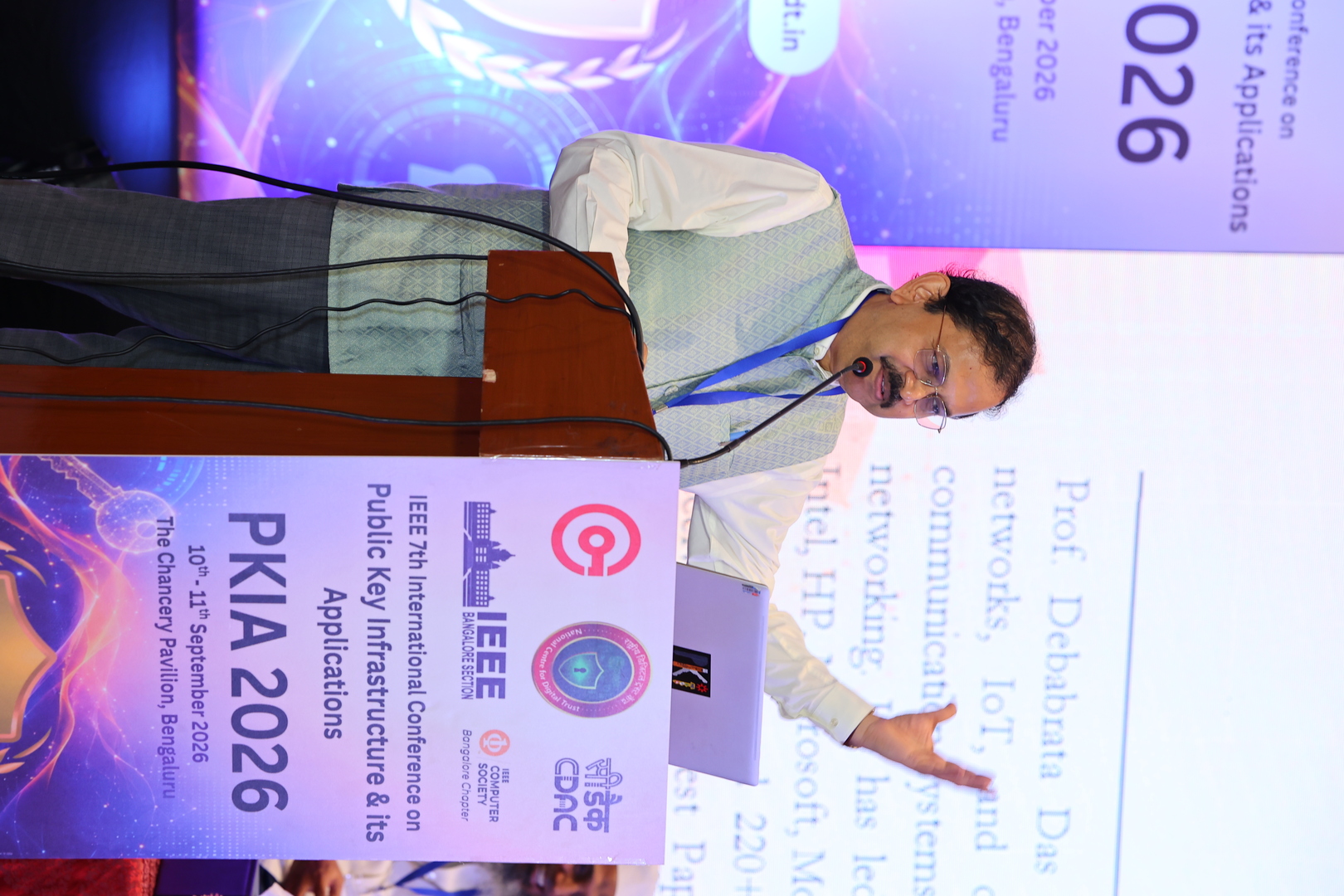
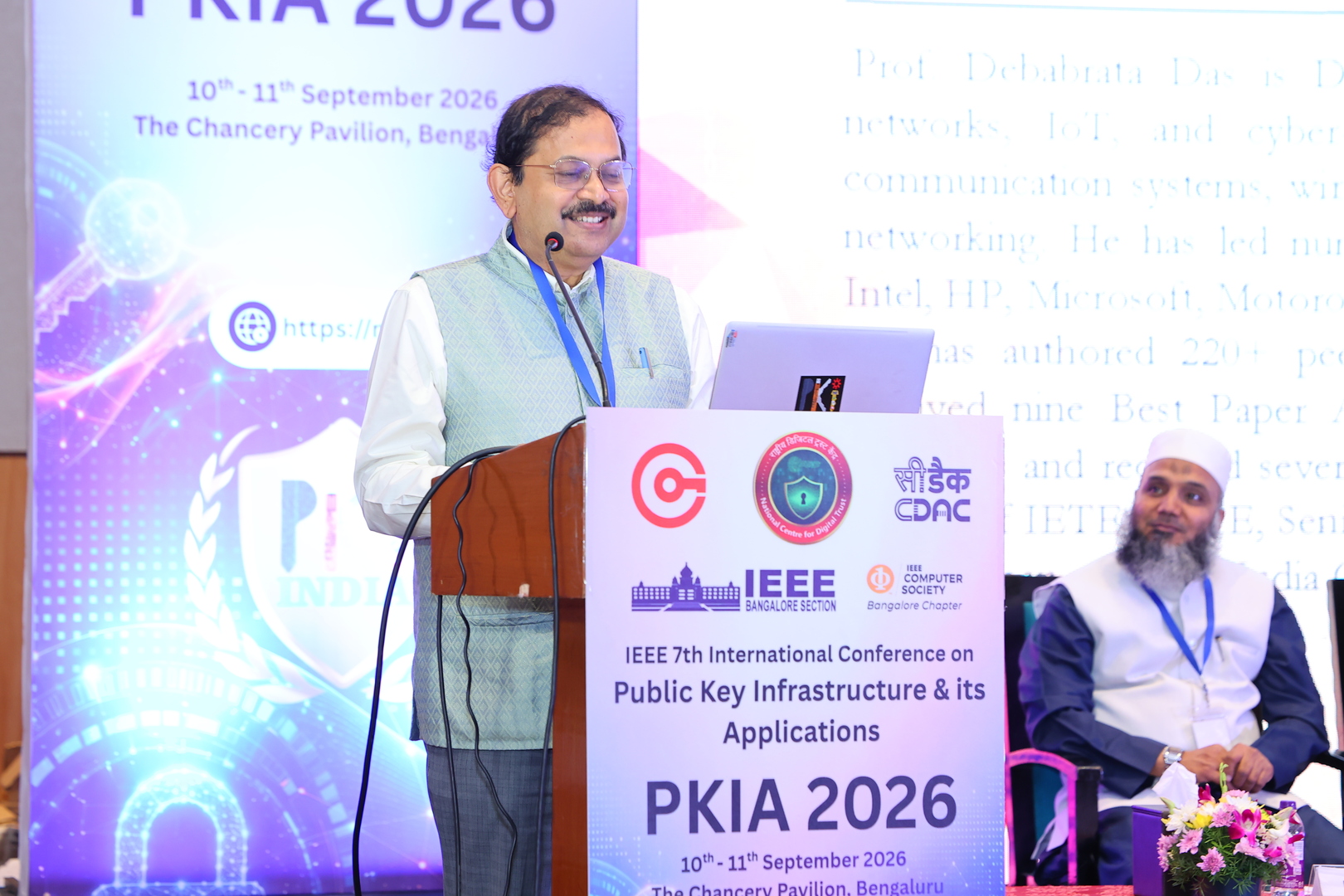
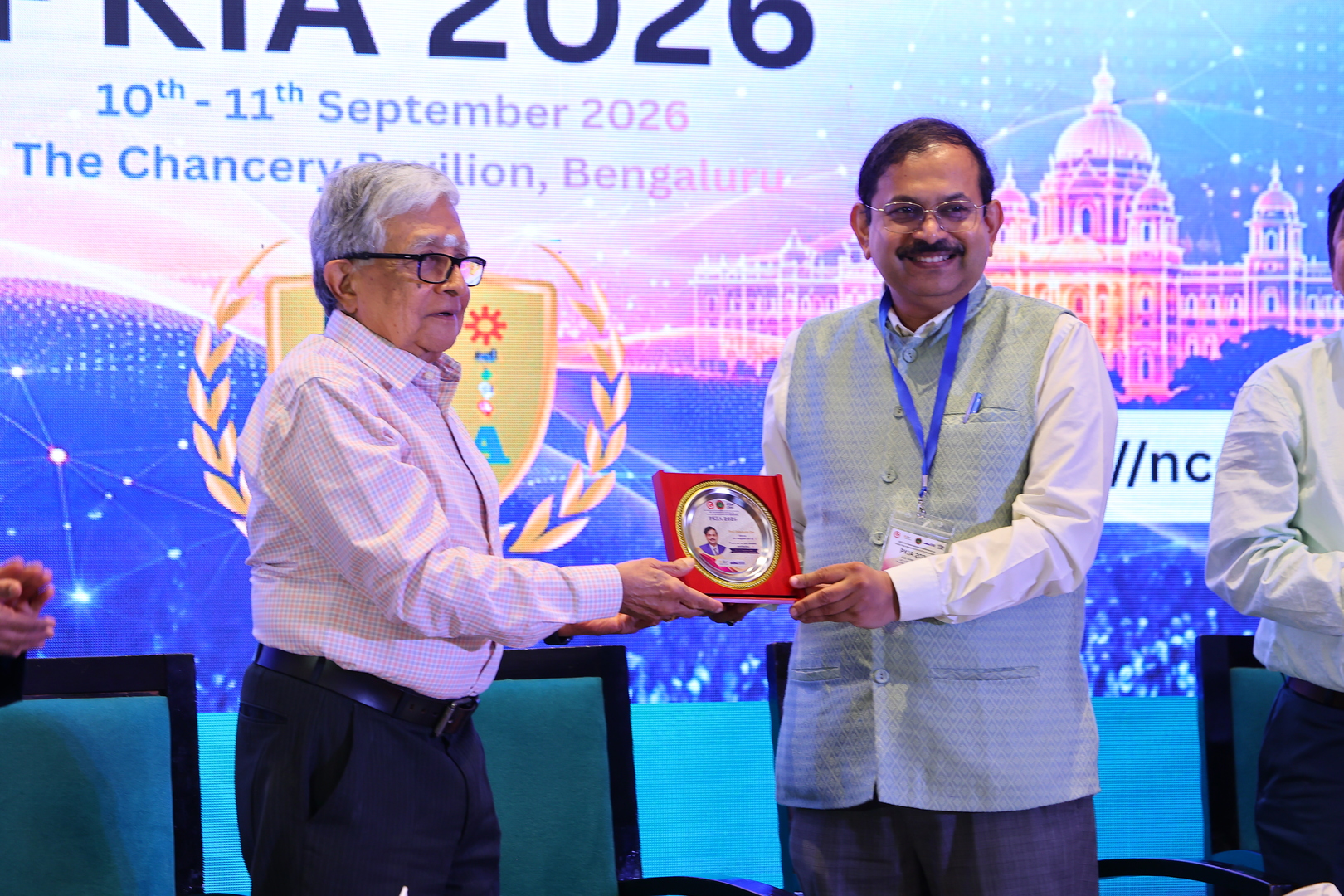
  • Special Address: Prof. Debabrata Das, Director, IIIT-Bangalore (IIIT-B)
  • Special Address by Patron: Shri Magesh Ethirajan, Director General, C-DAC
  • Special Address by Patron: Dr. Sanjay Bahl, Controller of Certifying Authorities and Director General, CERT-In
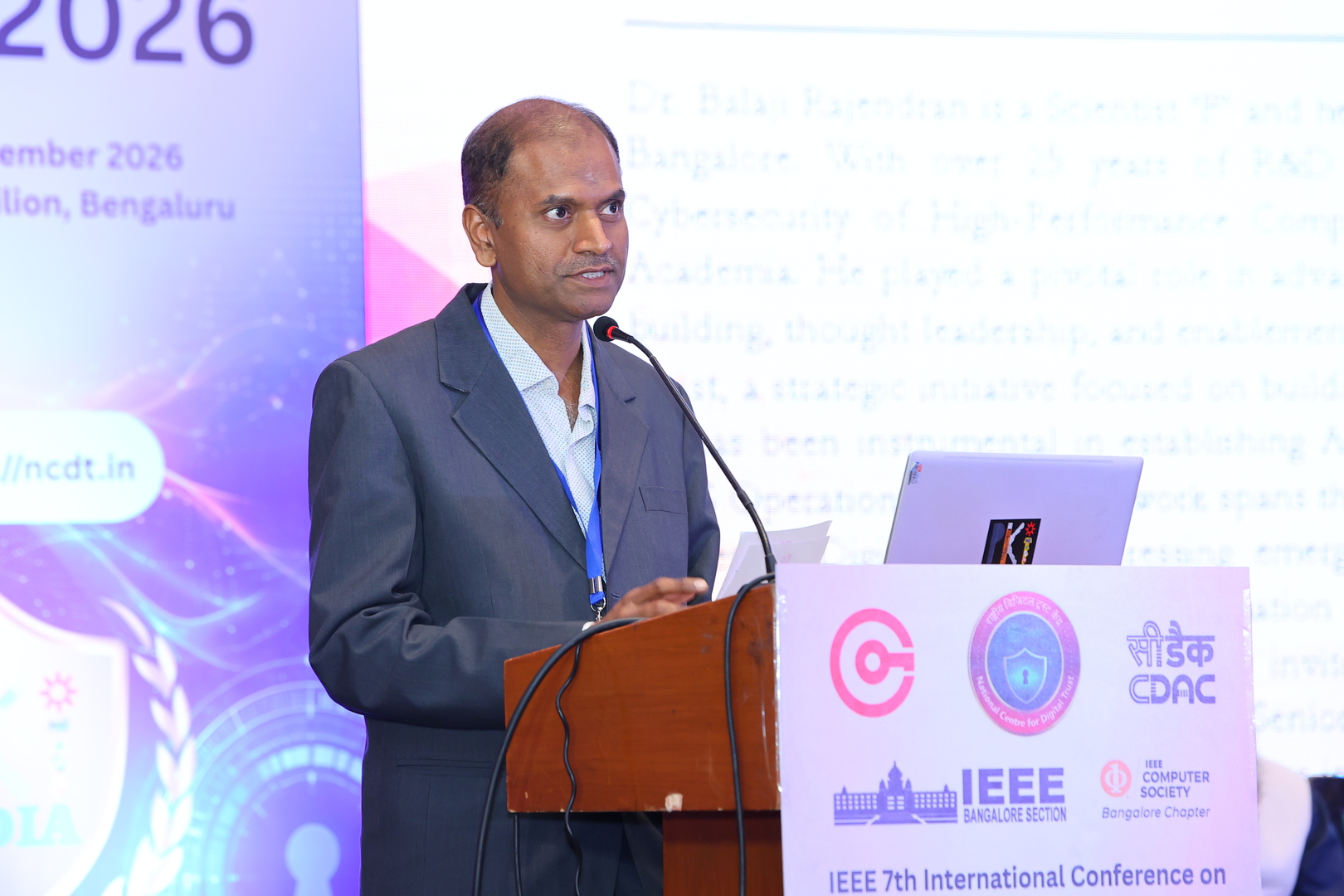
  • Vote of Thanks: Dr. Balaji R, Scientist 'F', C-DAC, Bengaluru

Welcome Address

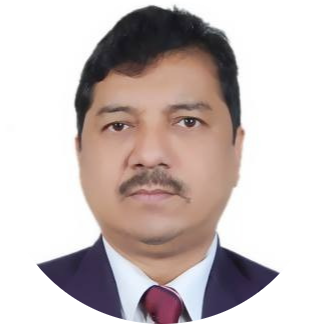
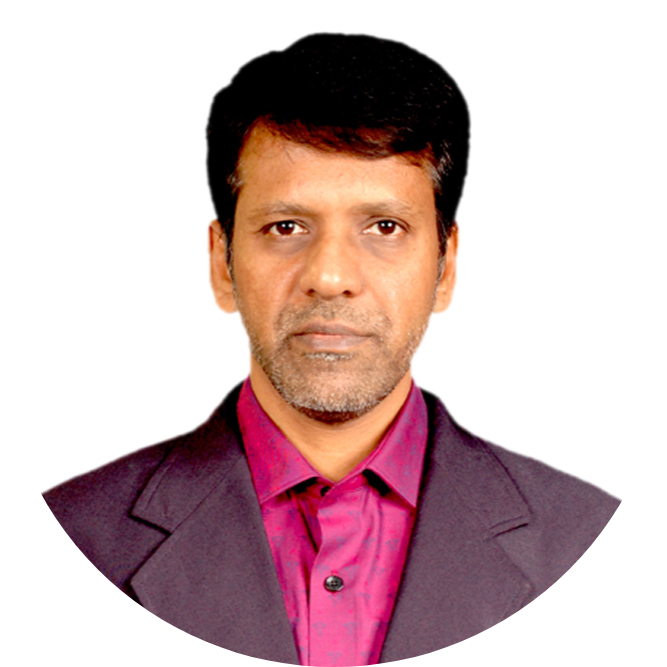
  • Speaker: Shri Dilip Kumar Barman
    Deputy Controller (Investigation) O/o CCA, MeitY
  • Bio:
    Shri Dilip Kumar Barman is presently serving as Deputy Controller (Investigation) in the Office of the Controller of Certifying Authorities, Ministry of Electronics and Information Technology, Government of India. He has over two decades of experience in the field of information technology, digital security, and advanced computer networks. He has played a key role in the design and implementation of national-level initiatives such as UGC NET, ICAR NET, AICTE NET, and the National Medical College Network. His contributions also include spearheading projects for the development of an Indian Browser and Indian SSL Root setups, aimed at strengthening the country's internet resilience and digital sovereignty. His research interests include advanced computer networks, cybersecurity, public key infrastructure, and digital trust services.

Address by General Chair

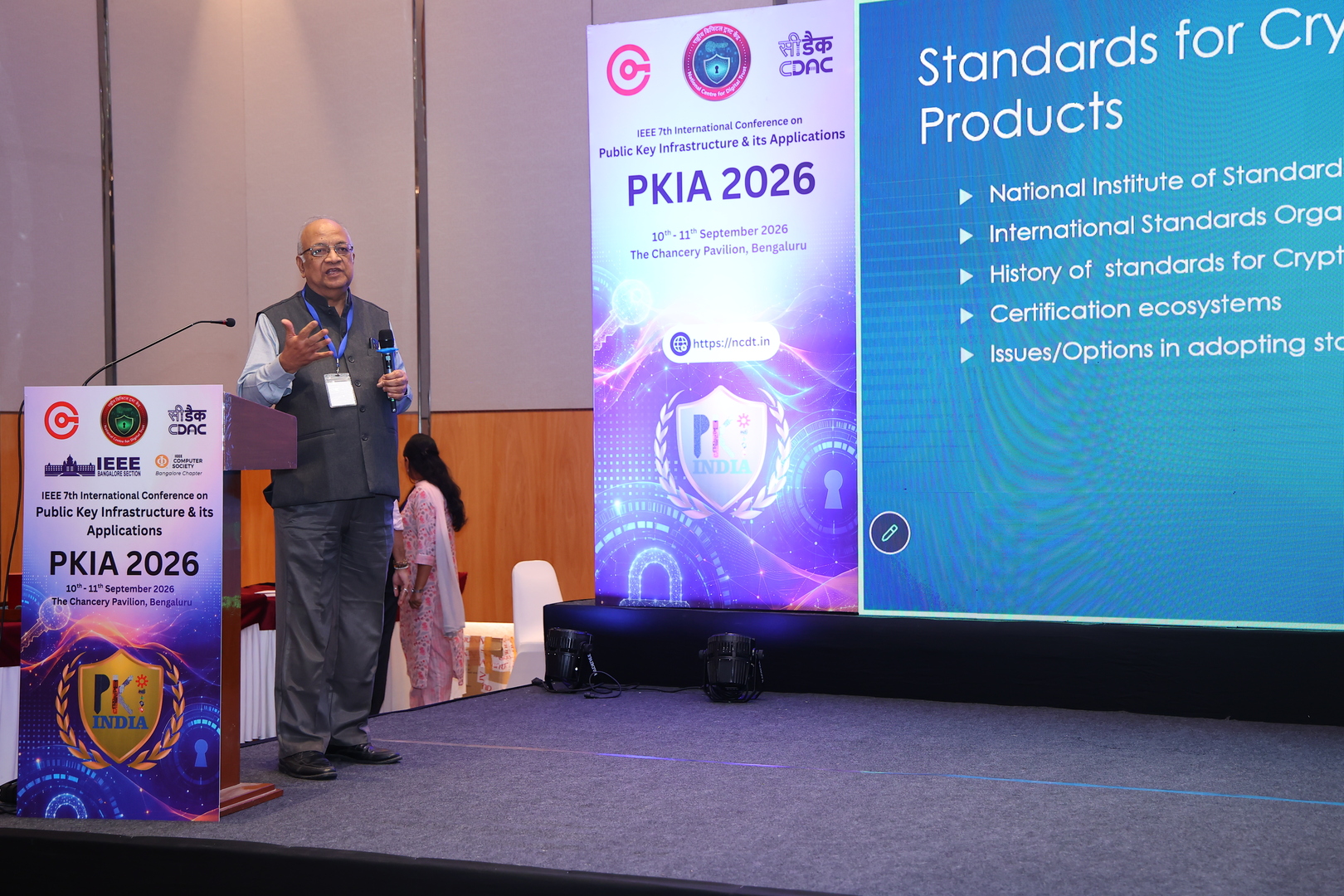
  • Speaker: Dr. S. D. Sudarsan LinkedIn
    Executive Director, C-DAC Bangalore
  • Bio:
    Dr. S. D. Sudarsan is the Executive Director at C-DAC Bangalore since August 2020. He has more than three decades of R&D experience as Researcher and Manager in various domains of ICT. Prior to the current assignment, he served as R&D Manager at ABB, Visiting Scientist at US Food & Drug Administration (FDA), USA, Group Head at the Central Research Laboratory (CRL) of Bharat Electronics Limited (BEL), Scientist at funded R&D institutions. He is an alumnus of BITS, Pilani and University of Arkansas at Little Rock, USA for Masters and PhD respectively. He is actively involved with professional bodies including IEEE, ACM, and IETE. He has contributed to various standard related activities at IEC/ISO/BIS and has served in various committees as well as task forces. He has multiple patents, and research publications in peer-reviewed International Journals and Conferences. His areas of specialization include Wireless Communications, Next Generation Networks, Quantum Computing, Cyber Physical Systems, Cyber Security, Industrial IoT, R&D Management, IPR. He leads the domains including Safety and Mission Critical Systems; Quantum Computing, Cyber Security, IoE, HPC etc. Dr. Sudarsan is an outstanding professional, great mentor, industrious and an altruist.

Introduction to PKIA 2026

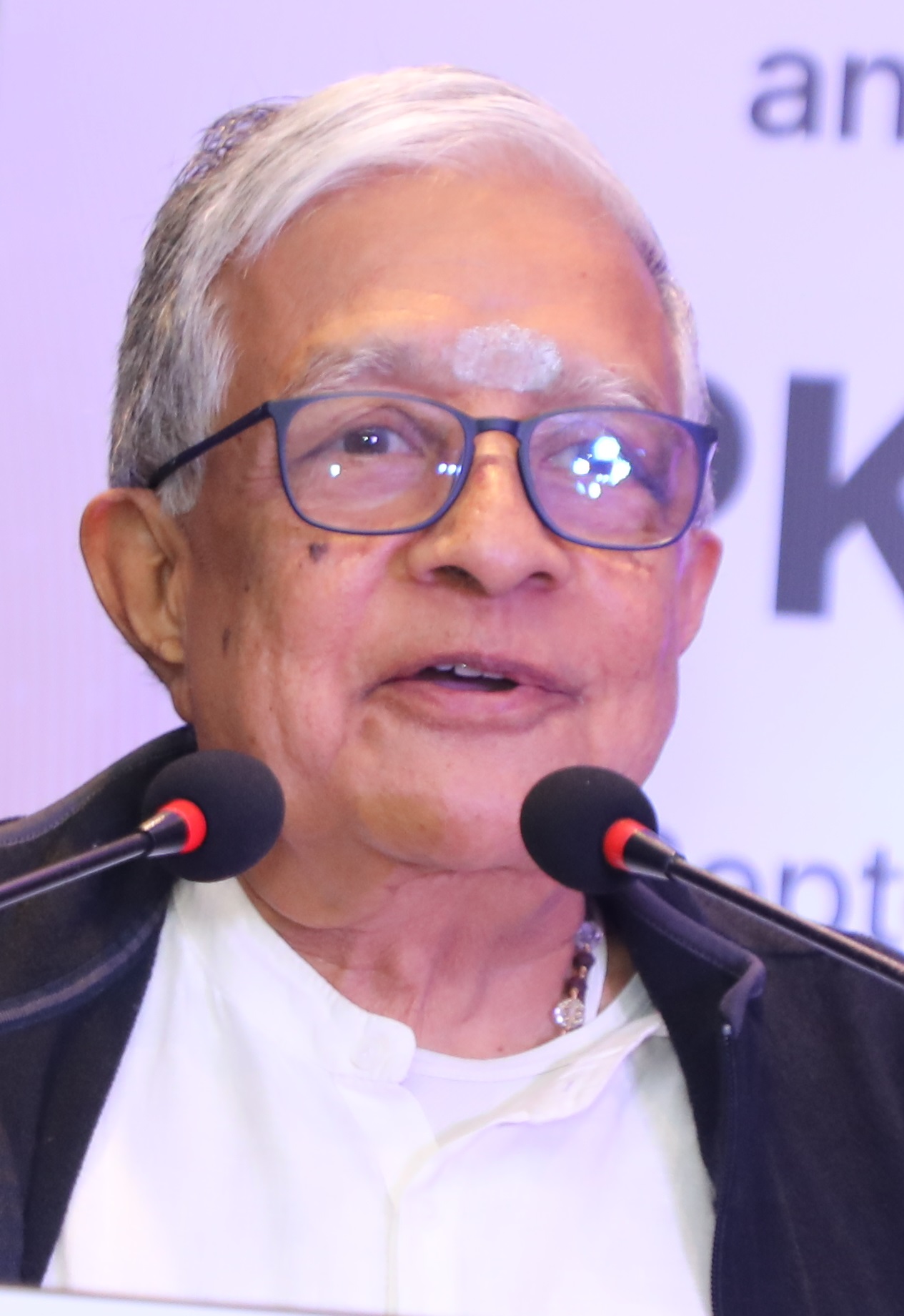
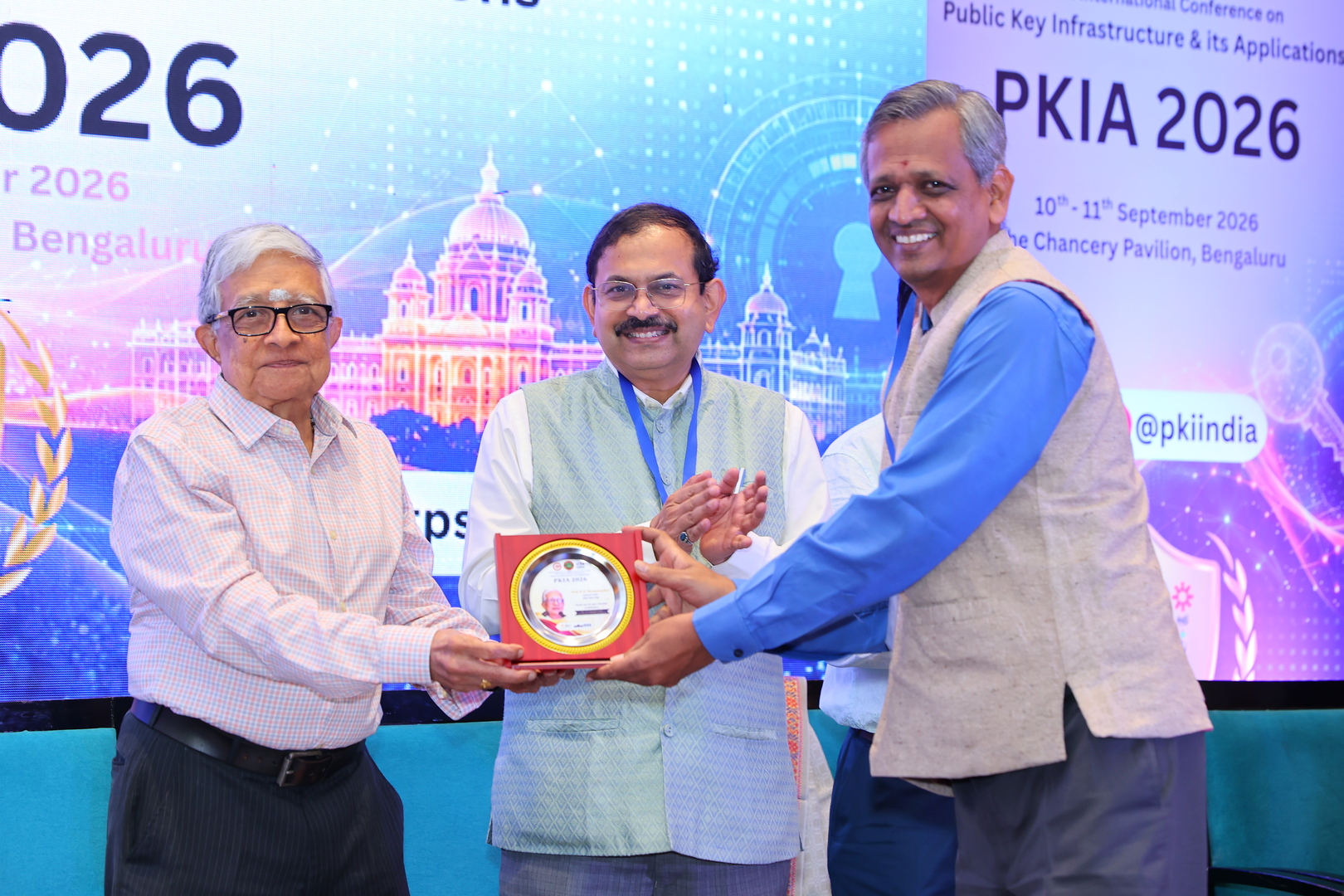
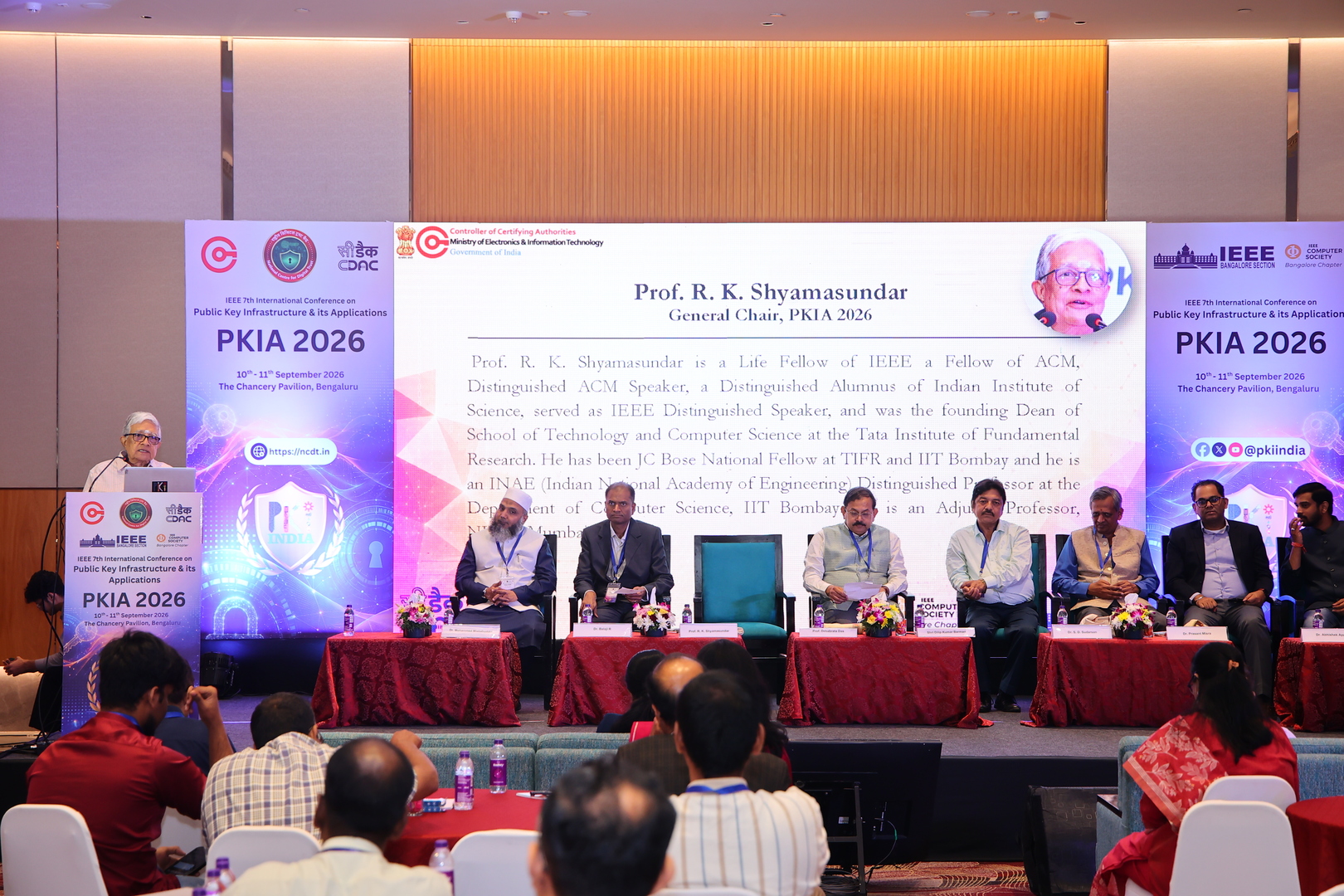
  • Speaker: Prof. R. K. Shyamasundar
    General Chair, PKIA 2026
  • Bio:
    Prof. R. K. Shyamasundar is a Life Fellow of IEEE a Fellow of ACM, Distinguished ACM Speaker, a Distinguished Alumnus of Indian Institute of Science, served as IEEE Distinguished Speaker, and was the founding Dean of School of Technology and Computer Science at the Tata Institute of Fundamental Research. He has been JC Bose National Fellow at TIFR and IIT Bombay and he is an INAE (Indian National Academy of Engineering) Distinguished Professor at the Department of Computer Science, IIT Bombay. He is an Adjunct Professor, NITIE, Mumbai.

Address by General Co-Chair

  • Speaker: Dr. Prasant Misra LinkedIn
    Senior Scientist, TCS Research
  • Bio:
    Dr. Prasant Misra is a TCS Distinguished Senior Scientist in the Data and Decision Sciences division of TCS Research. He also serves as Visiting Faculty in the Department of Cyber Physical Systems at the Indian Institute of Science, Bangalore. His work broadly lies at the intersection of mobility, energy, and intelligent systems. His current research is centered around modeling, optimization and decision intelligence for operations management of urban mobility and infrastructure systems. He has authored several patents, publications, position papers, and editorials spanning CPS/IoT, mobile and network embedded systems, and electric mobility. He has been recognized by numerous awards and honors, including multiple Best Paper & Poster awards. Notable among them include: the TCS Distinguished Scientist in 2026; the IEEE Computer Society Distinguished Contributor in 2025; the MIT Technology Review TR35 India "Top 10 Innovators Under 35" and the TCS Exemplary Contribution Award in 2017; the ERCIM Alain Bensoussan & EU Marie Curie Fellowship in 2012; and the Australian Government's AusAID Australian Leadership Awards Scholarship in 2008. Dr. Misra actively contributes to the broader scientific and professional community through his involvement with a wide range of academic, industry, and government bodies. He has served on the committees of leading professional organizations (viz. IEEE | ACM | COMSNETS Association); government agencies (viz. MeitY); standard development organizations (viz. BIS | ISO/IEC); editorial boards (viz. Elsevier Ad Hoc Networks Journal | IEEE ITS Magazine | IEEE Communication Magazine). He also plays an active advisory role in public technology policy and capacity-building initiatives. He has over 19 years of professional experience. He received his Ph.D. in Computer Science and Engineering from the University of New South Wales (UNSW), Sydney, and completed his Post-doctoral fellowship from RISE SICS Stockholm (formerly the Swedish Institute of Computer Science). He has held research positions at CSIRO Australia and IISc Bangalore; short-term visiting positions at NICTA Australia, TIFR Mumbai, Universiteit Gent, ETH Zurich; and software engineering positions at NTT DATA. He is a senior member of IEEE and ACM. He is an ACM Distinguished Speaker. He currently serves as the 2026 Chair of IEEE Bangalore Section (the State of Karnataka).

Address by General Co-Chair

  • Speaker: Dr. Abhishek Appaji LinkedIn
    Professor, B.M.S. College of Engineering
  • Bio:
    Dr. Abhishek Appaji, a passionate educator and researcher, currently serving as Professor at B.M.S. College of Engineering, Bengaluru. He is also serving as Guest faculty at Maastricht University, the Netherlands. He is a graduate of the Massachusetts Institute of Technology Global Entrepreneurship Bootcamp specializing in new ventures leadership. He obtained his Bachelor of Engineering in Medical Electronics with University Rank from BMSCE, Masters of Technology in Information Technology, and a Masters of Engineering (M.E) in Bioinformatics from University Visvesvaraya College of Engineering, Bengaluru. His Ph.D. was in Mental Health and Neurosciences from Maastricht University, the Netherlands which received the best thesis award and his postdoctoral fellowship from Ohio State University, USA. Abhishek is a Senior Member of IEEE. He has served in various volunteering positions at IEEE. Currently, he is the Treasurer of the IEEE Education Society, and Chair, IEEE Computer Society Bangalore Chapter. He is also in MGA, EAB and Global Conference committees of IEEE. Abhishek has received various grants from Indian agencies like DST, DBT, BIRAC, and from abroad. Abhishek has also worked as a research associate at the Centre for Nanoscience and Engineering (CeNSE), Indian Institute of Science (IISc), Bengaluru. He has a patent granted in Medtech Space. He has more than 100 International/National journal publications and conferences to his credit. He has been a part of more than 200+ Invited expert talks at various conferences, forums, and events. He has renowned laurels including IEEE International Best Paper Award in Malaysia, MGH CamTech Jugadathon Awards, Best Nodal Coordinator award, Gandhian Young Technological Innovation Award 2016 at Rastrapathy Bhavan (President of India House) New Delhi, Elderly care Hackathon (the Netherlands), Winner of Class 5 Massachusetts Institute of Technology (MIT) Global Entrepreneurship Bootcamp, IEEE MGA Young Professional Achievement Award, R10 YP achievement award, DST Inspire Award, IEEE CS Chief of Disruption Award, IEEE SPS Bangalore Outstanding Award, IUCEE TLC Award, IEEE MGA Achievement Award, etc. Recently he was awarded with Theodore W Hissey Young Professionals Award from IEEE Board of Directors. His research interest includes Neuroscience, AI, Deep Learning and Entrepreneurship.

Special Address

  • Speaker: Prof. Debabrata Das LinkedIn
    Director, IIIT-Bangalore (IIIT-B)
  • Bio:
    Prof. Debabrata Das is serving as Director of IIIT-Bangalore (IIIT-B). Before joining IIIT-B in 2002, he had served at G S Sanyal School of Telecommunication at IIT Kharagpur and later at Kirana Networks in New Jersey, USA. He is Project Officer of National Mission for Interdisciplinary Cyber Physical Systems in the areas of Advanced Communication System, from DST, Govt of India. He was PI of multiple sponsored projects from Intel, Hewlett Packard, Microsoft, Motorola Research, Tejas Networks, Nokia, Govt. of India, in the areas of Broadband Wireless MAC/QoS/Energy-saving, and IMS. His main areas of research interest are IoT and Wireless Access Network's MAC, QoS, Power saving. Dr. Das received his Ph.D. degree from the Indian Institute of Technology Kharagpur. He has more than 220 peer reviewed papers in different Transaction/Journals and International Conferences. Dr. Das has received 9 best paper awards. He has 12 US/Indian patents and 10 more are under review. He and his wireless network team had contributed ideas to IEEE Wireless Broadband Standard. He has received Prof. K. Sreenivasan Memorial Award 2017 for excellent teaching and Prof. S V C Aiya Memorial Award 2022 for Research in the areas of Telecommunication and Electronics from IETE. Dr. Das is recipient of IEEE Region-10 Outstanding Volunteer Award 2020, Global IEEE MGA Achievement Award 2012 and Outstanding Volunteer Award IEEE Bangalore Section 2008. He is Fellow-IETE, Fellow-IE and SM-IEEE. He is a Member of National Academy of Science India (NASI). He was Chairman of IEEE India Council for the year 2023 and 2024. He was Chairman of IEEE Bangalore Section 2017. Dr. Das is in Steering, Empower and Technical committees of multiple Departments of Government of India and Government of Karnataka.

Special Address by Patron

  • Speaker: Shri Magesh Ethirajan LinkedIn
    Director General, C-DAC
  • Bio:
    Shri Magesh Ethirajan has taken charge as Director General, C-DAC since April 2022. He is spearheading the National Mission Programs like the National Supercomputing Mission, Digital India RISC-V (DIR-V) and C-DAC Mission Mode Programs in HPC, AI, Cyber Security, Quantum Computing and Next Generation Computing. Since June 2023, he is also assigned with the Additional Charge as Director General, Centre for Materials for Electronics Technology (C-MET). Under his leadership, C-MET is continuing to develop leapfrogging electronic materials technologies such as Compound semiconductors for high power devices, ultra high purity materials for National Semiconductor Mission, Quantum & 2D materials, resource efficiency and circular economy through e-waste recycling, niche ceramic and composite materials for 5G & 6G communications etc. Prior to this Shri Magesh was heading C-DAC Thiruvananthapuram Centre as Executive Director, C-DAC Hyderabad Centre as Director and has also served as Vice President of MNC. Shri Magesh has more than 29 years of diversified experience ranging from Design Engineering, Project Management and delivery of turnkey projects. He has in depth expertise in Electronics and CHIP design, VLSI, Hardware, IP, Complete Product Cycle. He was also responsible for SOC integration, front end to backend, tape-out and silicon validation, interfacing with various functional groups to deliver tested products and managed various ASIC tape-out for customers. Leveraging three decades of his technology expertise, Shri Magesh has significantly contributed towards end-to-end mission planning of national importance, design, integration and analysis. His innovative contributions, particularly the strategies adopted in R&D towards realising 25 Plus ASIC/CHIP, C-DAC's indigenous series 32/64 bit RISCV based of Processor called VEGA, and SOC's called THEJAS under National Microprocessor Development Program, development of 20 Petaflops Supercomputing Facility with indigenous 'RUDRA Server Board', TRINETRA High Speed Interconnect, designing and making our own 'RISC-V based Chip' and 96 core ARM 64bit Processor in 5 nano meter for India first HPC SOC towards Exa-scale computing to 'HPC Storage' to 'HPC-AI Converged Solutions for high level projects of national importance like Safe City including ERSS and Smart Cities, Integrated Cyber Physical Systems, AI based Anomaly Detection for Cyber Security, establishing first of its kind AI Specific National Critical Cloud Infrastructure, HPC-AI Converged Processor has put a good foundation for launch of various indigenous products and solutions making our country self-reliant and in line with the goals of AatmaNirbhar Bharat and Digital India. His visionary approach in conceptualizing ideas in Quantum Technologies is helping to establish a Quantum Computer. This shall enable develop applications to solve grand challenges and societal problems having economic impact leveraging cutting edge scientific research for India's sustainable development.

Special Address by Patron

  • Speaker: Dr. Sanjay Bahl LinkedIn
    Controller of Certifying Authorities and Director General, CERT-In
  • Bio:
    Dr. Sanjay Bahl is currently Controller of Certifying Authorities and Director General, CERT-In. He has been providing consultancy in the areas of governance, risk, compliance, security, privacy, forensics, investigation and fraud management to national level projects in India. Prior to CERT-In, he was the chief security officer for Microsoft Corporation in India where he was responsible for interaction with the government, academia, key strategic accounts and the CXO community with respect to Microsoft's security policy. Prior to joining Microsoft, Dr. Bahl was the global CSO of TCS where he established an enterprise-wide converged security environment and effectively addressed risk management and security across the organization worldwide. He has also worked with academic and professional communities as well as government groups to enhance their awareness of comprehensive security models. He has been in the IT industry since 1984 with experience in various areas.Dr. Bahl is and has been a member of various security committees at national and international level.

Vote of Thanks

  • Speaker: Dr. Balaji R. LinkedIn
    Scientist 'F', C-DAC Bengaluru
  • Bio:
    Dr. Balaji Rajendran is a Scientist 'F' and heads the Resilient Information Systems and Engineering (RISE) Group at C-DAC Bangalore. With over 24 years of pioneering R&D experience, he has been instrumental in shaping digital trust and cybersecurity ecosystem through national initiatives, international collaborations, and indigenous technology development. He has played a pivotal role in proliferating Digital Signatures across the country through lectures, capacity building, and interactive content development. He established Asia's first Centre of Excellence in DNS Security with support from the government and industry and continues to drive mission-critical programs that strengthen the nation's cyber resilience. He is leading the National Centre for Digital Trust (NCDT), a pioneering initiative aimed at creating the next generation of digital trust frameworks and technologies for the systems and services that surround our everyday lives.

High Tea and Exhibition Inaugural (11:00 - 11:30)

Invited Talk - 1 (11:30 - 12:15)

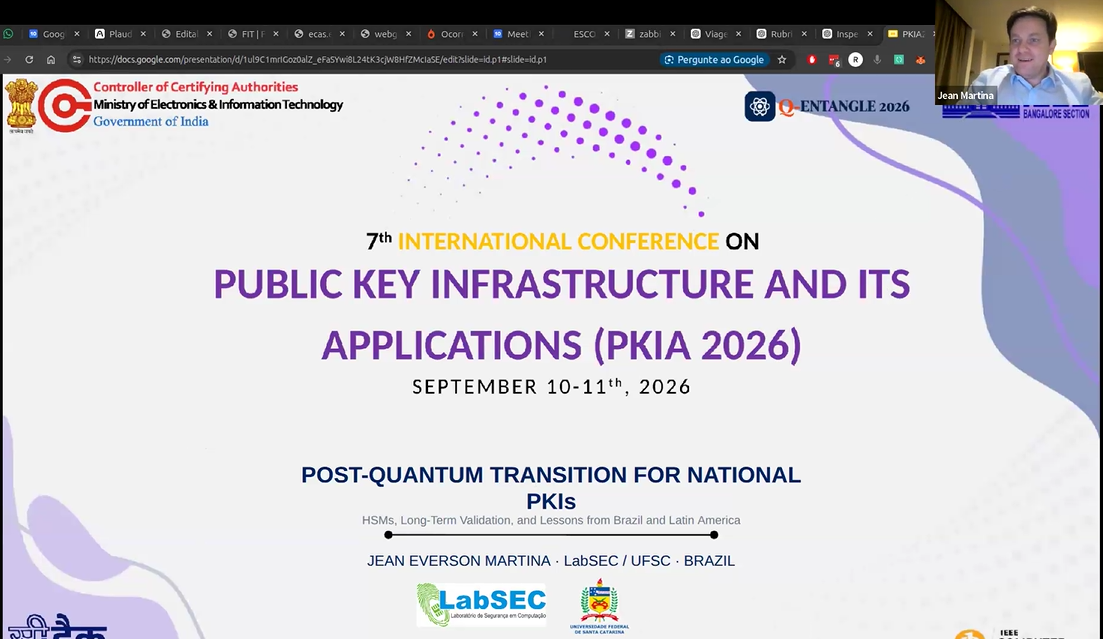
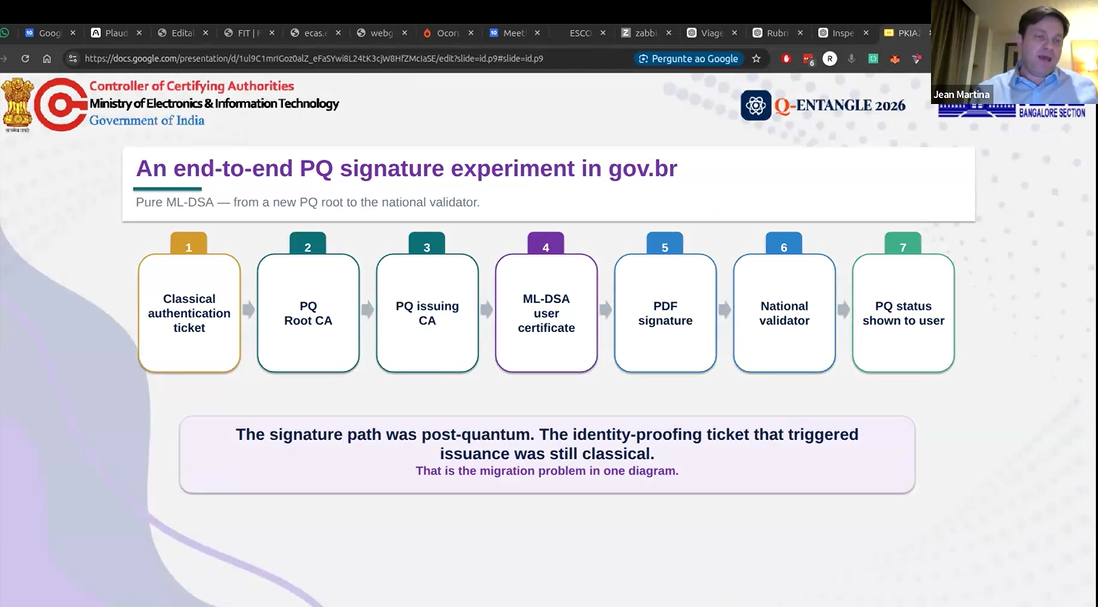
  • Title: Post-Quantum Transition for National PKIs: HSMs, Long-Term Validation, and Lessons from Brazil and Latin America
  • Speaker: Jean Everson Martina LinkedIn
    Prof. Computer Science, Federal University of Santa Catarina, Brazil
  • Bio:
    Jean Everson Martina is a Professor of Computer Science at the Federal University of Santa Catarina, Brazil, and a researcher at the Computer Security Laboratory, LabSEC. His work focuses on applied cryptography, digital trust infrastructures, public key infrastructure, electronic signatures, digital identity, verifiable credentials, blockchain, long-term validation, and post-quantum cryptography. He has contributed to several Brazilian national initiatives involving digital signatures, digital documents, trust services, and government digital infrastructures, working in cooperation with public institutions and industry. He also participates in international cooperation and standardization activities related to digital trust and cross-border interoperability.

Invited Talk - 2 (12:15 - 12:45)

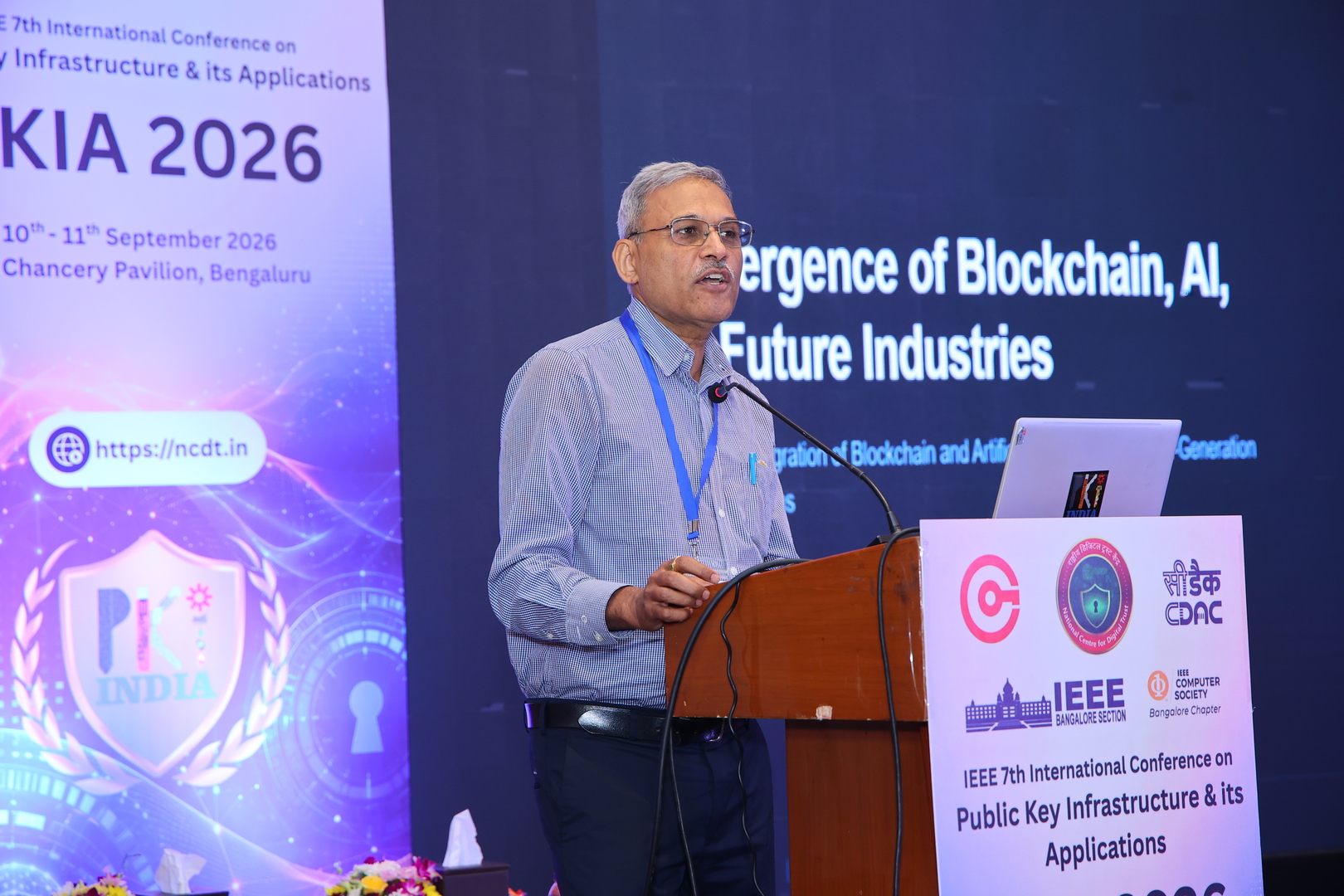
  • Title: Convergence of Blockchain, AI, and Future Industries
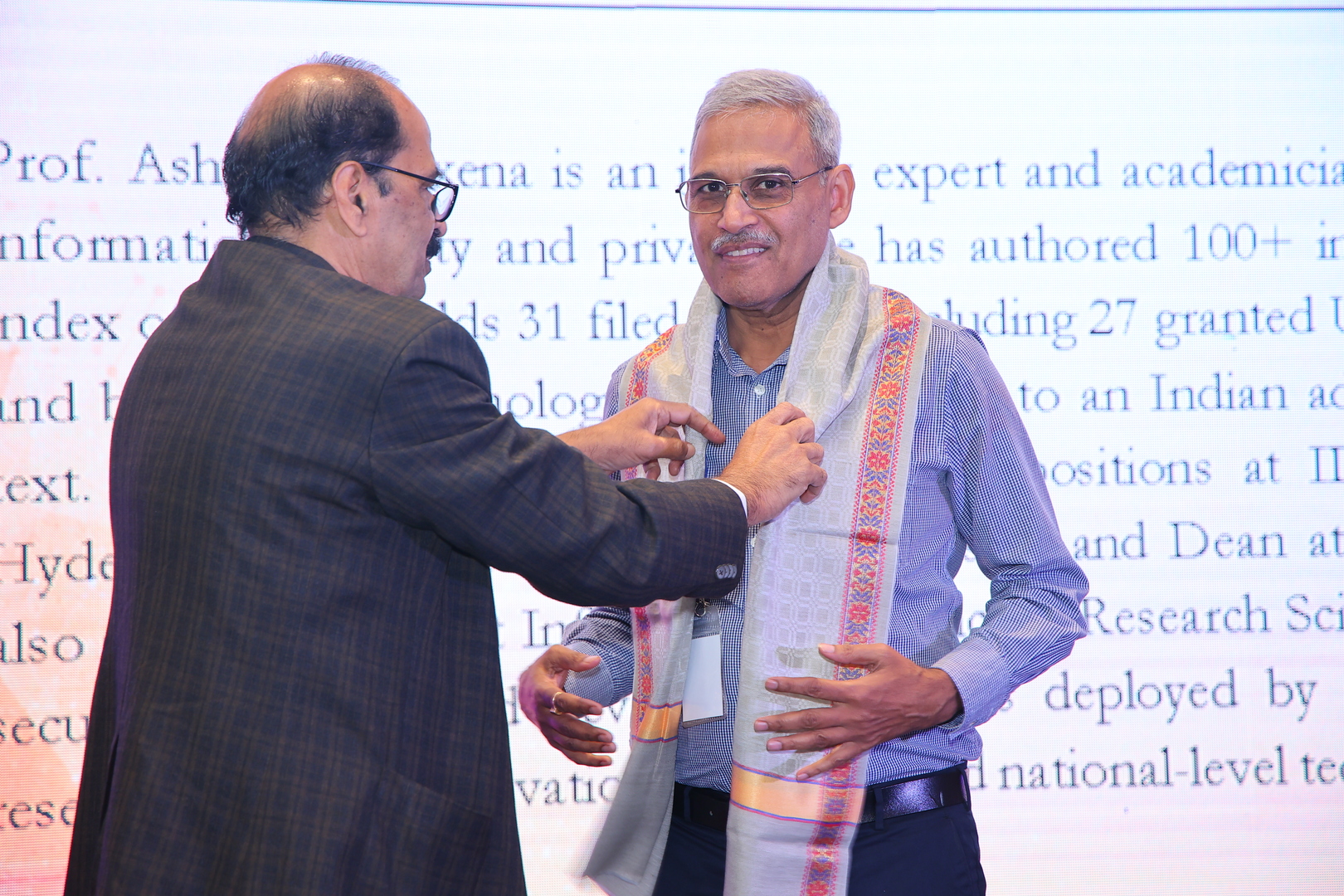
  • Speaker: Prof. Ashutosh Saxena
    Prof and Dean, CMR Technical Campus, Hyderabad
  • Bio:
    Prof. Ashutosh Saxena (PhD 1997 in AI from DAVV title: Utility of Genetic Algorithm and Neural Network for Cell Placement-A Special Case for VLSI Standard Cell Placement) is an industry expert and academician with over two decades of experience, 100+ international publications with Scopus h-index of 17, along with 31 filled patents out of which 27 are now US granted patents. Authored two books, one on “PKI: Concept, Design and Deployment” (Tata McGraw Hill Publications 2004) and second on “Blockchain Technology: Concepts and Applications”, (Wiley Publications 2020). He also had a credit to adapt one book titled “Information Security: Principles and Practice, An Indian Adaptation by Mark Stamp; (Wiley Publications 2023). His research interest is in the areas of information security and privacy. Worked as Associate Professor at the IDRBT (established by Reserve Bank of India), Hyderabad, (1998-2006) on many national level projects. Joined Infosys (2006-16) and worked as Principal Research Scientist & Associate Vice President, at Infosys Labs, Hyderabad where he led security research as part of the Security Center of Excellence, Infosys Center for Advanced Technologies, conceived security solutions that have already been deployed to many clients. He has been a member of the review board for many international journals, conferences and committees. He also served as Adjunct Faculty at NIT Warangal for one year, worked as Professor (CS) at CRRAO-AIMSCS, University of Hyderabad Campus, Hyderabad, and now as Prof and Dean CMR Technical Campus, Hyderabad.

  • Abstract:
    As digital transformation accelerates, individual technologies are hitting structural boundaries: Artificial Intelligence faces data privacy and monopolisation crises, while Blockchain seeks scalable, real-world utility beyond speculation. This talk tries to explore the cutting-edge convergence of these two paradigm-shifting technologies and their combined impact on legacy industries. We will examine how decentralized architecture provides an immutable layer of truth for AI models—ensuring data provenance, securing decentralized infrastructure, and enabling autonomous AI agents to conduct secure economic transactions via smart contracts. Attendees will discover how this technical synergy is creating privacy-preserving diagnostic tools in healthcare, streamlining autonomous supply chain logistics, and democratising real estate through algorithmic tokenization.

Invited Talk - 3 (12:45 - 13:15)

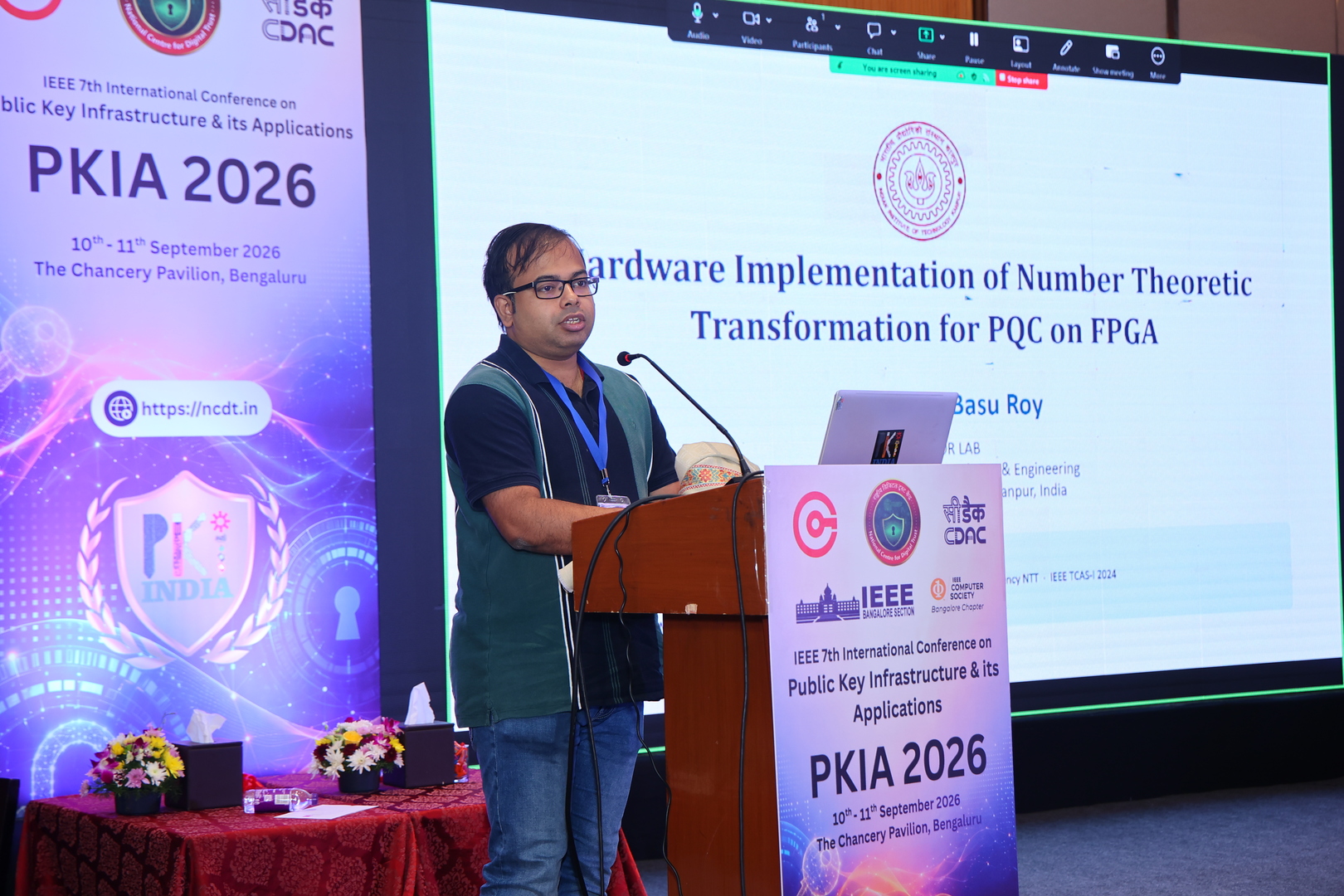
  • Title: Hardware implementation of Number Theoretic Transformation for PQC on FPGA
  • Speaker: Dr. Debapriya Basu Roy LinkedIn
    Assistant Professor at CSE, IIT Kanpur
  • Bio:
    Dr. Debapriya Basu Roy received his PhD degree from IIT Kharagpur and was a post-doctoral fellow with the Technical University of Munich. He is currently an Assistant Professor with the Department of Computer Science and Engineering, Indian Institute of Technology Kanpur. His research interests include applied cryptography, hardware security, post-quantum cryptography, side channel analysis and digital VLSI. Some of his notable contributions in the domain of hardware security are efficient implementation of elliptic curve cryptography, side-channel leakage quantification and implementation of post-quantum cryptography on FPGAs.

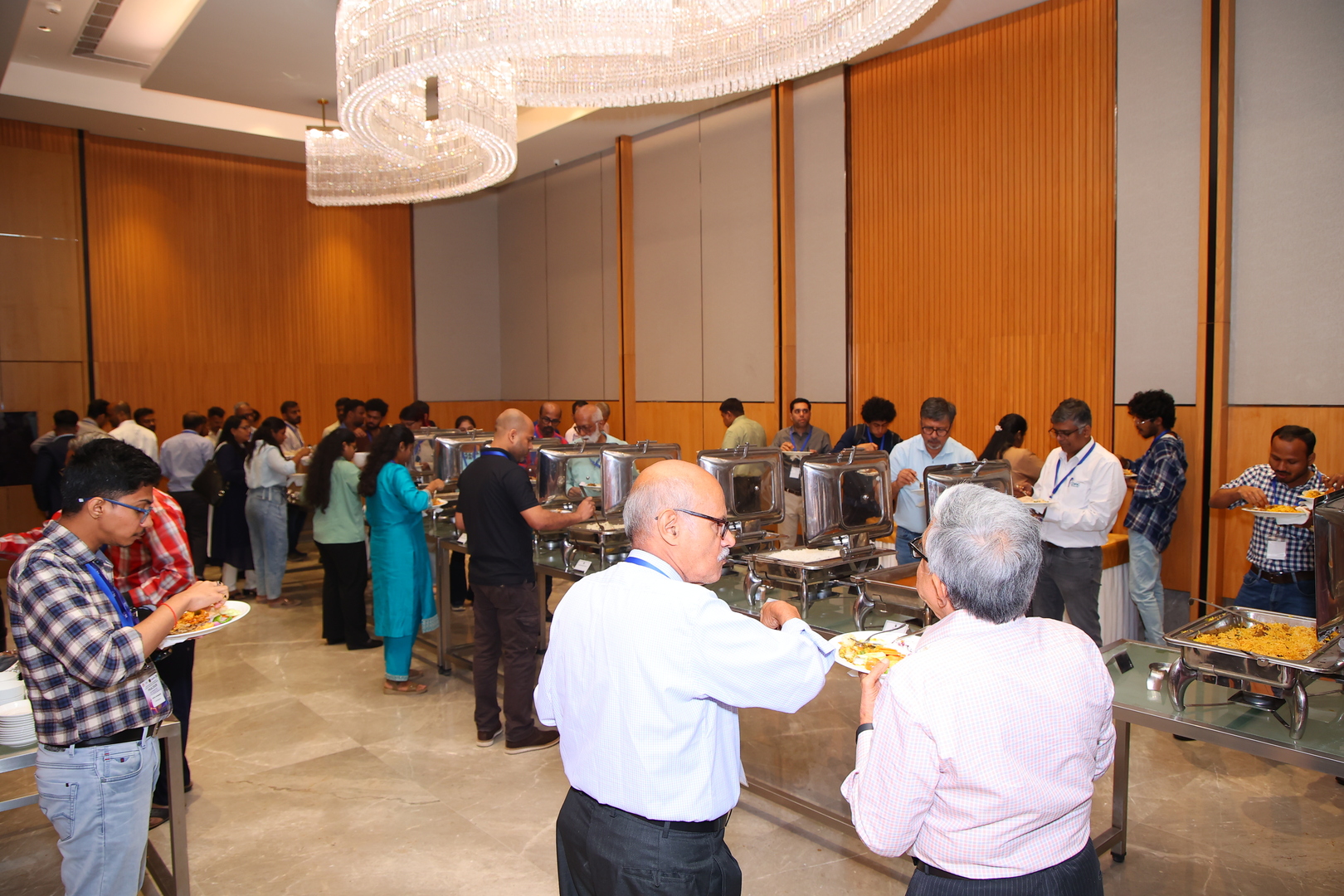
Lunch and Visit to Exhibition Stall (13:15 - 14:30)

Invited Talk - 4 (14:30 - 15:00)

  • Title: Isogeny-based cryptography made easy
  • Speaker: Dr. Sikhar Patranabis LinkedIn
    Staff research scientist at IBM Research
  • Bio:
    Sikhar Patranabis is a cryptographer and a staff research scientist at IBM Research India. He is a member of the Foundational Cryptography group within IBM Research. His research interests are in theoretical and applied cryptography, with a recent focus on quantum-safe cryptography and succinctly verifiable, privacy-enhancing cryptographic techniques. Prior to joining IBM, he was a staff researcher at VISA Research USA and a postdoctoral researcher at ETH Zurich, Switzerland. He received his B.Tech and PhD from IIT Kharagpur. His research has appeared at reputed crypto/security venues, such as the Journal of Cryptology (JoC), Crypto, Eurocrypt, Asiacrypt, IEEE S&P, ACM CCS, USENIX Security, NDSS, etc. He is a young associate of the Indian Academy of Sciences (IASc) and the Indian National Academy of Engineering (INAE). His research has been recognized by an IACR best early-career paper award at ASIACRYPT 2022, an IBM PhD fellowship, and a Qualcomm Research Innovation Fellowship. He has served on multiple program committees and editorial boards of top conferences and journals in crypto/security. He is also actively involved in various outreach activities organized by ACM India.

  • Abstract:
    Isogenies have emerged as a viable alternative to lattices for post-quantum cryptography over the past 20 years. However, due to the uniquely complex underlying mathematical features and security/efficiency properties, the landscape of isogeny-based cryptography has remained somewhat limited and inaccessible to the wider cryptographic community. Additionally, building new cryptographic applications from isogenies has been a potentially tedious and time-consuming task. In this talk, he will present an overview of two frameworks for isogeny-based cryptography, namely “cryptographic group actions” and “cryptographic forensic categories”. These frameworks enable viewing isogeny-based cryptography through the lens of abstract and easy-to-understand algebraic structures combined with simple cryptographic hardness assumptions. He will showcase some applications of these frameworks in: (i) enabling simplified expositions of well-known cryptographic constructions from isogenies (e.g., CSIDH-based public-key encryption and the SQIsign family of digital signatures), and (ii) realizing new (plausibly) post-quantum instances of advanced cryptographic primitives from isogenies. He hope to demonstrate the simplicity and usability of these frameworks for isogeny non-experts. Along the way, He will also talk about some hard problems that form the basis of isogeny-based cryptography, and their classical/quantum hardness as of today. No prior background in either cryptography or quantum computing will be necessary to follow the talk.

Invited Talk - 5 (15:00 - 15:30)

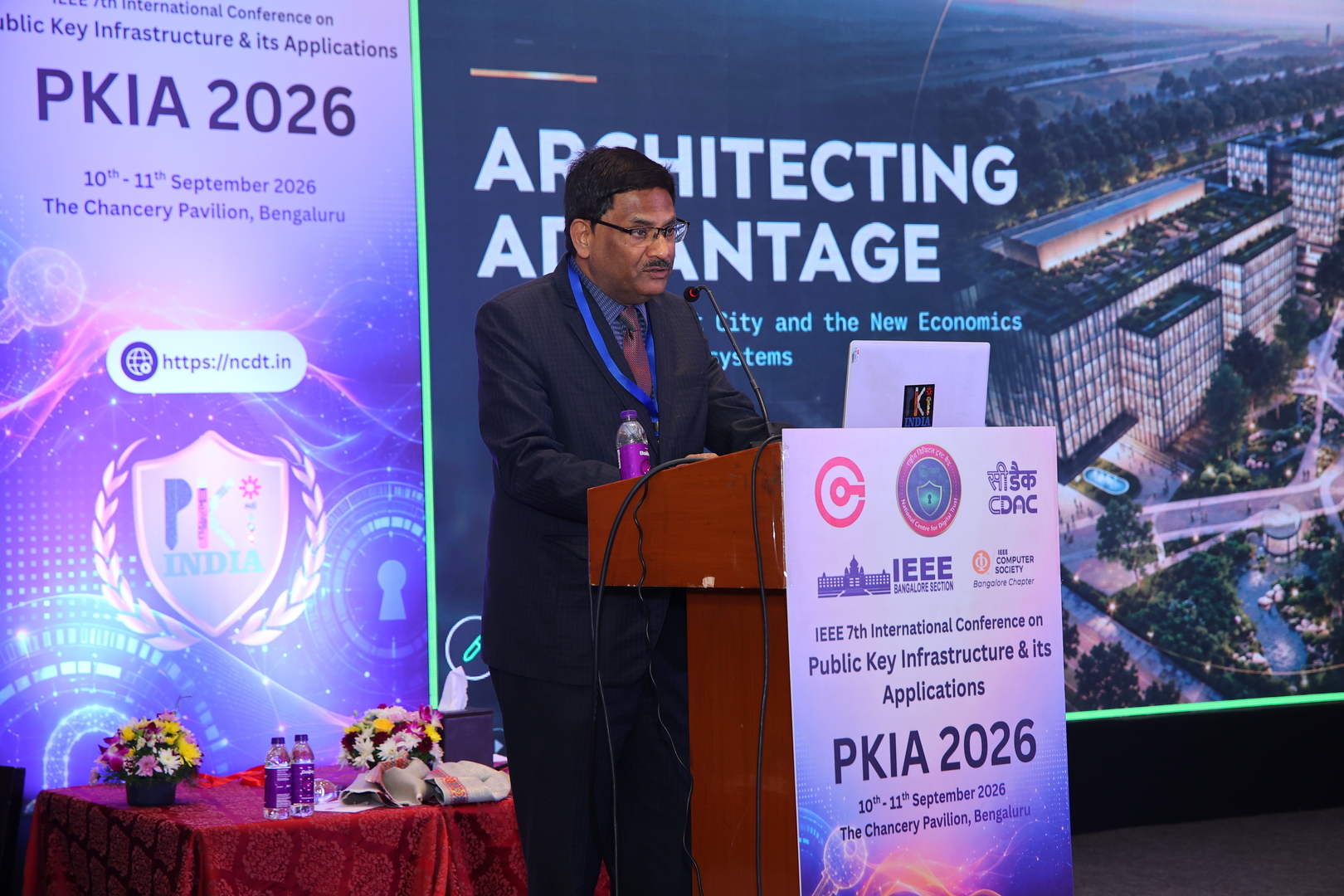
  • Title: Architecting Advantage - Bengaluru Airport City and the New Economics of India's GCC Ecosystems
  • Speaker: Rao Munukutla
    Executive Director & Chief Executive Officer, Bengaluru Airport City Limited - BACL
  • Bio:
    As the Executive Director and Chief Executive Officer, Rao Munukutla is responsible for developing the Airport City for BIAL, whose majority shareholder (74%) is the Fairfax Group, Canada. Bengaluru Airport City is being developed to standards that will be unprecedented, a futuristic city where Innovation happens 24/7 and that will be a test bed for 'Global Urban Solutions'. It is planned as Sustainable, Smart & Vibrant city celebrating a culture of innovation. In a career spanning over three decades, Rao has handled leadership roles in the infrastructure space and delivered various multi-billion-dollar projects in Singapore, Indonesia, Malaysia, India, Australia and Myanmar. These include massive Bintan Beach International Resort Project in Indonesia, a G-to-G collaboration between Indonesia and Singapore. During his previous stint in India, Rao led the operations of Jurong International as CEO of JTCi India, a wholly owned subsidiary of JTC Corp Singapore. Rao is a recipient of the National Science & Technology Board (NSTB) Gold Medal in Singapore.

Tea Break and Stall Visit (15:30 - 15:45)

Paper Presentation Session 1 (15:45 - 16:45)

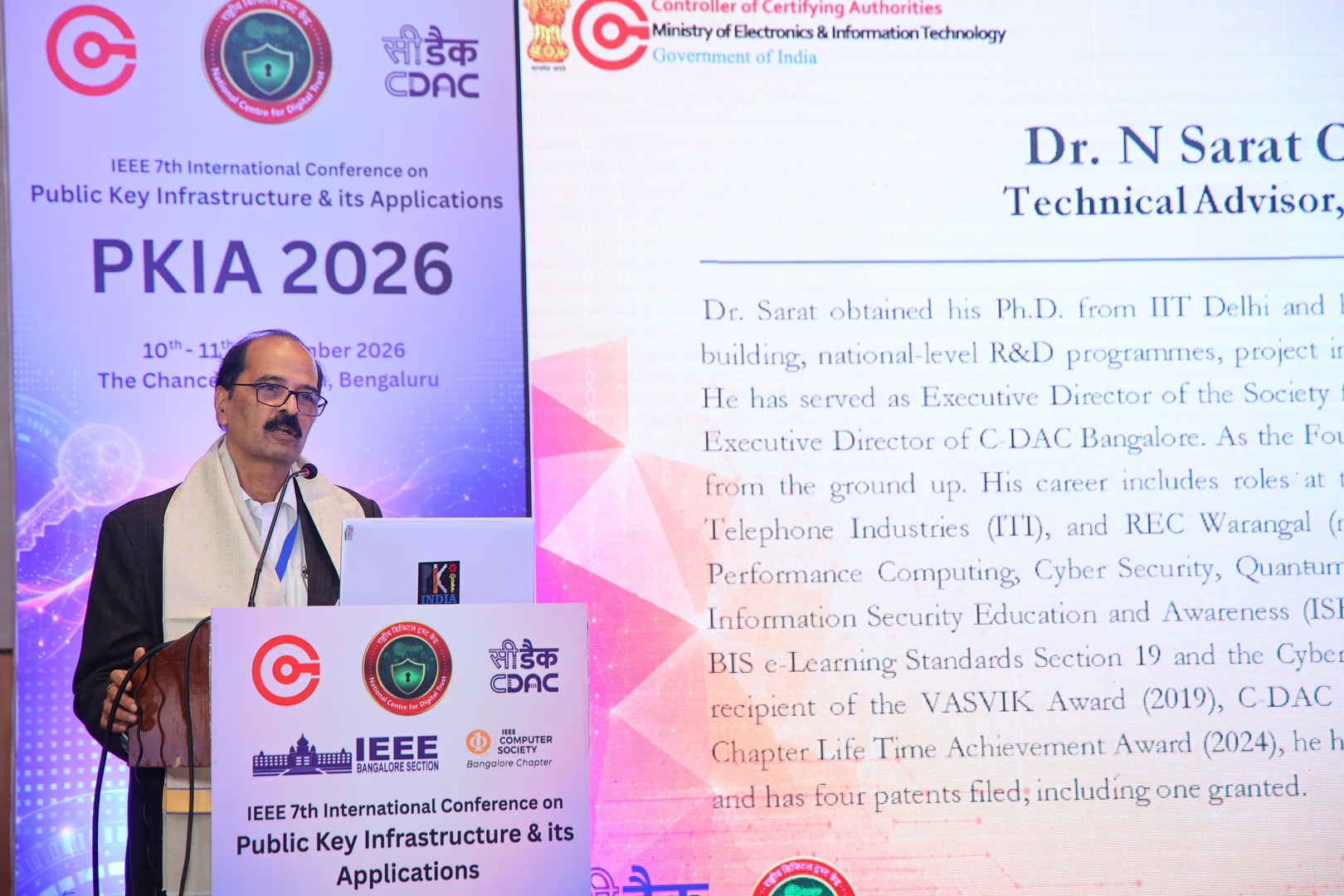
  • Session Chair: Dr. N Sarat Chandra Babu LinkedIn
    Technical Advisor, C-DAC Bangalore
  • Bio:
    Dr. Sarat obtained his Ph.D. from IIT Delhi and has over four and a half decades of experience in institution building, national-level R&D programmes, project implementation, education and training, and industry guidance. He has served as Executive Director of the Society for Electronic Transactions and Security (SETS), Chennai, and Executive Director of C-DAC Bangalore. As the Founder Director of C-DAC Hyderabad, he established the centre from the ground up. His career includes roles at the Department of Electronics, Government of India, Indian Telephone Industries (ITI), and REC Warangal (now NIT Warangal). He has led national initiatives in High Performance Computing, Cyber Security, Quantum Security, IoT, and e-Learning, and played a key role in the Information Security Education and Awareness (ISEA) programme of MeitY. Dr. Sarat serves as Chairman of the BIS e-Learning Standards Section 19 and the Cyber Security Working Group of Broadband India Forum (BIF). A recipient of the VASVIK Award (2019), C-DAC Leadership Award, and the IEEE Computer Society Chennai Chapter Life Time Achievement Award (2024), he has authored around 84 publications, guided three Ph.D. scholars, and has four patents filed, including one granted.
Dr. N Sarat Chandra Babu
  • Papers
    • 15:45 - 16:00
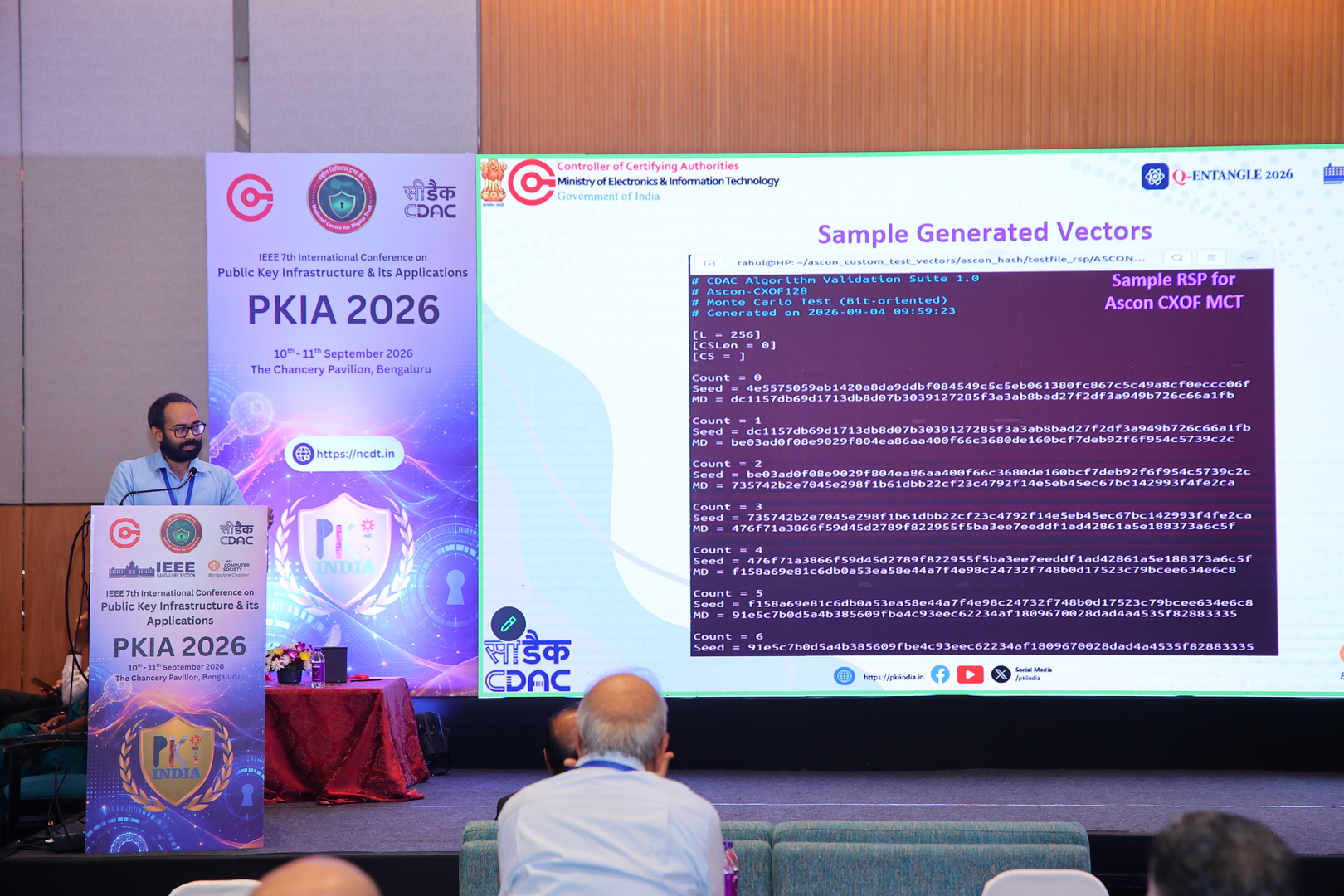
      Title: A NIST SP 800-232 Compliant Validation Suite for Unified ASCON Test Vector Generator
      Author: Abey Jacob

    • 16:00 - 16:15
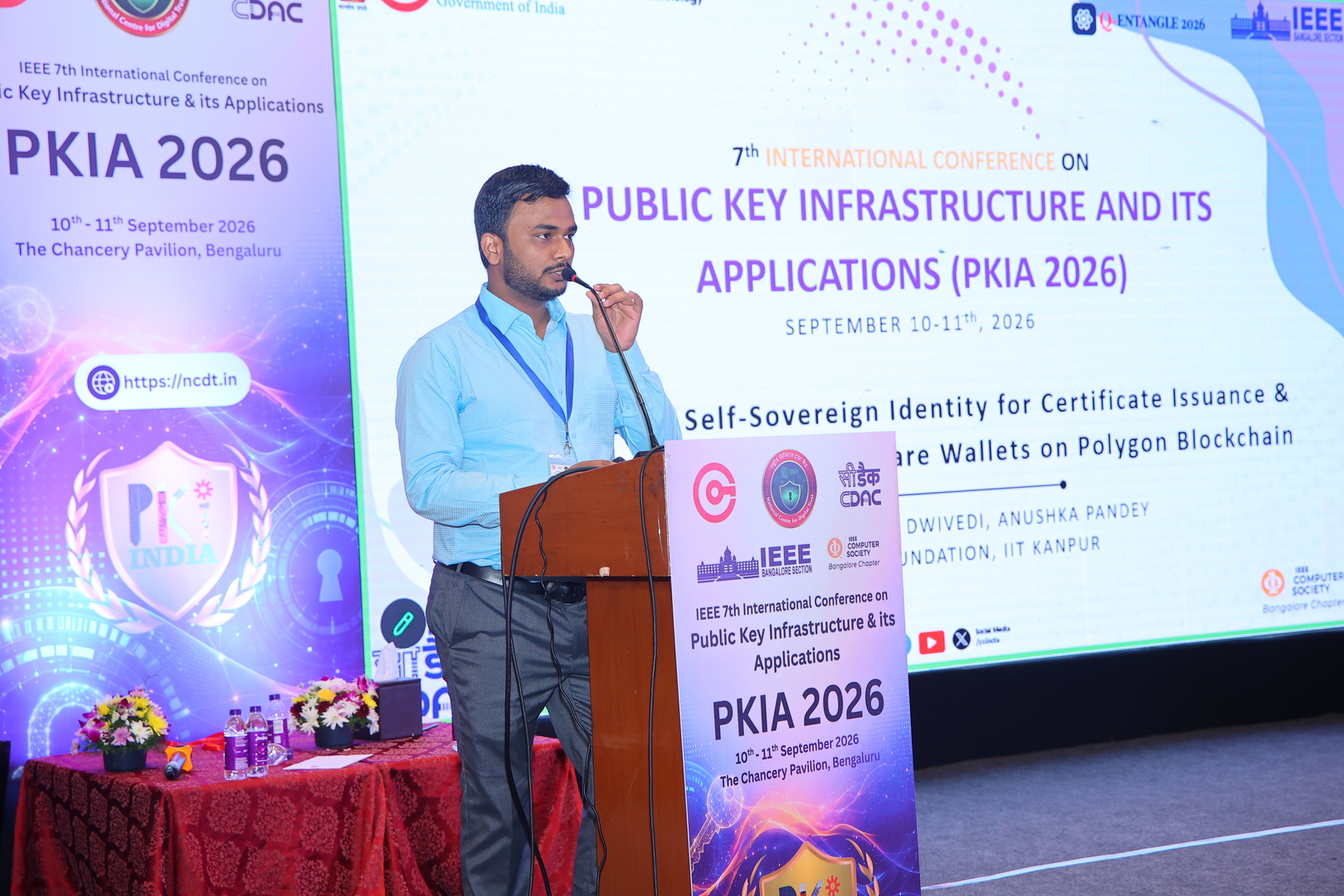
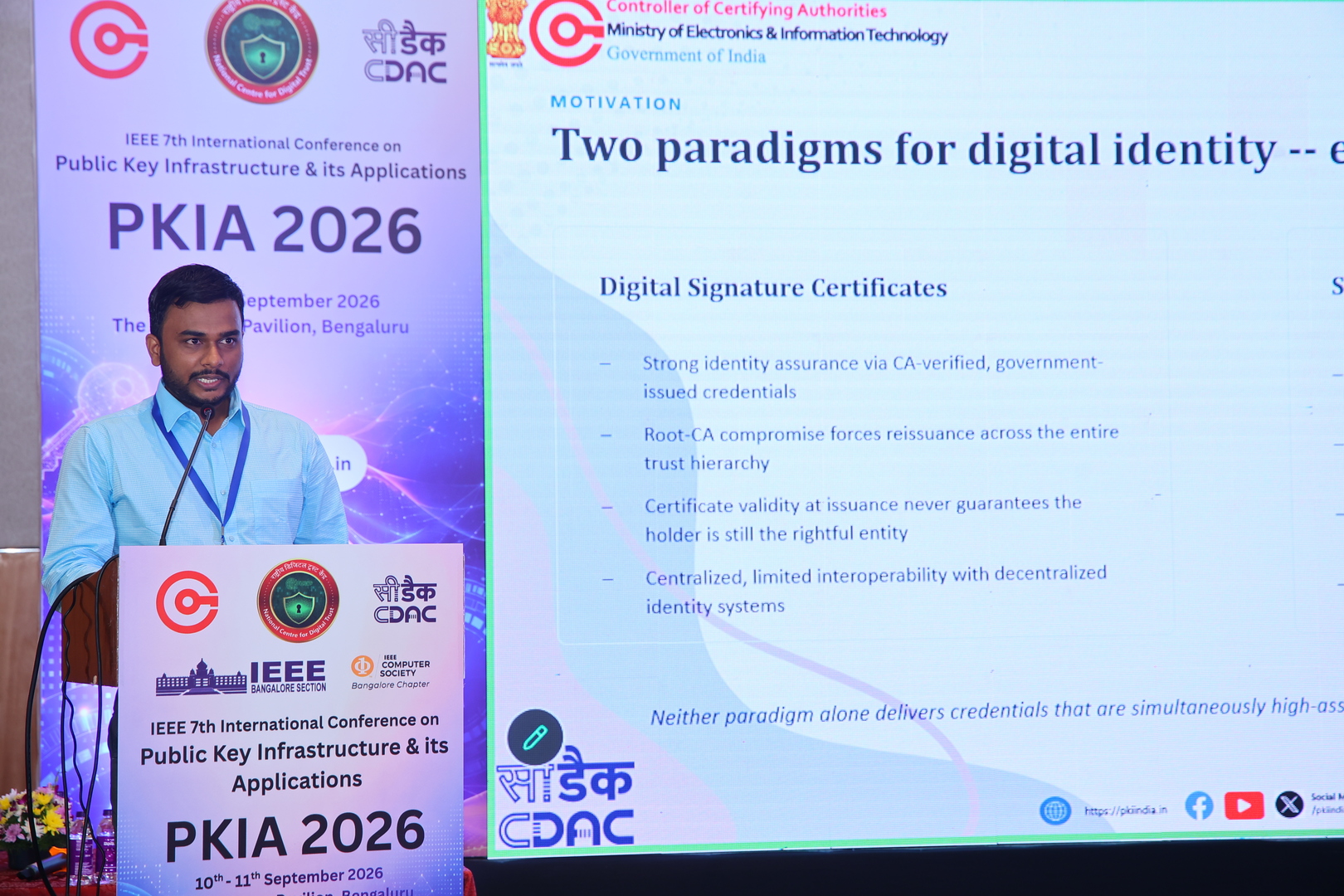
      Title: PKI-Anchored Self-Sovereign Identity for Certificate Issuance and Verification Using DSC Hardware Wallets on Polygon Blockchain
      Authors: Shrawan Kumar, Ras Dwivedi and Anushka Pandey

    • 16:15 - 16:30
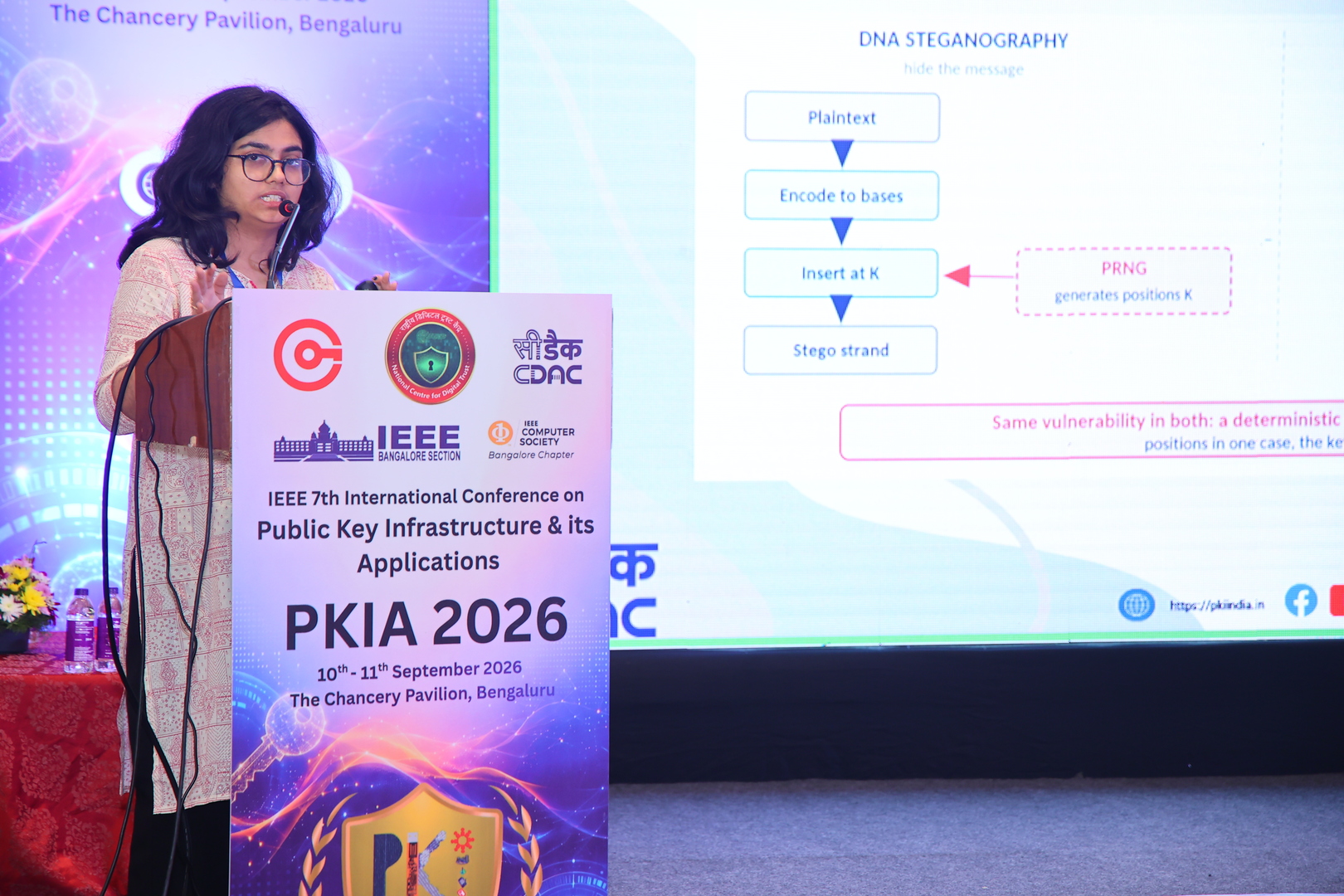
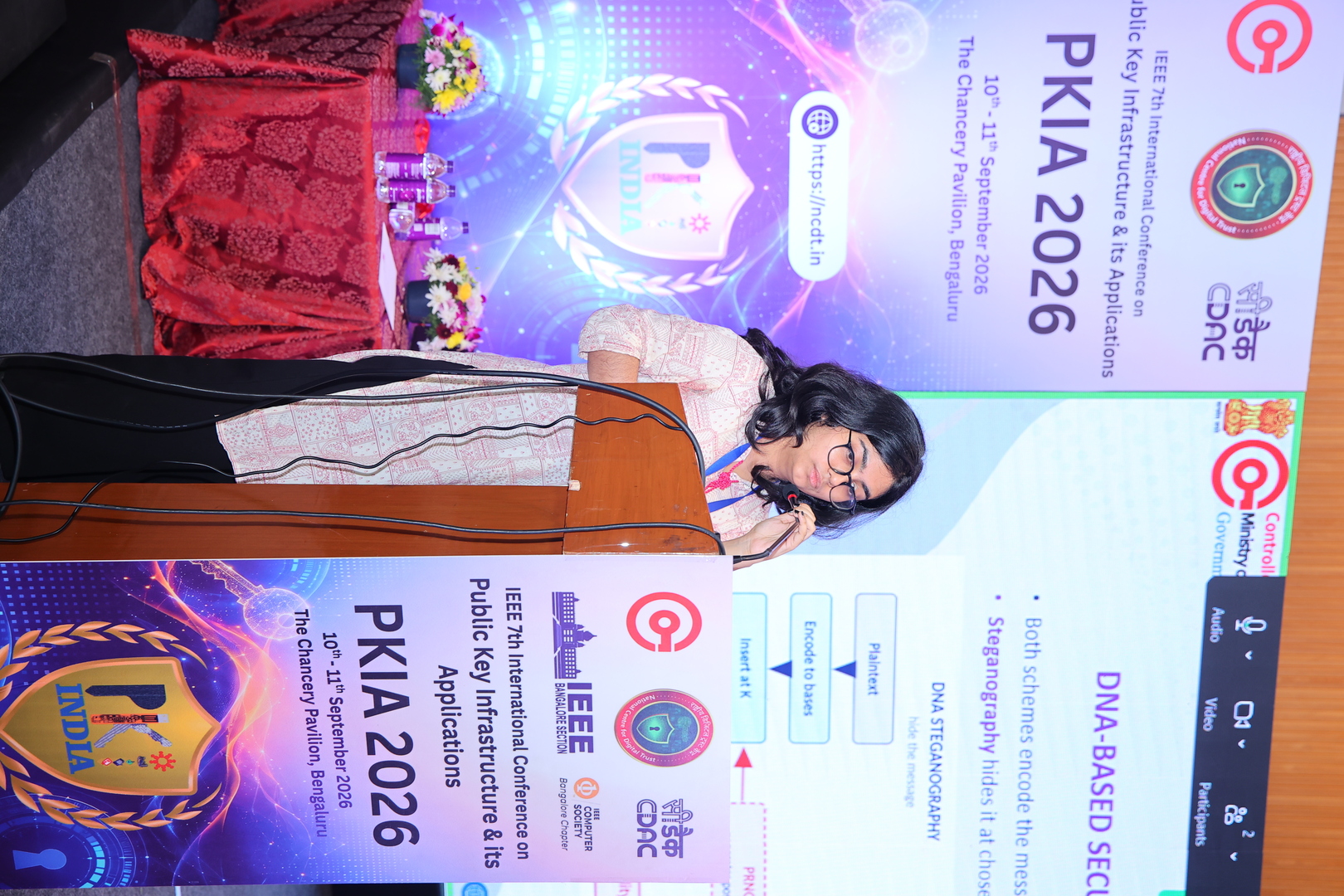
      Title: A Quantum Attack Pipeline on DNA-based Encryption: PRNG Vulnerabilities and QRNG based Defenses
      Author: Anjali Tiwari

    • 16:30 - 16:45
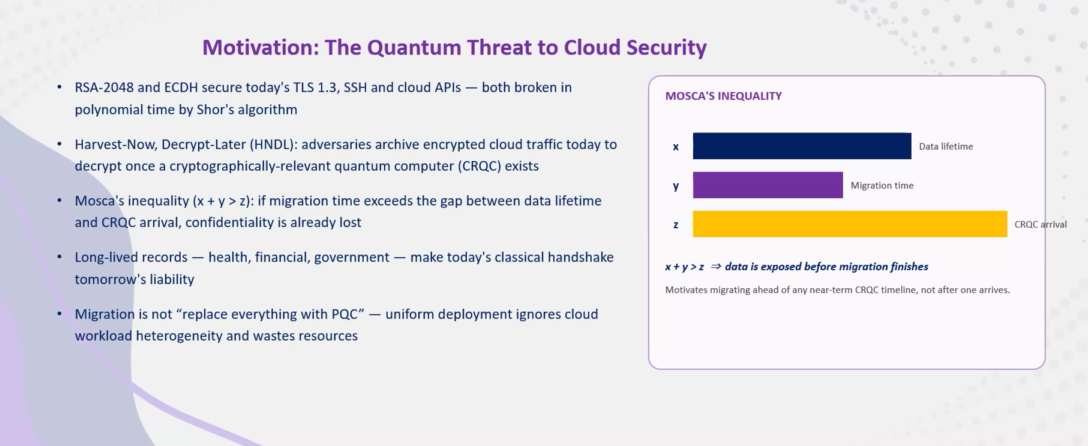
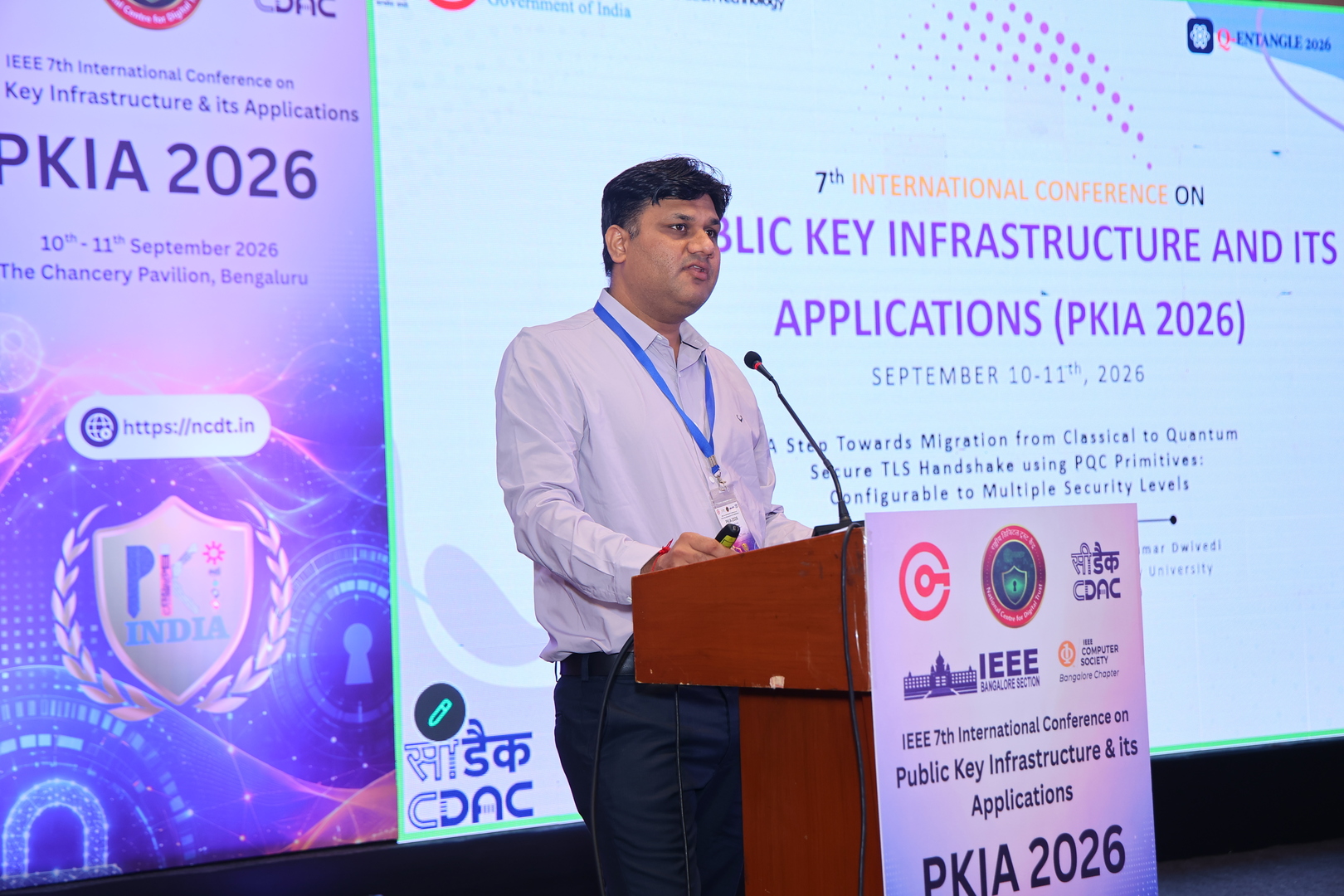
      Title: A Step Towards Migration from Classical to Quantum Secure TLS Handshake using PQC Primitives: Configurable to Multiple Security Levels
      Authors: Yagna Patel, Utkarsh Tiwari and Sanjeev Dwivedi

Invited Talk - 6 (16:45 - 17:15)

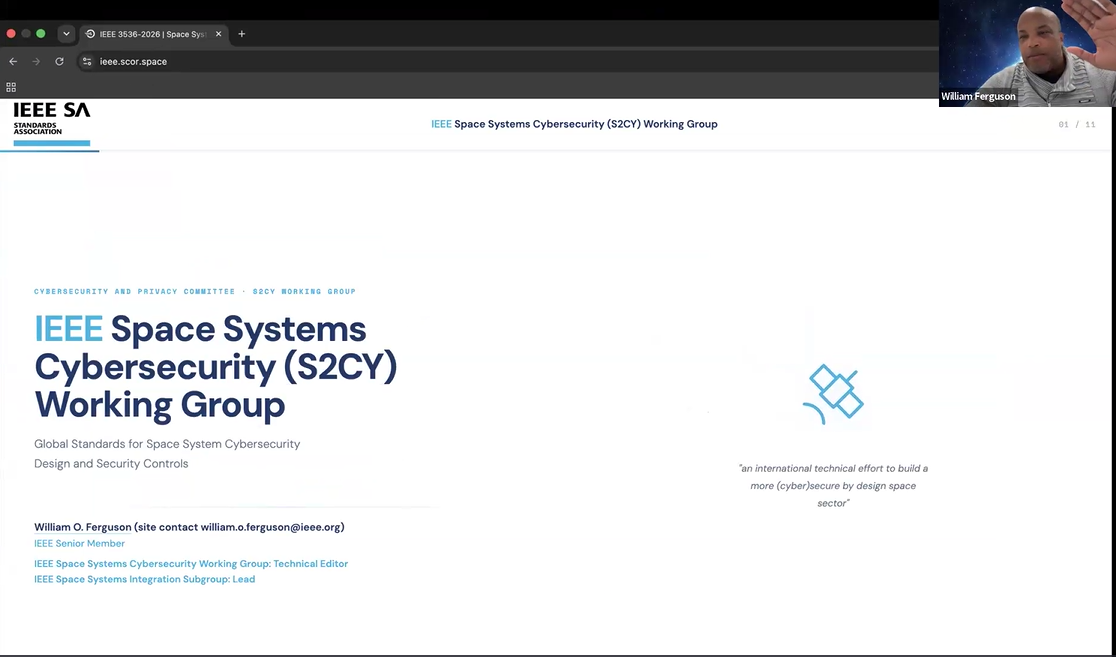
  • Title: From Failure Modes to Secure Blocks: Engineering Space System Resilience with IEEE P3536
  • Speaker: Mr. William Ferguson
    Chair - IEEE Standard for Space System Cybersecurity Design
  • Bio:
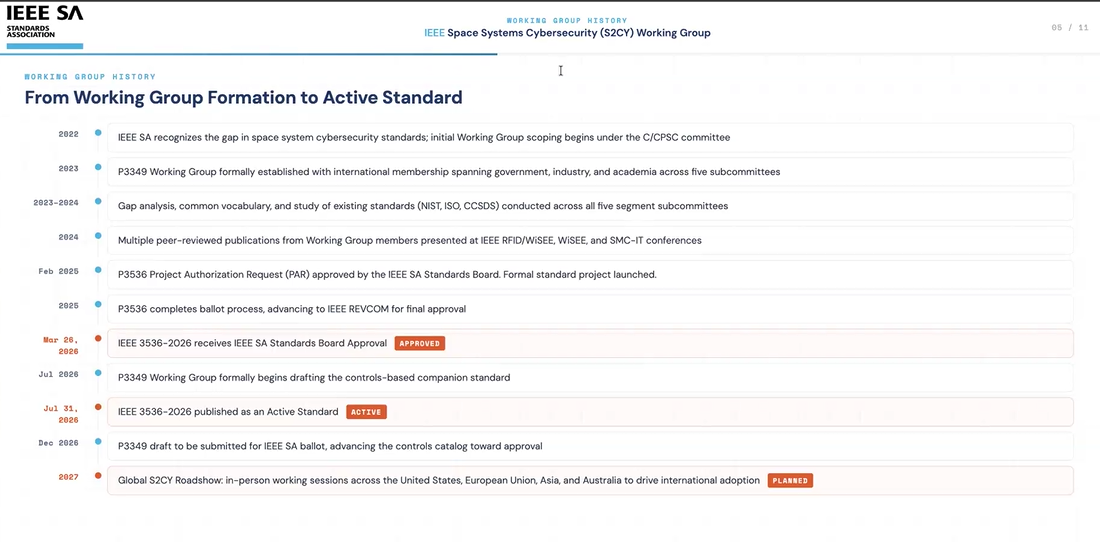
    Mr. William O. Ferguson is an IEEE Senior Member and a member of the IEEE Computer Society, the IEEE Standards Association, and the IEEE Aerospace and Electronic Systems Society. Since 2023 he has served as Technical Editor of IEEE P3536 within the Space Systems Cybersecurity Working Group of the IEEE Standards Association, coordinating contributions from government, industry, and academic stakeholders across four continents and carrying the draft from scoping through ballot. Since 2026 he has also led the working group's Space Systems Integration Subgroup, which specifies security requirements for the interfaces where ground control systems, RF and optical links, spacecraft, user terminals, and third party services interconnect, and establishes the validation methodology for multi segment security architectures. He is currently developing the IEEE Space Systems Resilience Engineering pilot cohort, an IEEE SA training initiative that translates P3536 into taught practice for working engineers and moves practicing cybersecurity professionals into space capable roles. He is an author on three peer reviewed IEEE works on space system security, published in the IEEE Journal of Radio Frequency Identification (2025), the IEEE International Conference on Wireless for Space and Extreme Environments (2024), and the IEEE International Conference on Space Mission Challenges for Information Technology (2024).
  • Abstract:
    Most space missions still add security after the design is fixed, or import rigid security baselines that do not fit the mission. IEEE P3536, under development within the IEEE Standards Association, takes a different route. By focusing on failure modes, which are universally understood and prioritized in the space system engineering community, it enables each mission to derive contextualized, mission specific technical security requirements, and it applies existing space system design artifacts as prerequisites so those requirements stay aligned with the actual design. The process has two prerequisites and six steps. The prerequisites map space mission objectives to failure modes of interest, and failure modes of interest to existing design reference artifacts. The six steps then formally document technical system boundaries, attack surfaces, threat techniques, protection techniques, the technical traceability between them, and finally the secure blocks: the functional technical requirements, with traceability, reviewed as part of the system engineering process. This talk, from the standard's Technical Editor and lead of its Space Systems Integration Subgroup, walks through that process end to end and shows how it produces traceable security requirements for segments, subsystems, and components rather than a generic checklist. It gives particular attention to the integration layer, where ground control systems, RF and optical links, spacecraft, user terminals, and third party services interconnect and where adversaries exploit trust between segments to move laterally. It also explains how the process serves sovereign export control and classification regimes as well as rapid or budget constrained New Space and open science missions, without a single global baseline.

Visit to Exhibition Stall (17:15 - 18:00)


Day 2: Friday, September 11, 2026

Paper Presentation Session 2 (09:30 - 10:15)

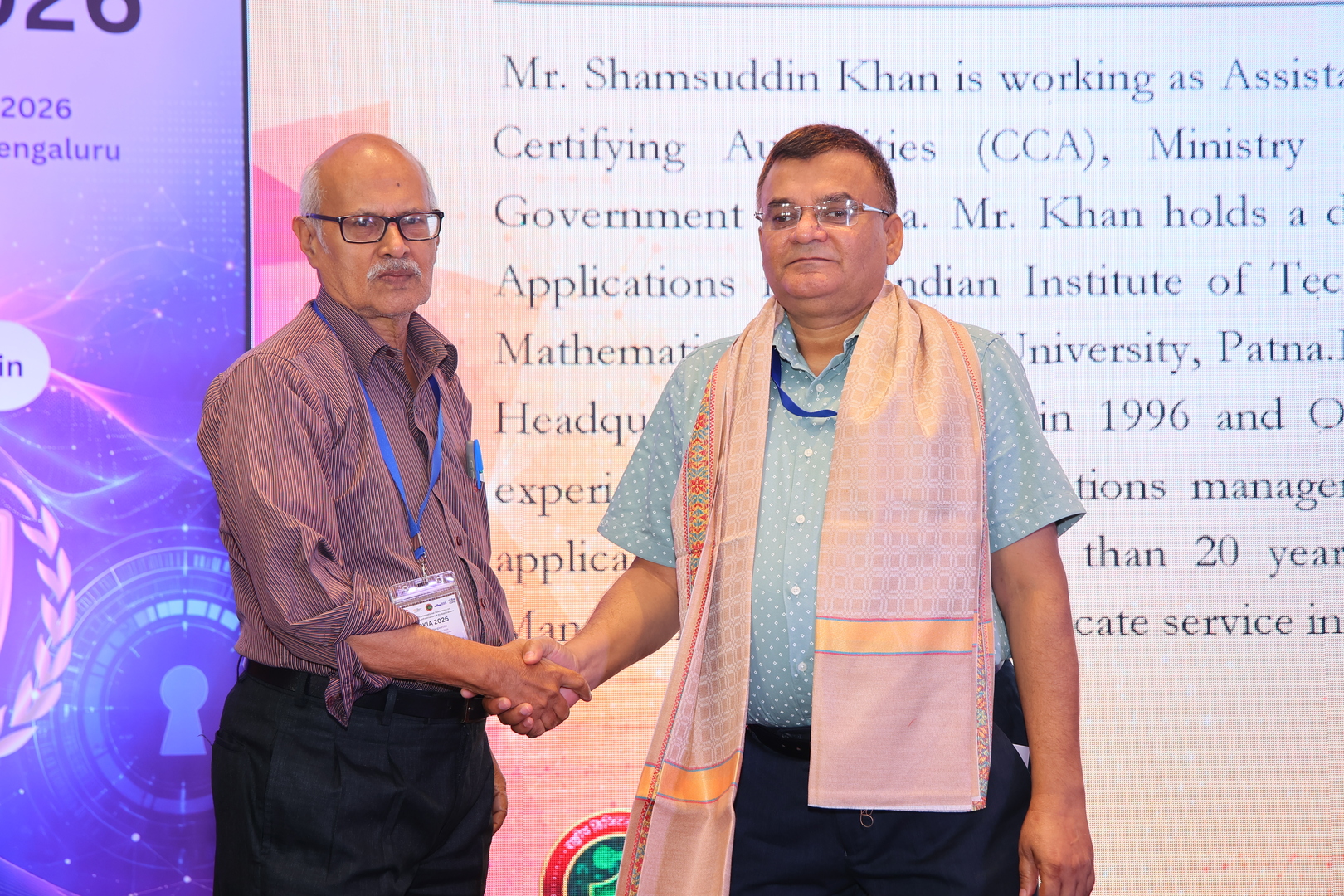
  • Session Chair: Shri Shamsuddin Khan
    Assistant Controller (Technology), O/o CCA
  • Bio:
    Mr. Shamsuddin Khan is working as Assistant Controller (Technology) in the office of Controller of Certifying Authorities (CCA), Ministry of Electronics & Information Technology (MeitY), Government of India. Mr. Khan holds a degree in Master of Technology (M.Tech.) in Computer Applications from Indian Institute of Technology (IIT), Delhi and Master of Science (M.Sc.) in Mathematics from Patna University, Patna.Mr. Khan had joined National Informatics Centre (NIC) Headquarters, New Delhi in 1996 and Office of CCA in 2014. He has more than 30+ years experience in network operations management, applications development & PKI enablement of applications including more than 20 years vast & gigantic experience in CA operations, PKI Management & Digital Certificate service in NIC Certifying Authority (NIC-CA) & office of CCA.
Shri Shamsuddin Khan
  • Papers
    • 09:30 - 09:45
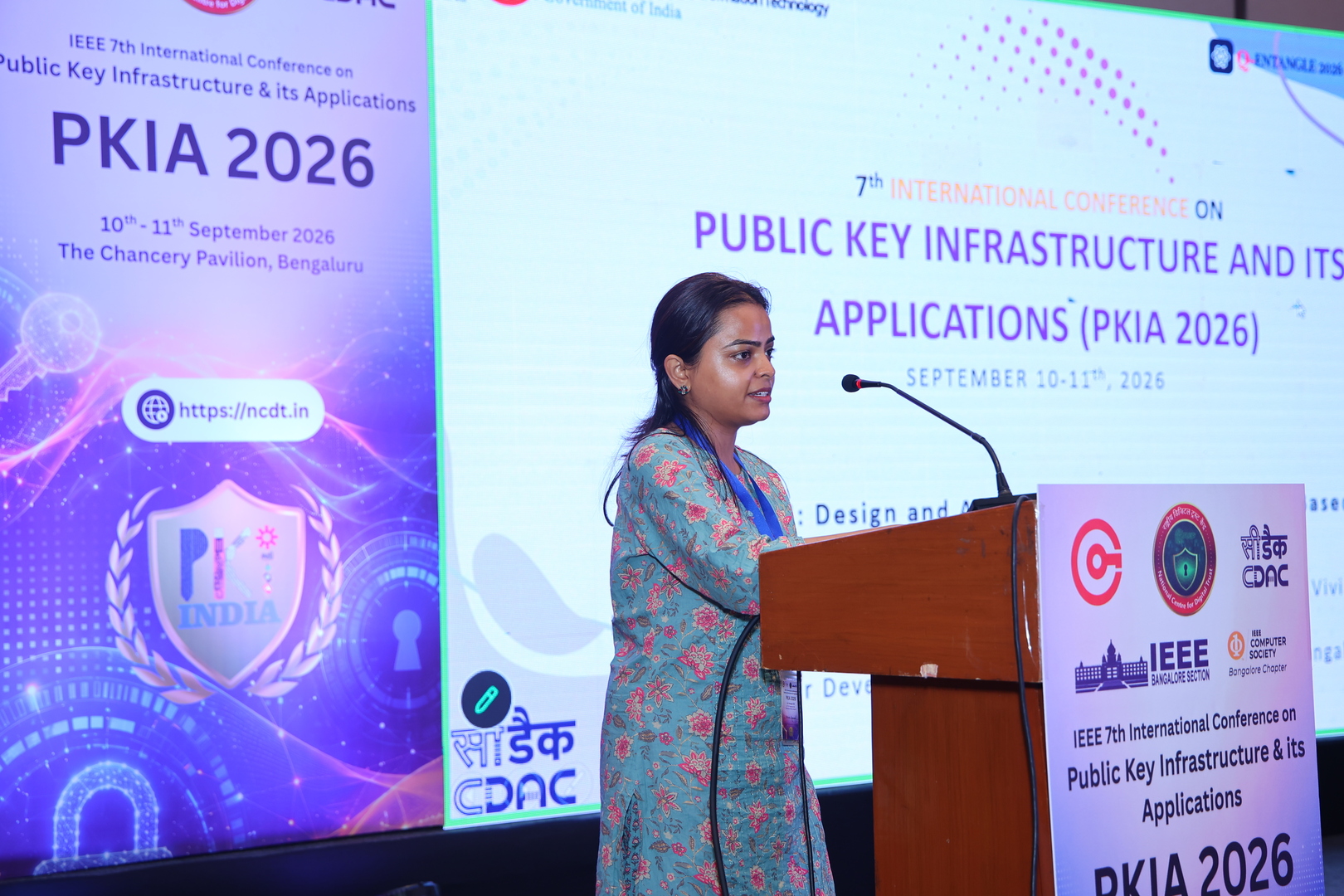
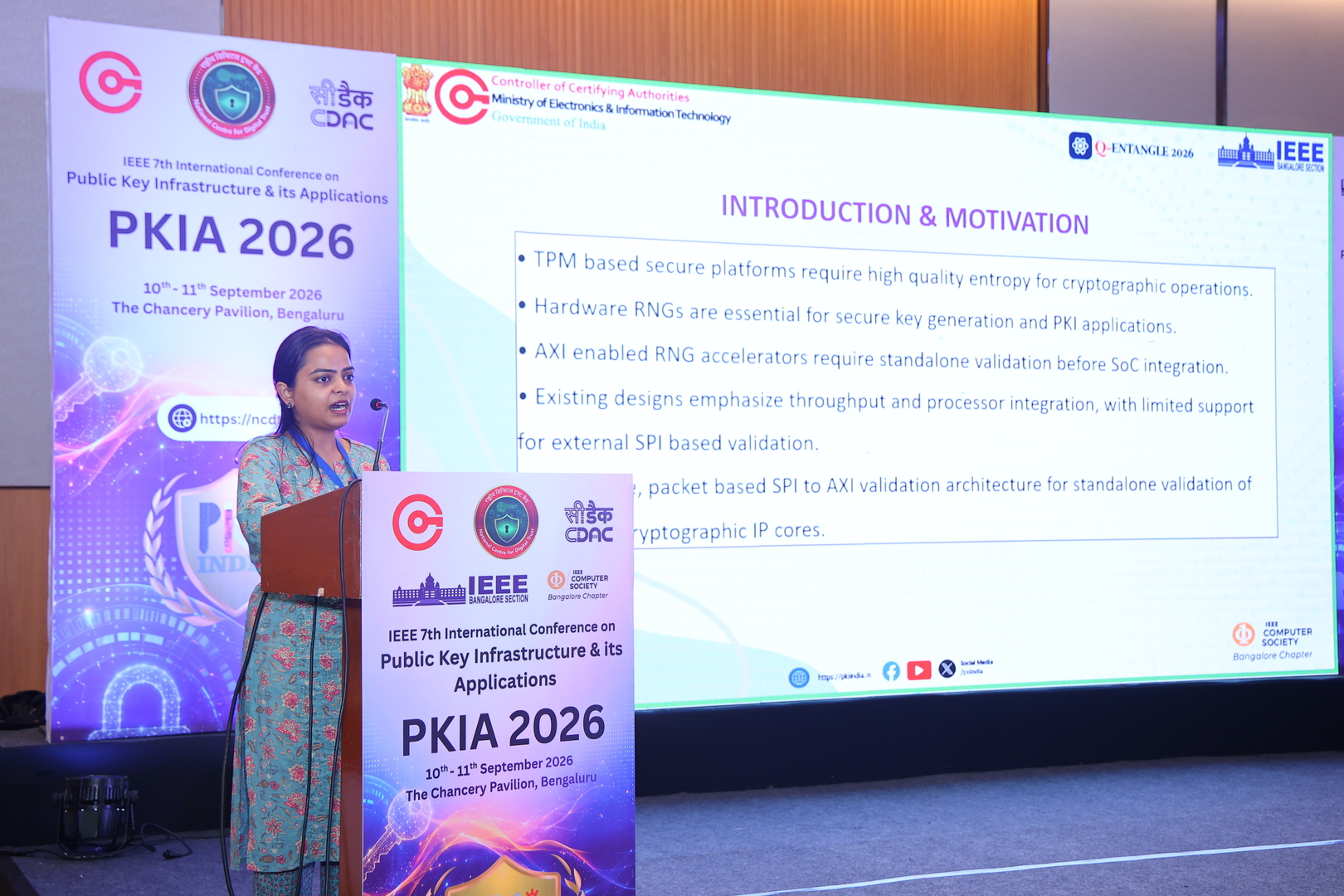
      Title: BHARAT-TPM: Design and ASIC Implementation of an SPI Based AXI Enabled RNG Accelerator
      Authors: Aneesh R, Mahima Agarwal, Soumya G Hosmani, Rajasekar K, Vivian Desalphine, Hari Babu P and S D Sudarsan

    • 09:45 - 10:00
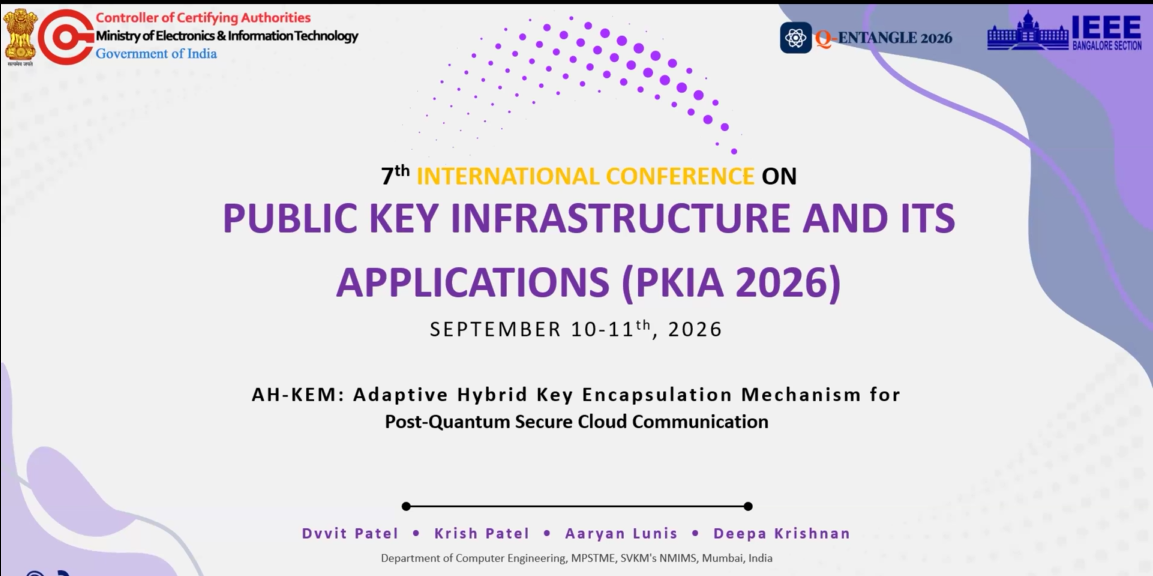
      Title: AH-KEM: Adaptive Hybrid Key Encapsulation Mechanism for Post-Quantumn Secure Cloud Communication
      Authors: Dvvit Patel, Krish Patel, Aaryan Lunis and Deepa Krishnan

    • 10:00 - 10:15
      Title: An AI-Assisted Framework for Post-Quantum Cryptography Bill of Materials Discovery
      Authors: Debasish Deb, Varun Grover, Prachi Gupta and Padmalav Sahoo

Invited Talk - 7 (10:15 - 11:00)

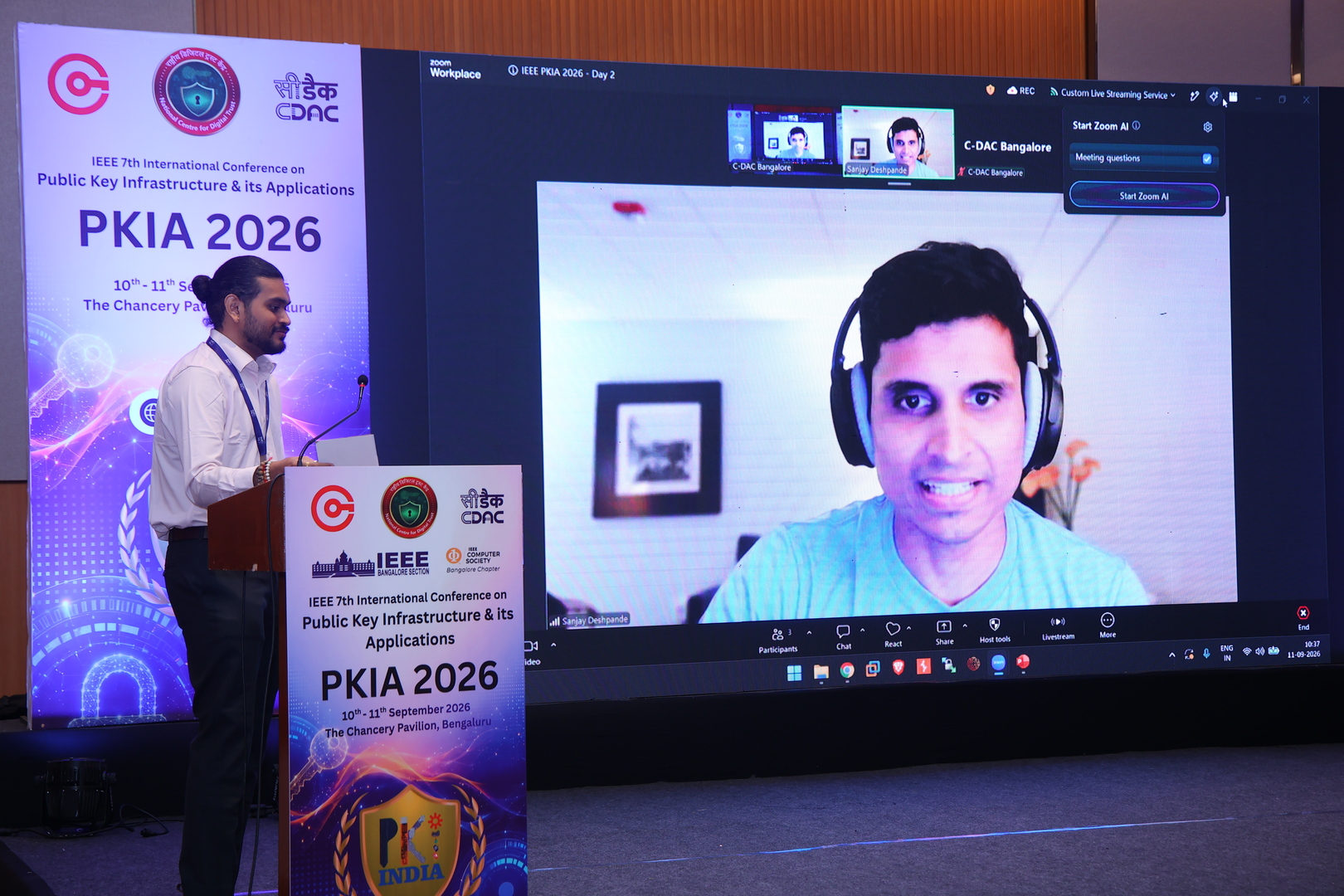
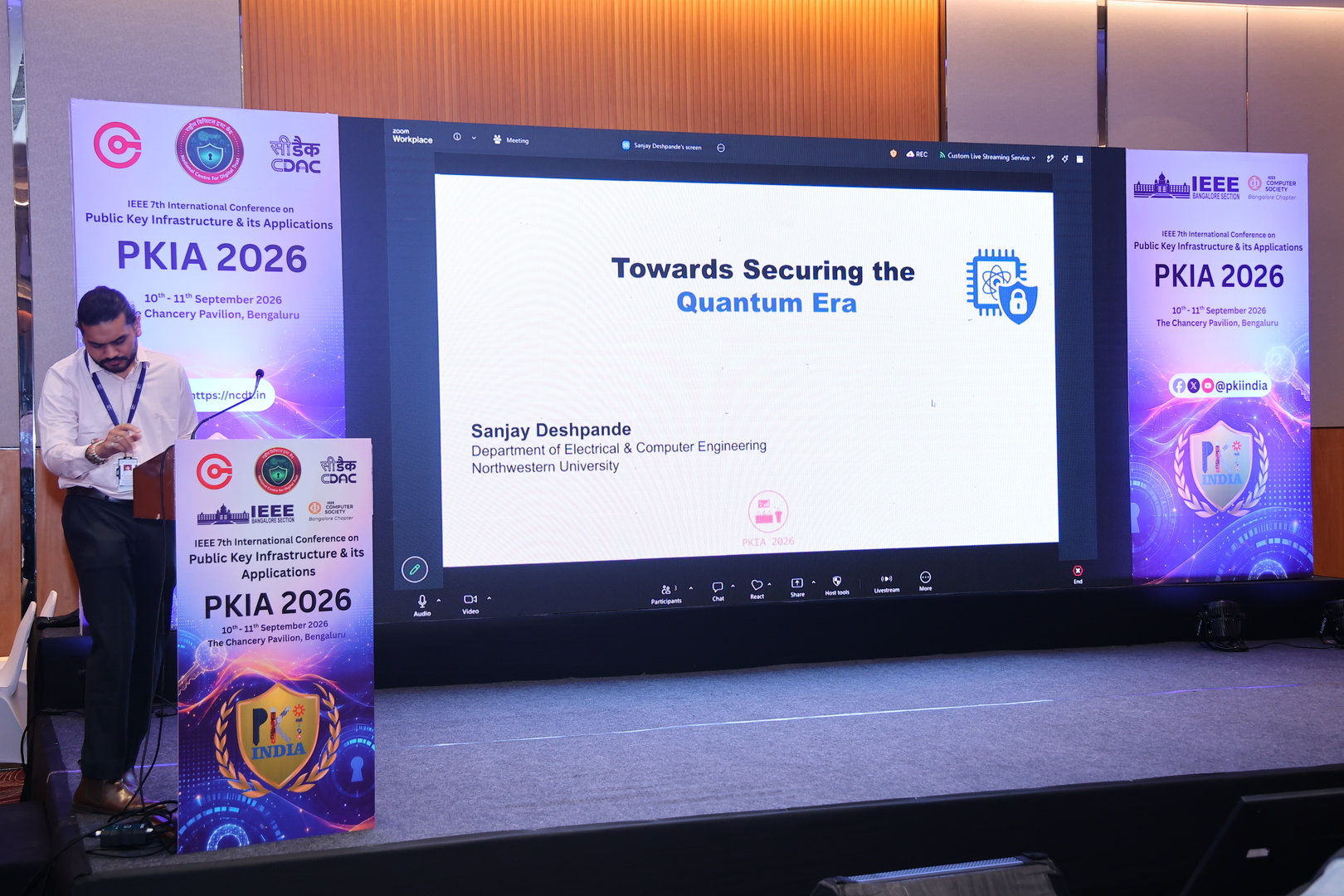
  • Title: Towards Securing the Quantum Era
  • Speaker: Dr. Sanjay Deshpande LinkedIn
    Postdoctoral Scholar, Northwestern University
  • Bio:
    Sanjay Deshpande is a Postdoctoral Scholar at Northwestern University, specializing in efficient and secure post-quantum cryptography implementations and quantum computer cybersecurity. He earned his Ph.D. in Electrical Engineering from Yale University and has held research positions at Microsoft Research, SandboxAQ, and the Technology Innovation Institute.

  • Abstract:
    The rapid advancement of quantum computing promises groundbreaking developments across many fields, but it also threatens the pre-quantum cryptographic systems we currently rely on. The race is on to transition to quantum-safe cryptography before quantum computers reach a critical threshold. At the heart of this global effort lies Post-Quantum Cryptography (PQC), a new generation of algorithms believed to be secure against both quantum and classical attacks. This talk explores the challenges and innovations in the transition to PQC, focusing on the role of hardware and software implementation and evaluation in ensuring both performance and security. It takes a deep dive into the Hamming Quasi-Cyclic (HQC) algorithm, selected for standardization by NIST in 2025, and examines how HQC performs under practical constraints and potential side-channel threats. Complementing this effort to safeguard classical data against quantum attacks, the talk also turns to the security of the quantum computers themselves. It shows how today's cloud-based quantum systems can be susceptible to low-level vulnerabilities and proposes novel methods of protection. Together, these threads offer a holistic approach to security in the quantum era.

Tea Break and Stall Visit (11:00 - 11:30)

Invited Talk - 8 (11:30 - 12:00)

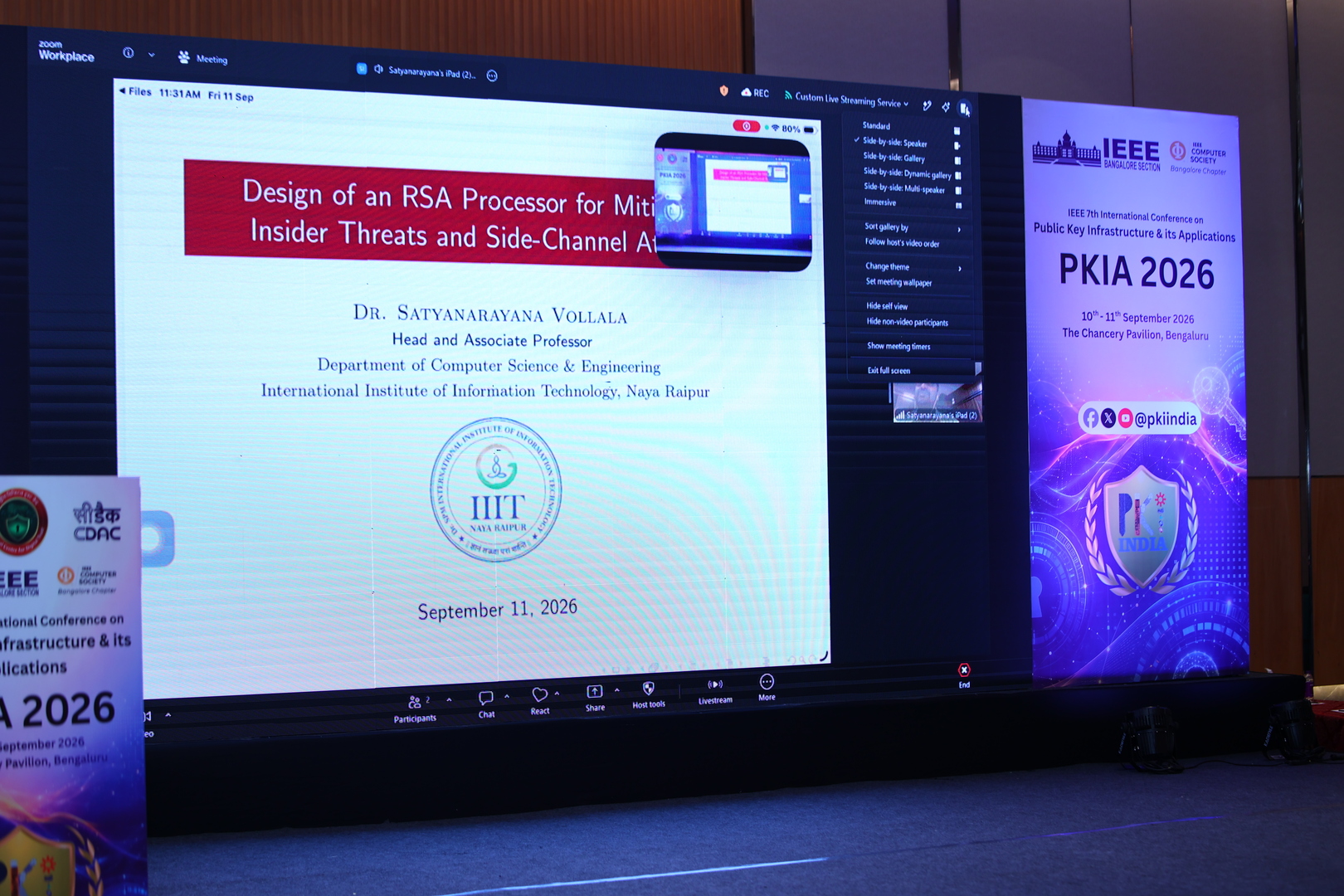
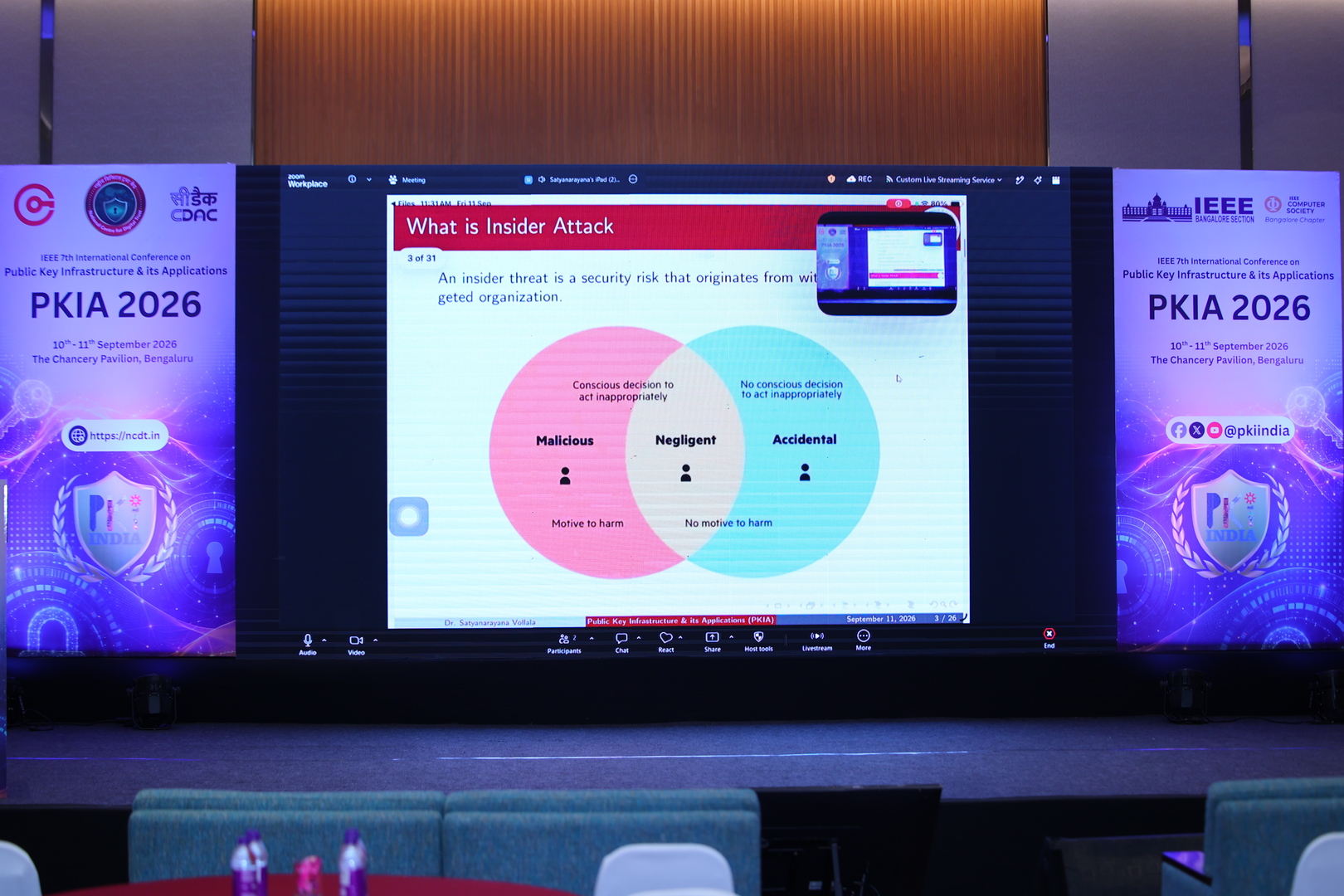
  • Title: Design of an RSA Processor for Mitigating Insider Threats and Side-Channel Attacks
  • Speaker: Dr. Satyanarayana Vollala LinkedIn
    Associate Professor & Head, Department of Computer Science and Engineering IIIT-Naya Raipur
  • Bio:
    Dr. Satyanarayana Vollala is an Associate Professor the Head, Department of Computer Science and Engineering at the International Institute of Information Technology, Naya Raipur (IIIT-NR). He is actively involved in teaching, research, academic administration, and technology development. He has also served in various academic and research leadership roles at the Institute. He received his Ph.D. from the National Institute of Technology, Tiruchirappalli, with specialization in Hardware Security. He is one of the recipients of the president fellowship under TEQIP during his Doctoral Degree. His research interests include Hardware Security, Cryptography, Post-Quantum Cryptography, Network Security, and FPGA-based security implementations. He has published extensively in reputed international journals and conferences and has guided research scholars in emerging areas of cybersecurity and related technologies. He has also filed more than 20 patents, including one U.S. patent, demonstrating his contribution to innovation and technology development. Among these, 10 Indian patents have been granted. His research and innovation activities have also resulted in the development of security-oriented technologies and systems. He has been associated with several major research and training initiatives, including cybersecurity training and capacity-building programs. He has played an important role in establishing and strengthening cybersecurity-related laboratory and training infrastructure at IIIT-Naya Raipur.
  • Abstract:
    Insider threats, hardware Trojans, and side-channel attacks are major security problems for cryptographic processors. An attacker may try to find the secret key by observing information such as power consumption and execution time. This presentation proposes a multi-core RSA crypto-processor to reduce these security risks. The proposed system contains multiple RSA cores, a scheduler, dedicated memory, random core selection, and a confusion mechanism. All the cores perform the RSA operation, but the important modular exponentiation operation is performed using different methods in different cores. Therefore, even when the same message and the same key are used, each core may show different power consumption, heat generation, and execution time. This makes the behaviour of the processor difficult to predict. As a result, even if an attacker knows the system parameters and observes the side-channel information, it becomes difficult to identify the secret key. The selected RSA cores also use BFW-based methods that can process two, three, or four consecutive bits instead of one bit at a time. Thus, the combination of memory protection, random core selection, and increased confusion provides better protection against side-channel attacks and insider attacks involving hardware Trojans.

Paper Presentation Session 3 (12:00 - 12:20)

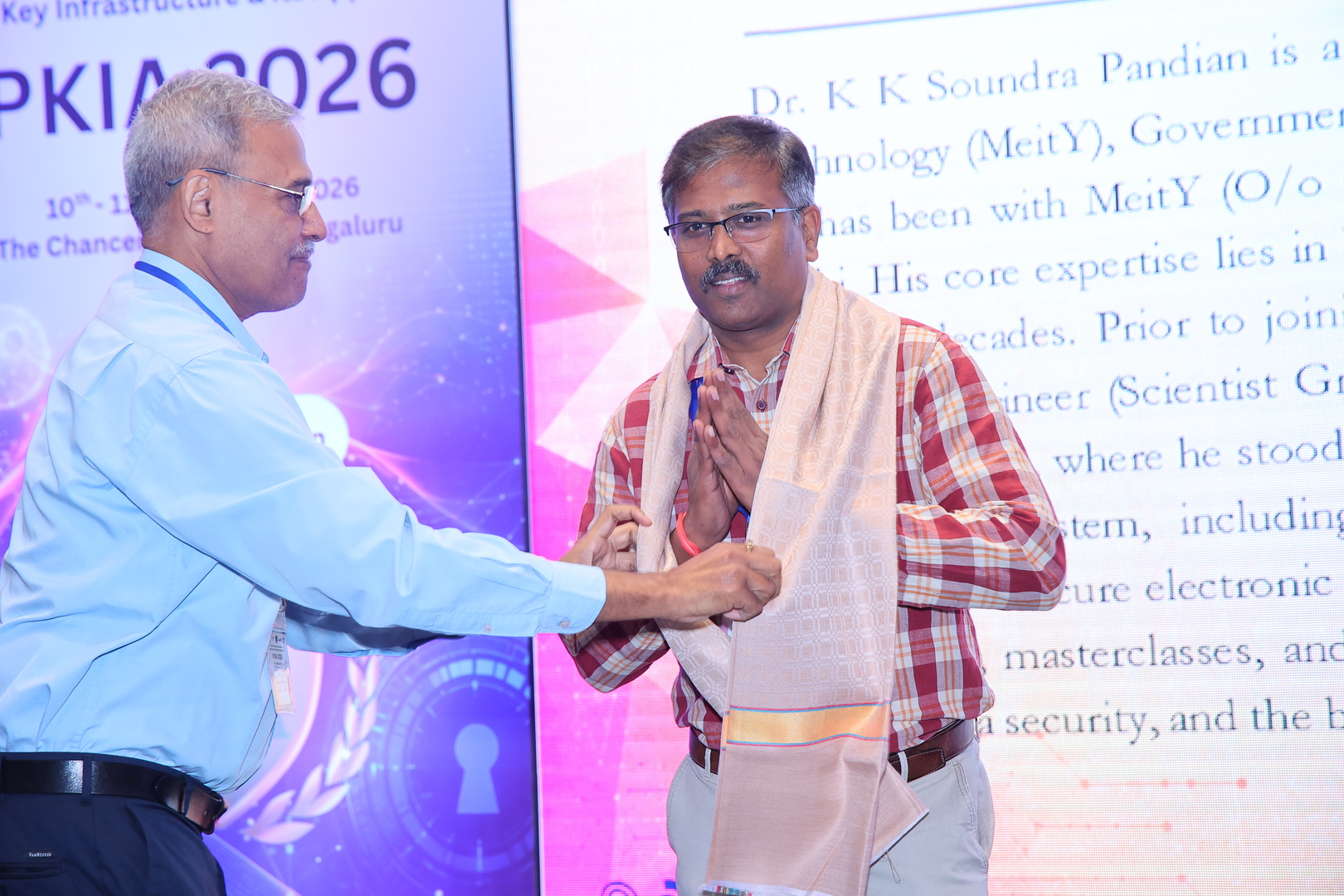
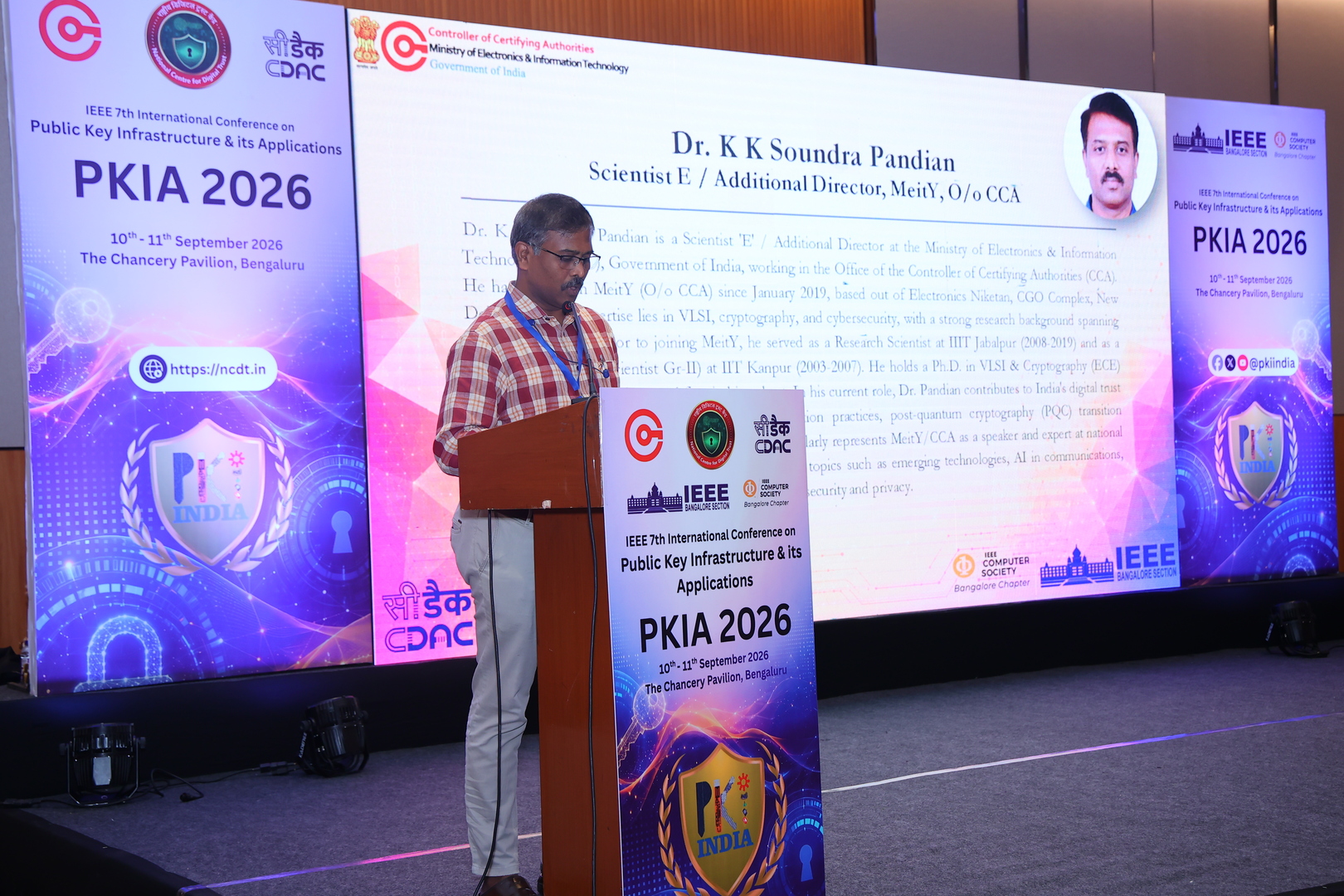
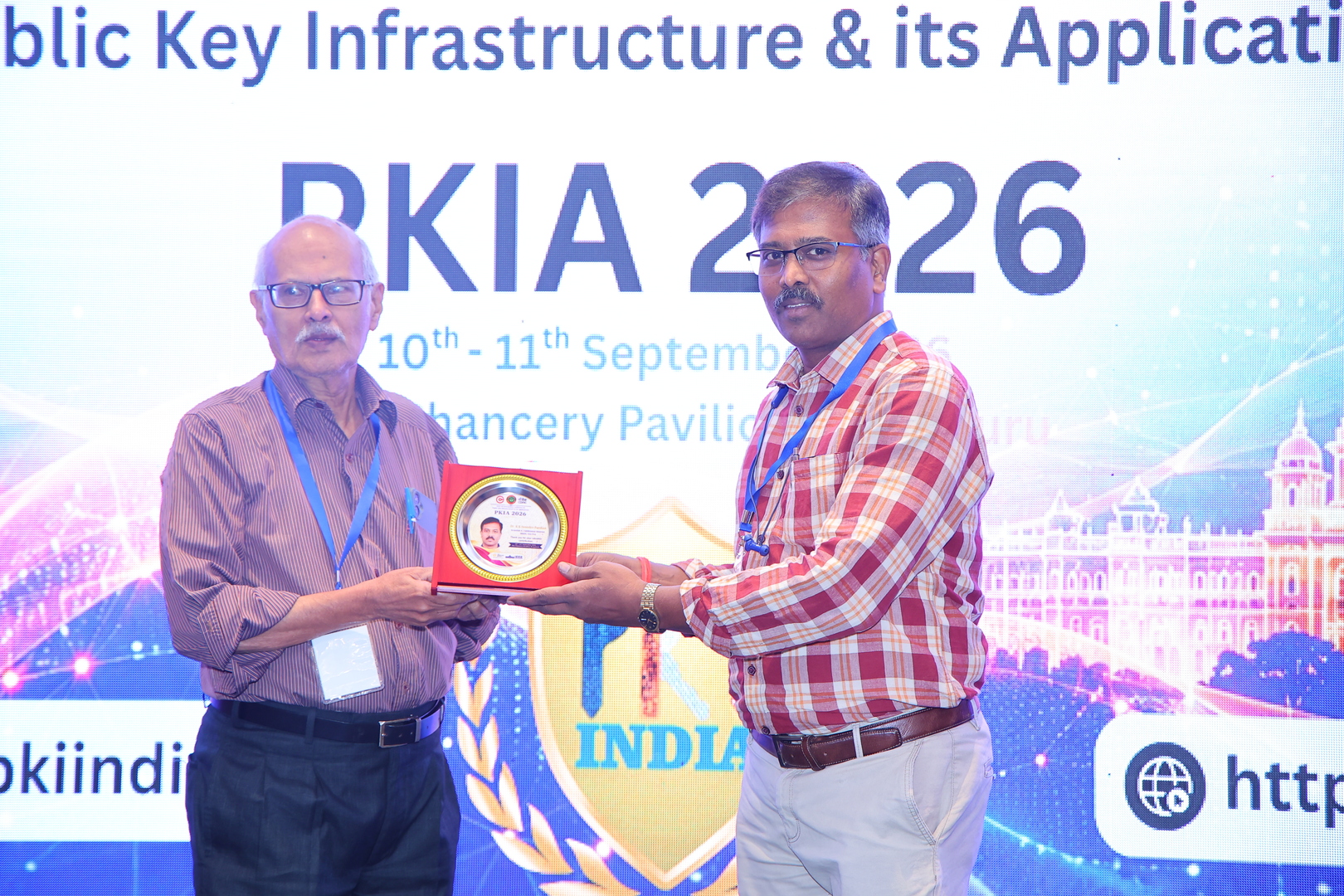
  • Session Chair: Dr. K K Soundra Pandian LinkedIn
    Scientist E / Additional Director, MeitY, O/o CCA
  • Bio:
    Dr. K K Soundra Pandian is a Scientist 'E' / Additional Director at the Ministry of Electronics & Information Technology (MeitY), Government of India, working in the Office of the Controller of Certifying Authorities (CCA). He has been with MeitY (O/o CCA) since January 2019, based out of Electronics Niketan, CGO Complex, New Delhi. His core expertise lies in VLSI, cryptography, and cybersecurity, with a strong research background spanning over two decades. Prior to joining MeitY, he served as a Research Scientist at IIIT Jabalpur (2008-2019) and as a Research Engineer (Scientist Gr-II) at IIT Kanpur (2003-2007). He holds a Ph.D. in VLSI & Cryptography (ECE) from IIT Patna, where he stood first in his cohort. In his current role, Dr. Pandian contributes to India's digital trust and PKI ecosystem, including work on certification practices, post-quantum cryptography (PQC) transition planning, and secure electronic transactions. He regularly represents MeitY/CCA as a speaker and expert at national conferences, masterclasses, and industry forums on topics such as emerging technologies, AI in communications, quantum-era security, and the balance between cybersecurity and privacy.
Shri Shamsuddin Khan
  • Papers
      • 12:00 - 12:10
        Title: Design and Comparative Evaluation of a Hybrid Post-Quantum Key Exchange Protocol for Quantum-Resistant Onion Routing Networks
        Authors: Subhash Kumar and Kishor Kolhe

      • 12:10 - 12:20
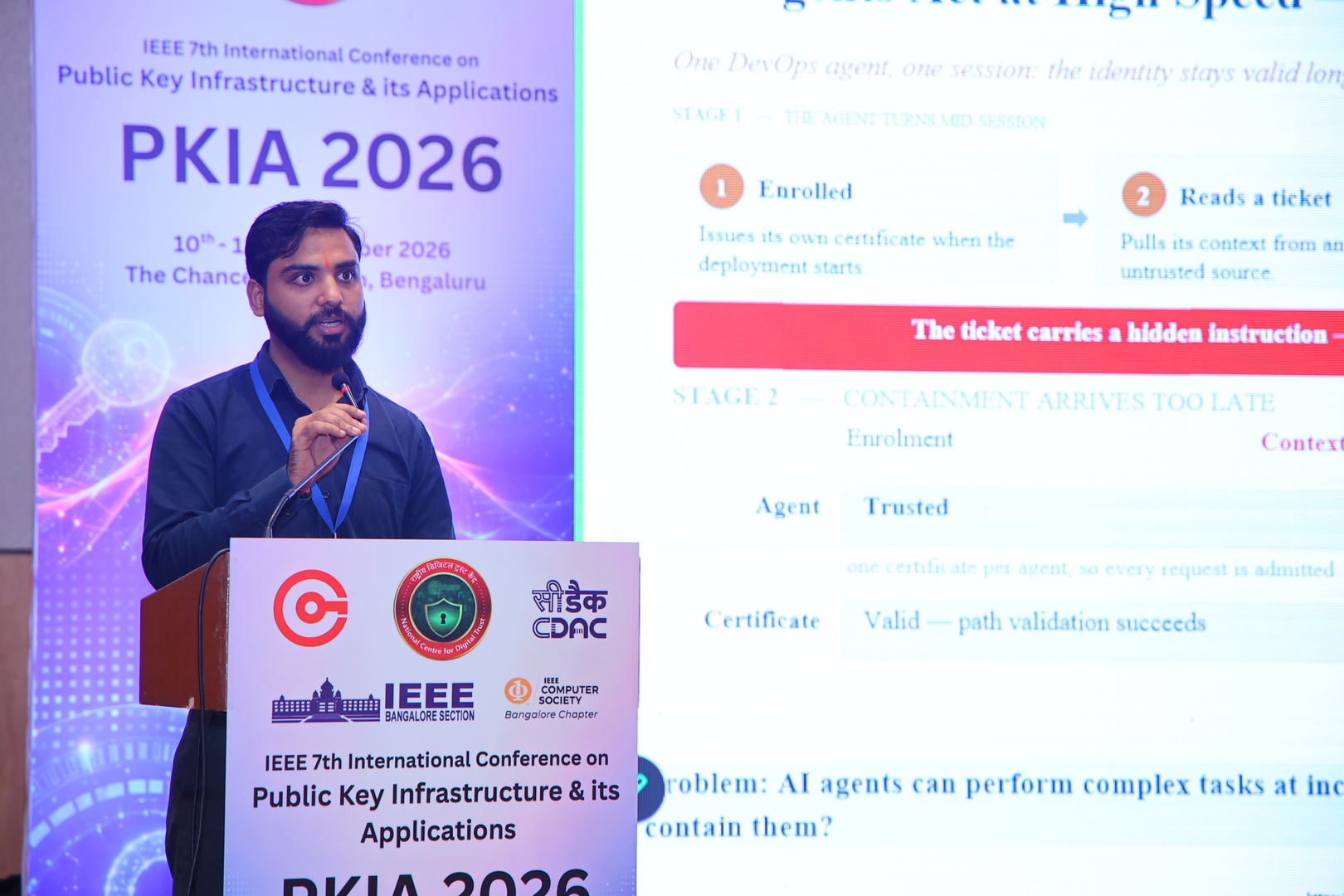
        Title: A Crypto-Agile PKI Revocation Framework for Real-Time Containment of Malicious AI Agents
        Authors: Abhishek Dhiman, Ramesh Naidu, Shreya Murgunde and S D Sudarsan

Invited Talk - 9 (12:20 - 12:45)

  • Title: Tale of two standards FIPS 140 and ISO 19790
  • Speaker: Muralidharan M. R.
    Consultant, C-DAC Bangalore
  • Bio:
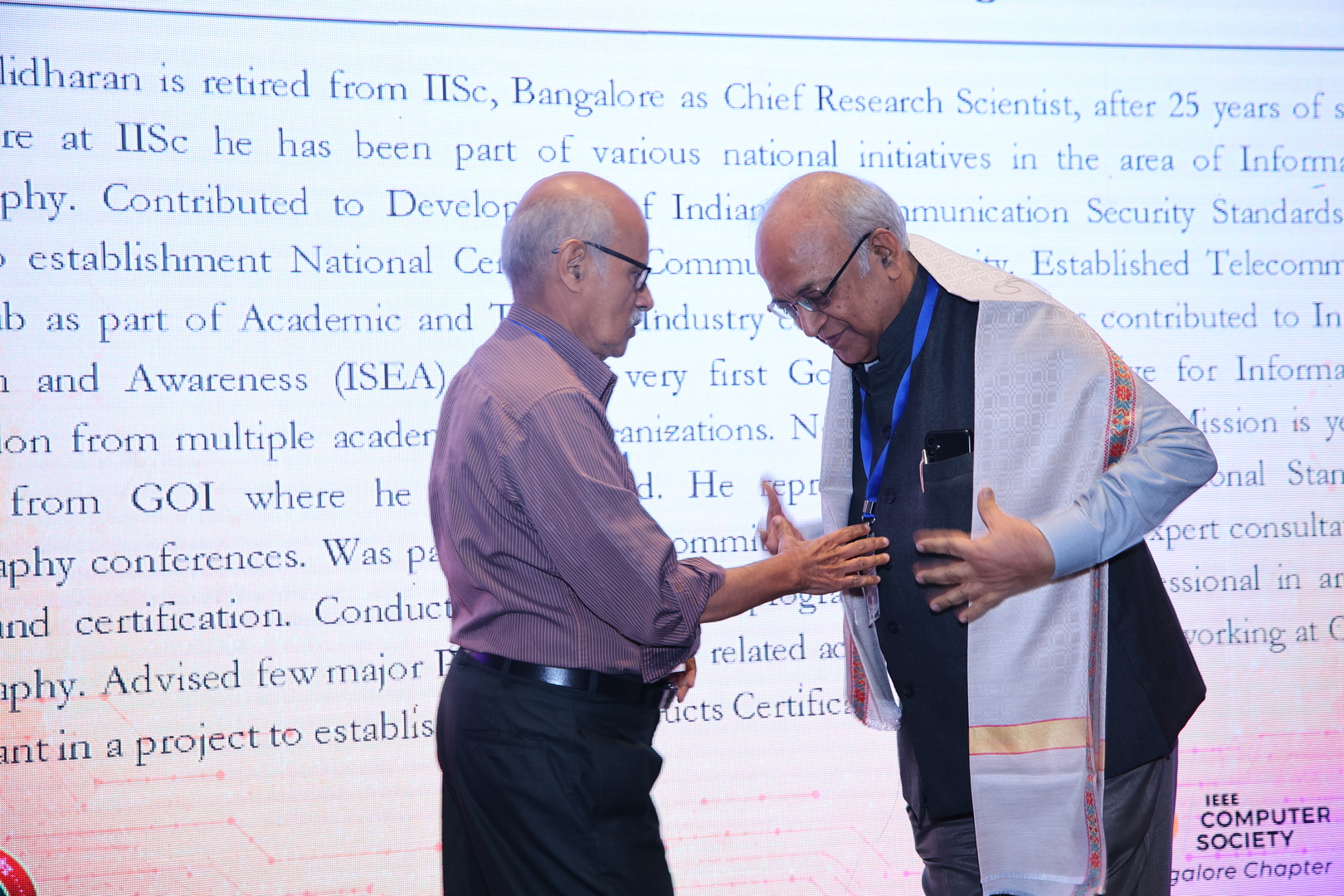
    Retired from IISc, Bangalore as Chief Research Scientist, after 25 years of service. During his long tenure at IISc he has been part of various national initiatives in the area of Information security and Cryptography. Contributed to Development of Indian Telecommunication Security Standards and certification, leading to establishment National Centre for Communication Security. Established Telecommunication security testing Lab as part of Academic and Telecom Industry collaboration. He has contributed to Information Security Education and Awareness (ISEA) Program very first Govt. Of India initiative for Information security with participation from multiple academic and organizations. National Supercomputing Mission is yet another national initiative from GOI where he was involved. He represented India in international Standards bodies and Cryptography conferences. Was part of various committees and inter-ministerial expert consultations in the area of security and certification. Conducted many training programs for working professional in area of Security and Cryptography. Advised few major PSU Banks in IT related activities. Currently working at CDAC Bangalore as a consultant in a project to establish Crypto Products Certification.



Invited Talk - 10 (12:45 - 13:10)

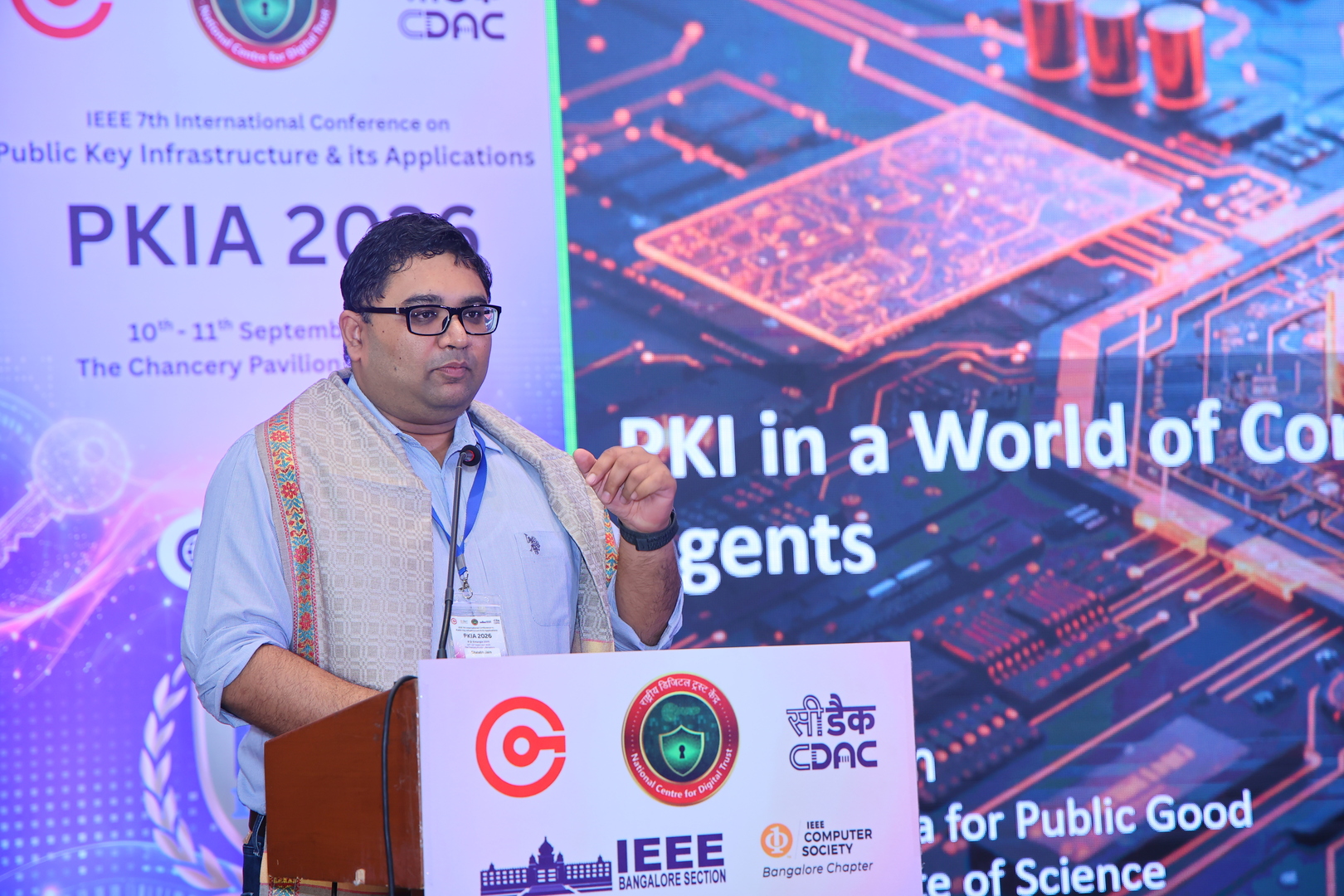
  • Title: PKI in the world of Confidential Computing and AI agents
  • Speaker: Dr. Shalabh Jain LinkedIn
    Security and Privacy Expert, CDPG, IISc
  • Bio:
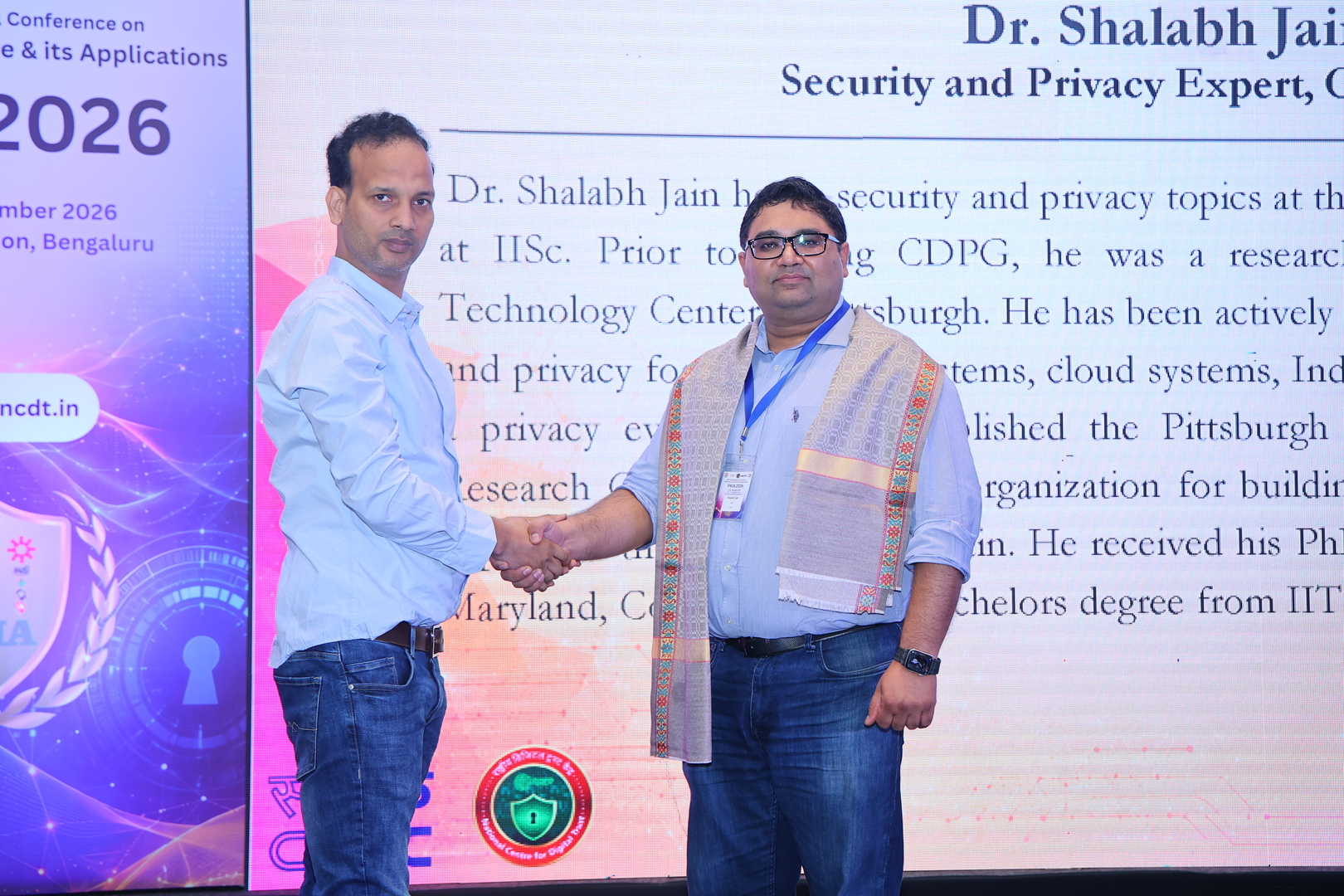
    Dr. Shalabh Jain heads security and privacy topics at the Center of Data for Public Good at IISc. Prior to joining CDPG, he was a researcher at the Bosch Research and Technology Center in Pittsburgh. He has been actively working in the domain of security and privacy for automotive systems, cloud systems, Industry 4.0 and IoT networks. He is a privacy evangelist. He established the Pittsburgh chapter of Automotive Security Research Group, a non-profit organization for building the next generation of security experts in the automotive domain. He received his PhD and masters from University of Maryland, College Park and Bachelors degree from IIT Roorkee.

  • Abstract:
    Long-lived certificates that bind a human-owned key to a DNS name and revoke via CRL are being displaced by a machine centric model where identity means attested state plus a scoped capability. In this talk, we touch upon how the usage of confidential computing and agentic AI are driving this change. We discuss how verification and trust establishment is moving towards a dynamic policy evaluation over fresh evidence rather than a static chain walk and how existing PKI systems can be enhanced to support this.

Lunch and Visit to Exhibition Stall (13:10 - 14:30)

Invited Talk - 11 (14:30 - 15:00)

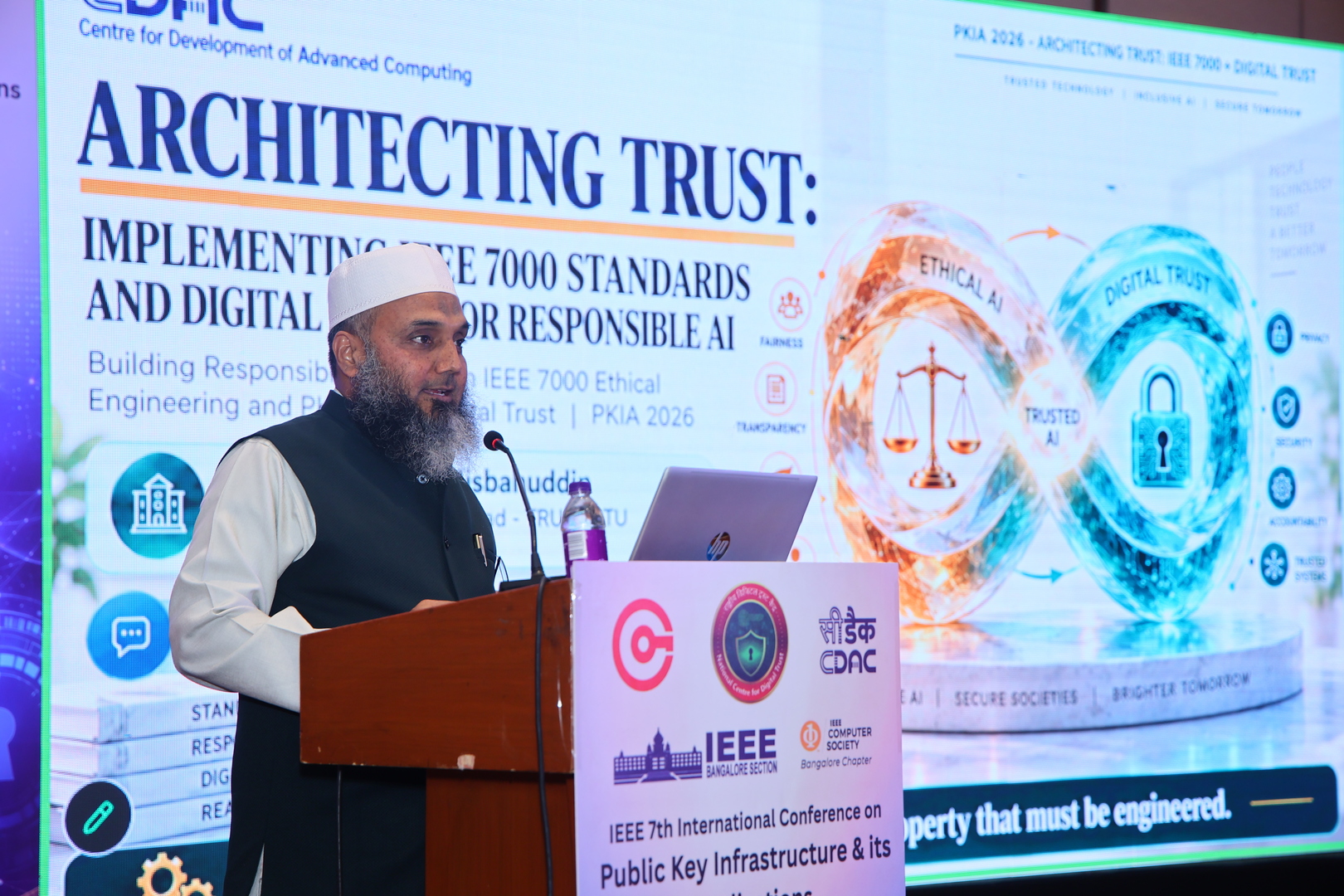
  • Title: Trusted AI: Extending Digital Trust to Autonomous Intelligent Systems
  • Speaker: Dr. Mohammed Misbahuddin LinkedIn
    Scientist 'F' & Head, TRUST, C-DAC Bangalore
  • Bio:
    Dr. Mohammed Misbahuddin is a Cybersecurity expert, AI Governance Assessor, and Technology Leader with over 24 years of experience, including 18 years in Research and Development. He is India's first IEEE CertifAIEd Authorized Assessor for Autonomous Intelligent Systems. He is a key contributor to Cybersecurity, Identity Management, Digital Trust and HPC projects of Government of India. He has established Centre for HPC Upskilling and Knowledge-sharing (C-HUK), C-DAC Bangalore & C-DAC Guwahati under the National Supercomputing Mission to strengthen national capacity in HPC through structured skilling, faculty development, professional training, and knowledge-sharing initiatives. He led the establishment of MEPZ-C-DAC IT Skill Centre & Centre of Excellence, Chennai to support industry-oriented applied training, and technology enablement in emerging areas for workforce development and digital transformation. He was instrumental in the establishment of the National Centre for Digital Trust (NCDT) at C-DAC Bangalore under the Office of the Controller of Certifying Authorities (CCA), MeitY, to advance trusted digital ecosystems, cybersecurity, identity, device trust, and emerging trust technologies. As a Chair of Coordination Committee, he successfully led the conduction of India's first Supercomputing India Conference (SCI2025) He Chairs the IEEE P2989 Working Group on Standard on “Authentication in a Multi-Server Environment”, shaping global authentication standards . He is a Senior Member of IEEE and IEEE Standards Association. He is an active contributor to IEEE Blended Learning Content in Cyber Security and HPC. With 2 granted patents in Secure Authentication, 50+ International research publications, and 5 successfully awarded PhD scholars under his supervision, he continues to lead impactful academic and research initiatives. Dr. Misbahuddin is the initiator of ePramaan, a National e-Authentication Service integrated with Aadhaar, significantly strengthening India's digital identity ecosystem. He has been instrumental in developing the Cyber Security Framework (CSF) for multiple Government Ministries and contributed to the e-Authentication Standards & Guidelines for the Ministry of Electronics & IT (MeitY). A dedicated advocate for Cybersecurity awareness, Dr. Misbahuddin has educated over 25,000 people, including government officials, across India through Digital Signature and Cybersecurity Campaigns. He has delivered 300+ expert talks across 33 states and UTs, making cybersecurity knowledge accessible to diverse audiences. Dr. Misbahuddin is also involved in Capacity Building and Skill Development programmes. As Member-Convener of the Academic Council of C-DAC, he is involved in efforts to modernize academic programs and align them with emerging technology trends. He also serves on the Board of Studies of various universities, contributing to curriculum development and research initiatives.


  • Abstract:
    The rapid evolution of Artificial Intelligence from predictive systems to autonomous and agentic AI is creating a new class of digital entities capable of making decisions, invoking services, accessing sensitive resources, and acting on behalf of individuals and organizations. This shift raises a fundamental trust question: how can the identity, authority, integrity, provenance, accountability, and legal validity of an AI system and its actions be established? This talk examines Trusted AI through the lens of Public Key Infrastructure (PKI) and Digital Trust. It explores the application of cryptographic identities, digital certificates, authentication, authorization, digital signatures, timestamping, revocation, and trust chains to AI models and autonomous agents. Particular emphasis is placed on establishing verifiable identities for agentic AI, defining authorization boundaries, and maintaining accountable machine-to-machine interactions. The presentation further connects PKI with data integrity and provenance, arguing that trustworthy AI decisions require not only reliable algorithms but also authentic, traceable, untampered, and contextually appropriate data. It examines how cryptographically verifiable data and model provenance can strengthen auditability and support evidentiary requirements for AI-generated transactions and decisions. Beyond technical trust, the talk integrates ethical AI principles—fairness, transparency, accountability, privacy, human oversight, and respect for human values—with cryptographic assurance mechanisms. Finally, it examines the bidirectional relationship between AI for Cyber Security and Cyber Security for AI, including the need to secure AI against data poisoning, model manipulation, prompt injection, unauthorized agents, and adversarial attacks. The talk proposes a unified Trust-by-Design architecture in which Identity, Authentication, Data Integrity, Provenance, Ethics, Cybersecurity, Auditability, and Legal Accountability collectively form the trust fabric for dependable AI systems.

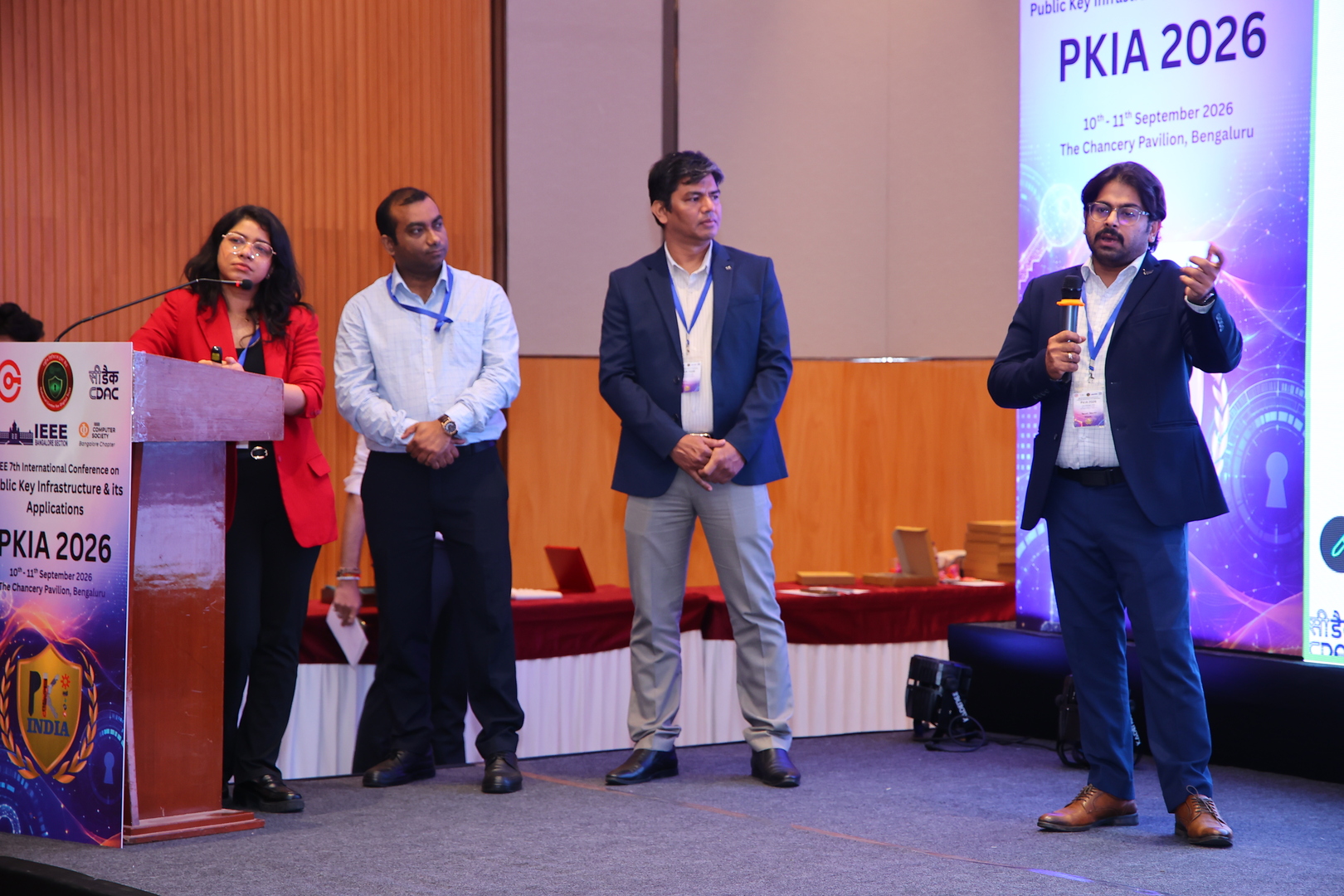
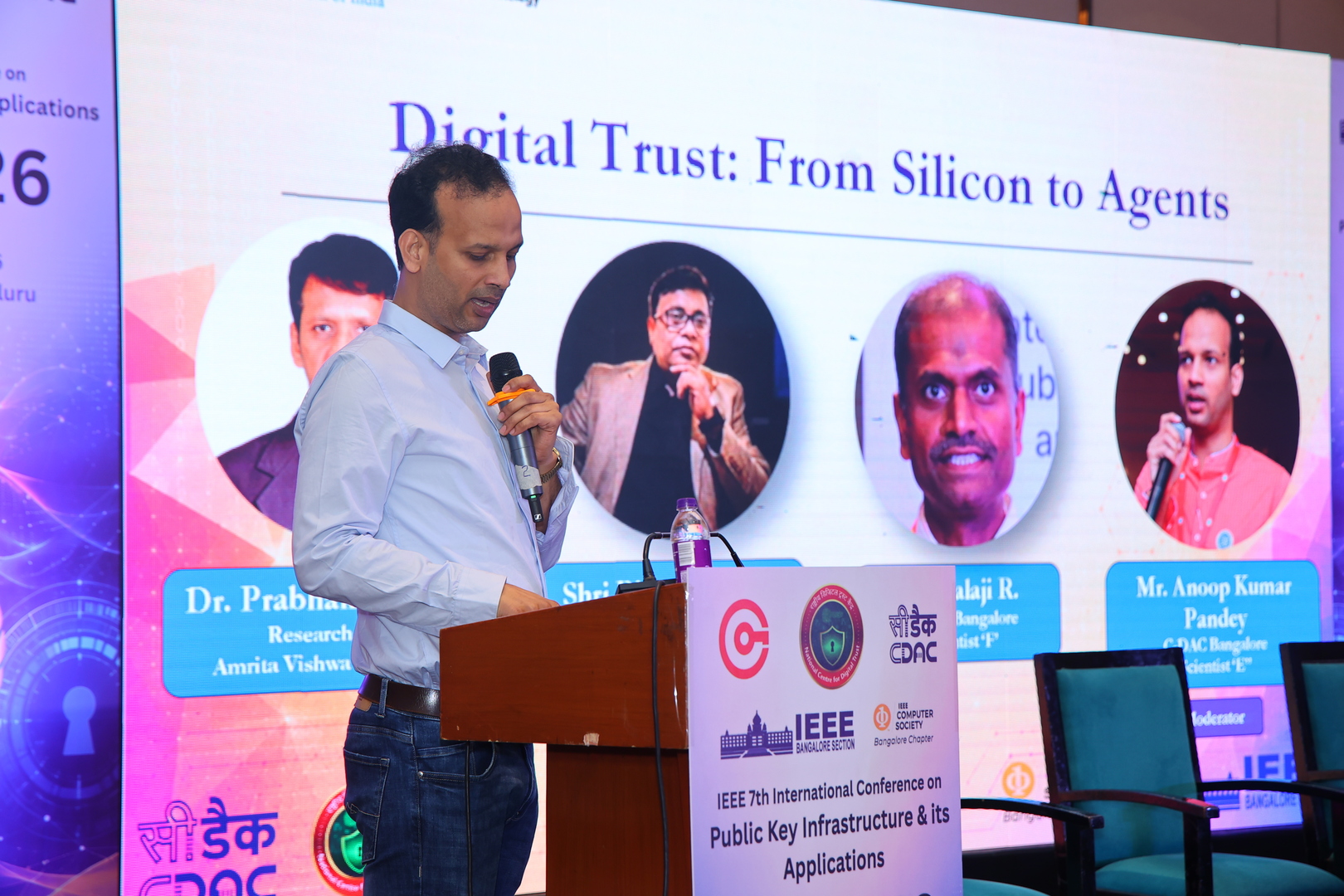
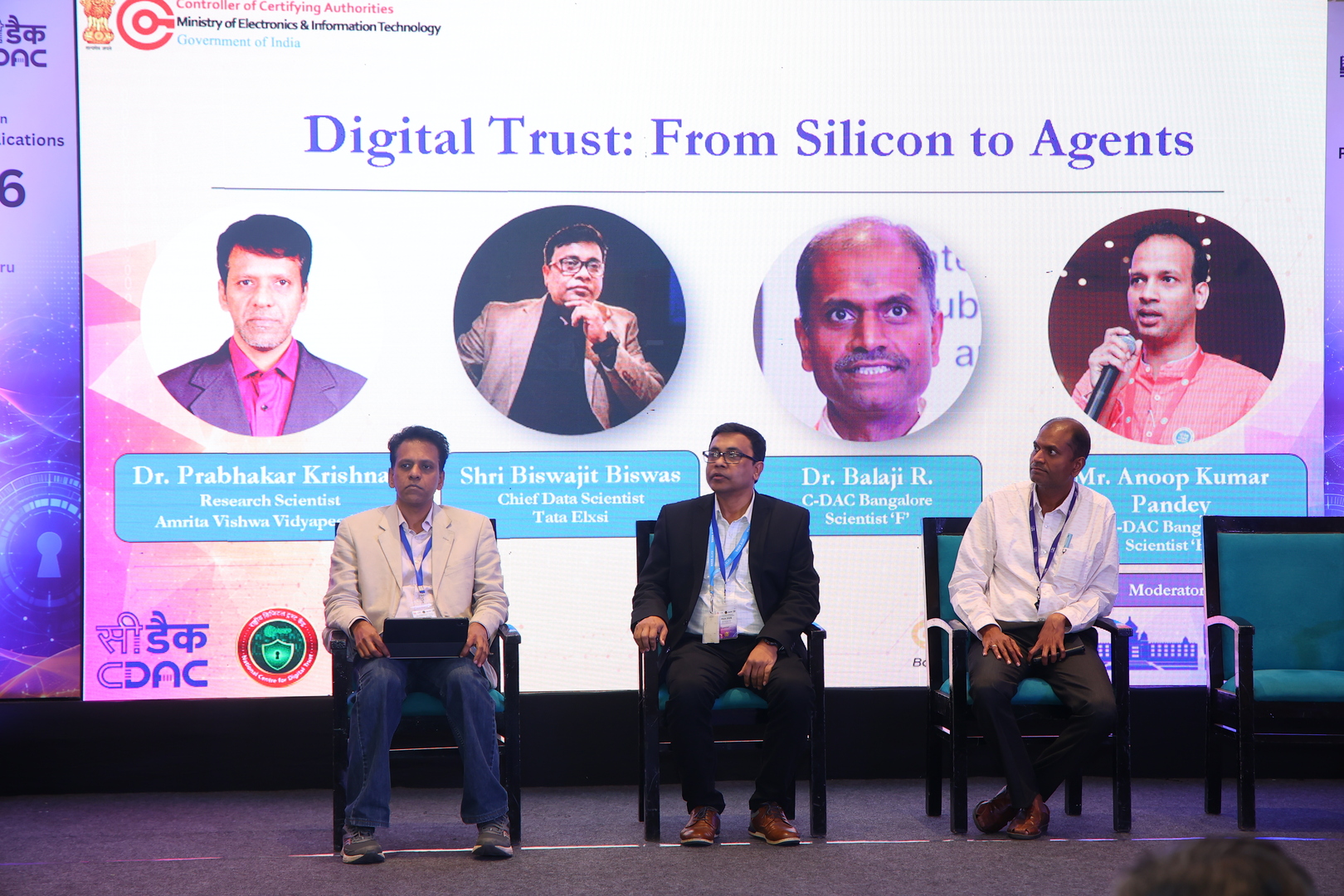
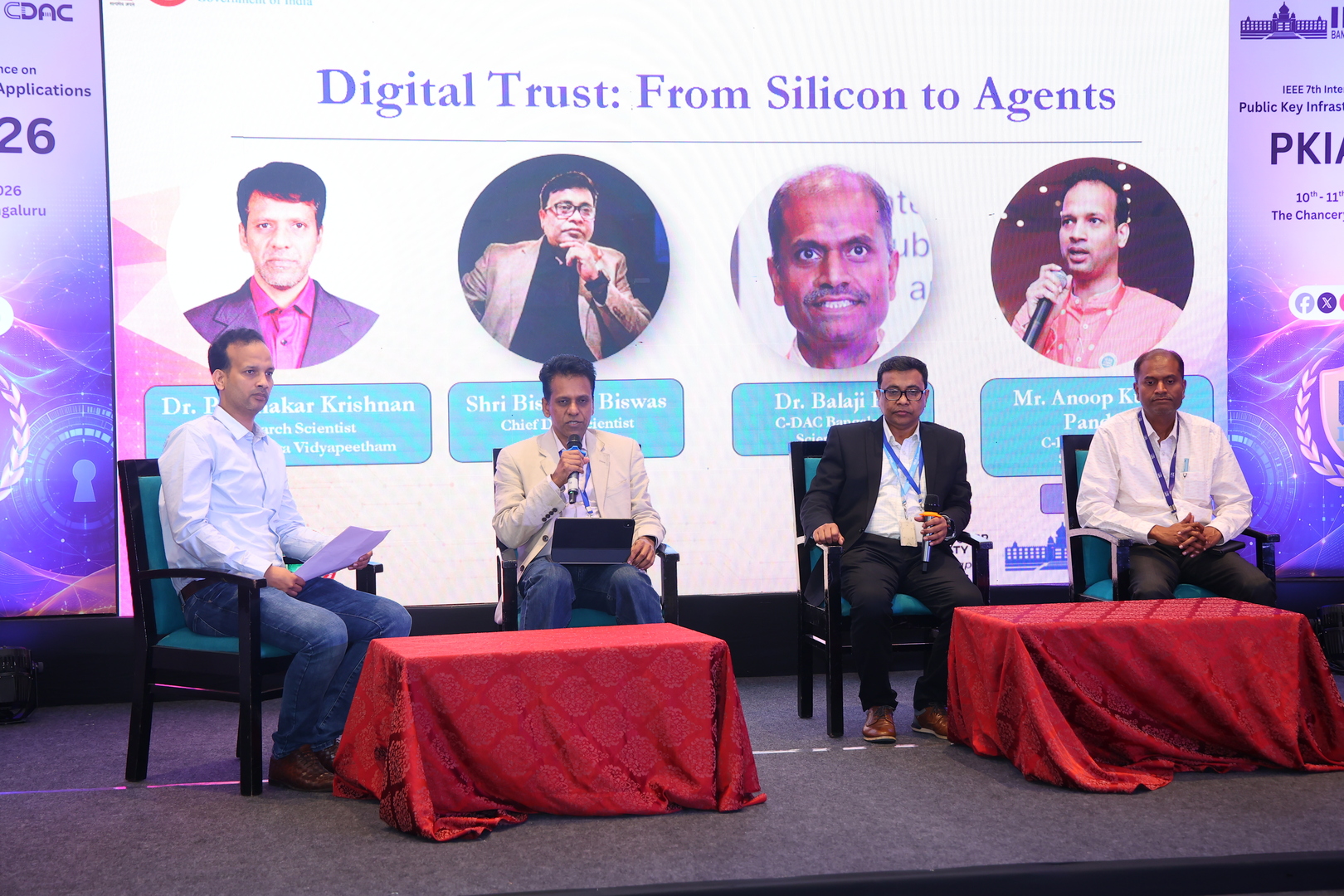
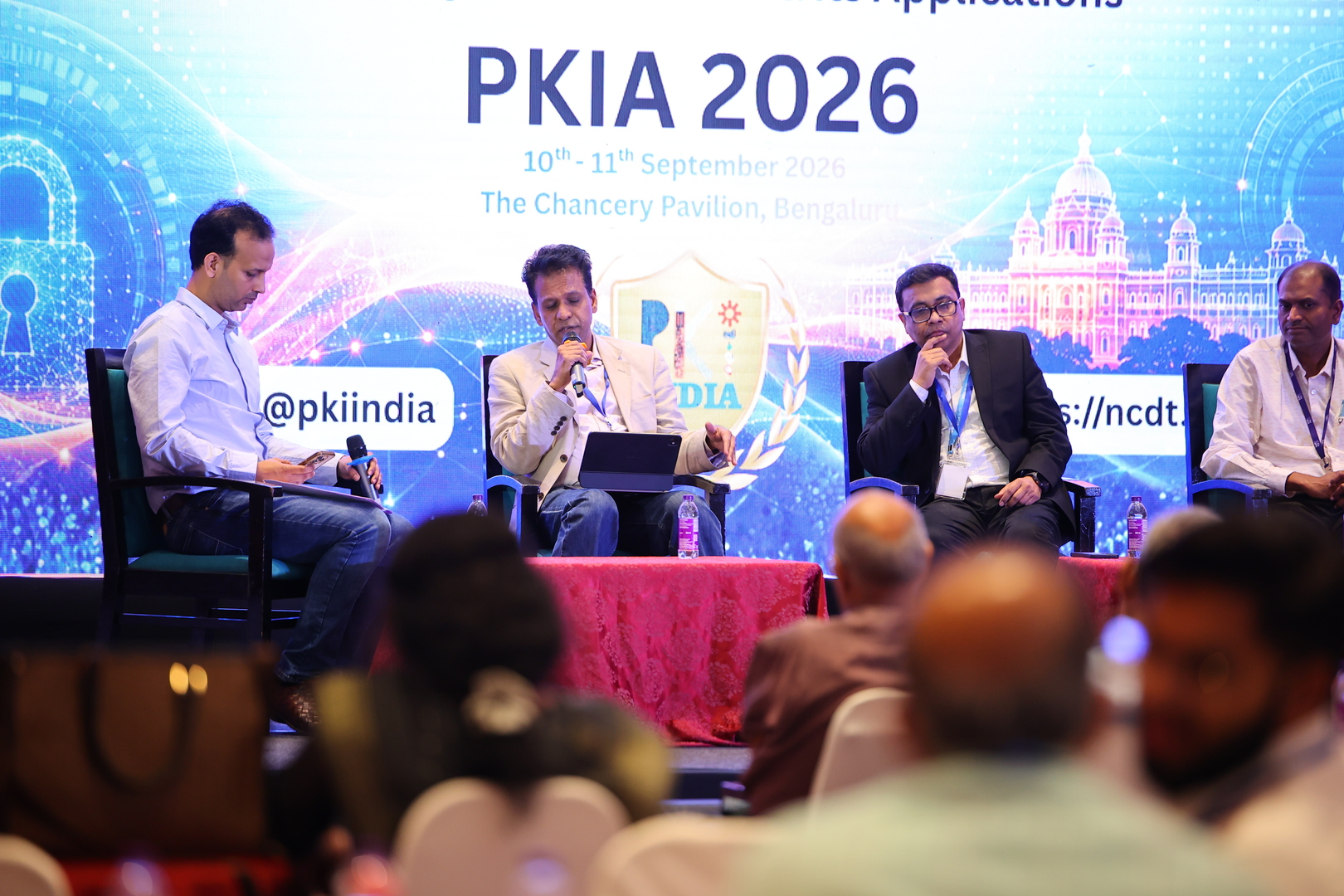
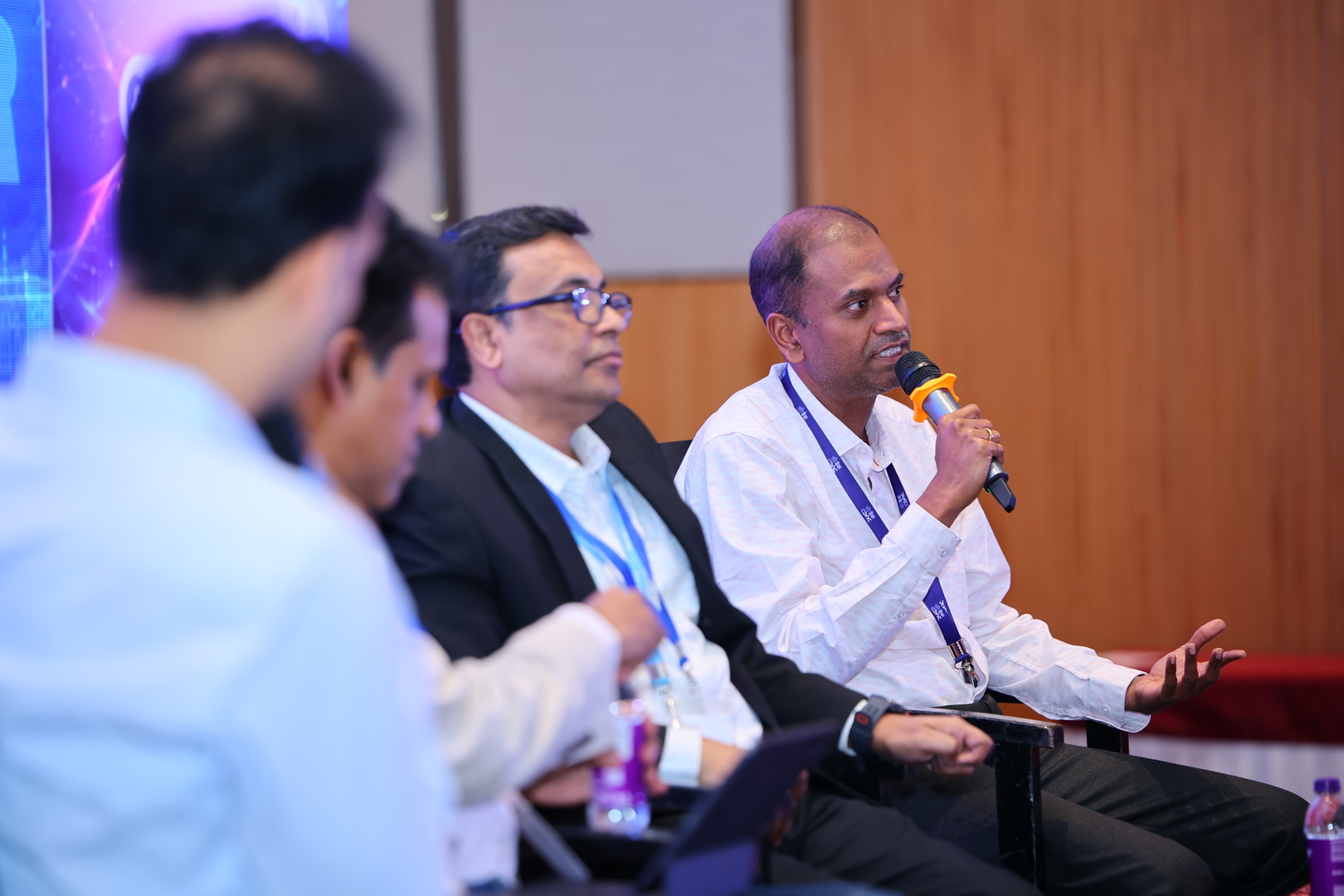
Panel Discussion (15:00 - 15:45)

  • Title: Digital Trust: From Silicon to Agents
  • Panel Members:
  • Speaker: Biswajit Biswas LinkedIn
    Chief Data Scientist, Tata Elxsi
  • Bio:
    Biswajit Biswas brings a career spanning the full arc of modern technology — from designing Digital Signal Processing and wireless communication systems (LTE, WiMAX, CDMA, 4G) in the early 2000s, to architecting AI-powered autonomous systems, embedded systems, smart appliances, and Industry 4.0 platforms today. This rare combination of hardware/embedded and system software-layer depth and enterprise AI breadth gives him a systems-thinking perspective. In the domain of AI and Data Governance, Biswajit has been instrumental in establishing enterprise-grade frameworks that balance innovation velocity with regulatory compliance and ethical AI principles. He has led the design and implementation of data lineage architectures, model risk management protocols, and responsible AI guardrails — ensuring that AI systems deployed across mission-critical verticals such as healthcare, media, industry, and connected systems meet the highest standards of transparency, auditability, and fairness. A holder of five patents in AI-based solutions, Biswajit is recognised nationally as a thought leader in Quantum Computing and AI policy. He also serves as a Working Group Member of the Bureau of Indian Standards (BIS) for Quantum Applications and Benchmarking, actively shaping the frameworks that will govern India's quantum future. He is a speaker and panelist at IITs, IIMs, IISc, India AI Summit 2026, and other international conferences. Beyond building technology, Biswajit also helps build and mentor talent, including AI engineers, data scientists, and product teams, while contributing to the broader ecosystem through academic collaboration and national standards work.

  • Moderator: Dr. Balaji R LinkedIn
    Scientist 'F', C-DAC Bangalore
  • Bio:
    Dr. Balaji Rajendran is a Scientist 'F' and heads the Resilient Information Systems and Engineering (RISE) Group at C-DAC Bangalore. With over 24 years of pioneering R&D experience, he has been instrumental in shaping digital trust and cybersecurity ecosystem through national initiatives, international collaborations, and indigenous technology development. He has played a pivotal role in proliferating Digital Signatures across the country through lectures, capacity building, and interactive content development. He established Asia's first Centre of Excellence in DNS Security with support from the government and industry and continues to drive mission-critical programs that strengthen the nation's cyber resilience. He is leading the National Centre for Digital Trust (NCDT), a pioneering initiative aimed at creating the next generation of digital trust frameworks and technologies for the systems and services that surround our everyday lives.

Tea Break and Stall Visit (15:45 - 16:00)

Invited Talk - 12 (16:00 - 16:30)

  • Title: TBA
  • Speaker: TBA
  • Bio:
    TBA

Valedictory Session (16:30-16:45)

  • Announcement - Best Paper
  • Address by Chief Guest
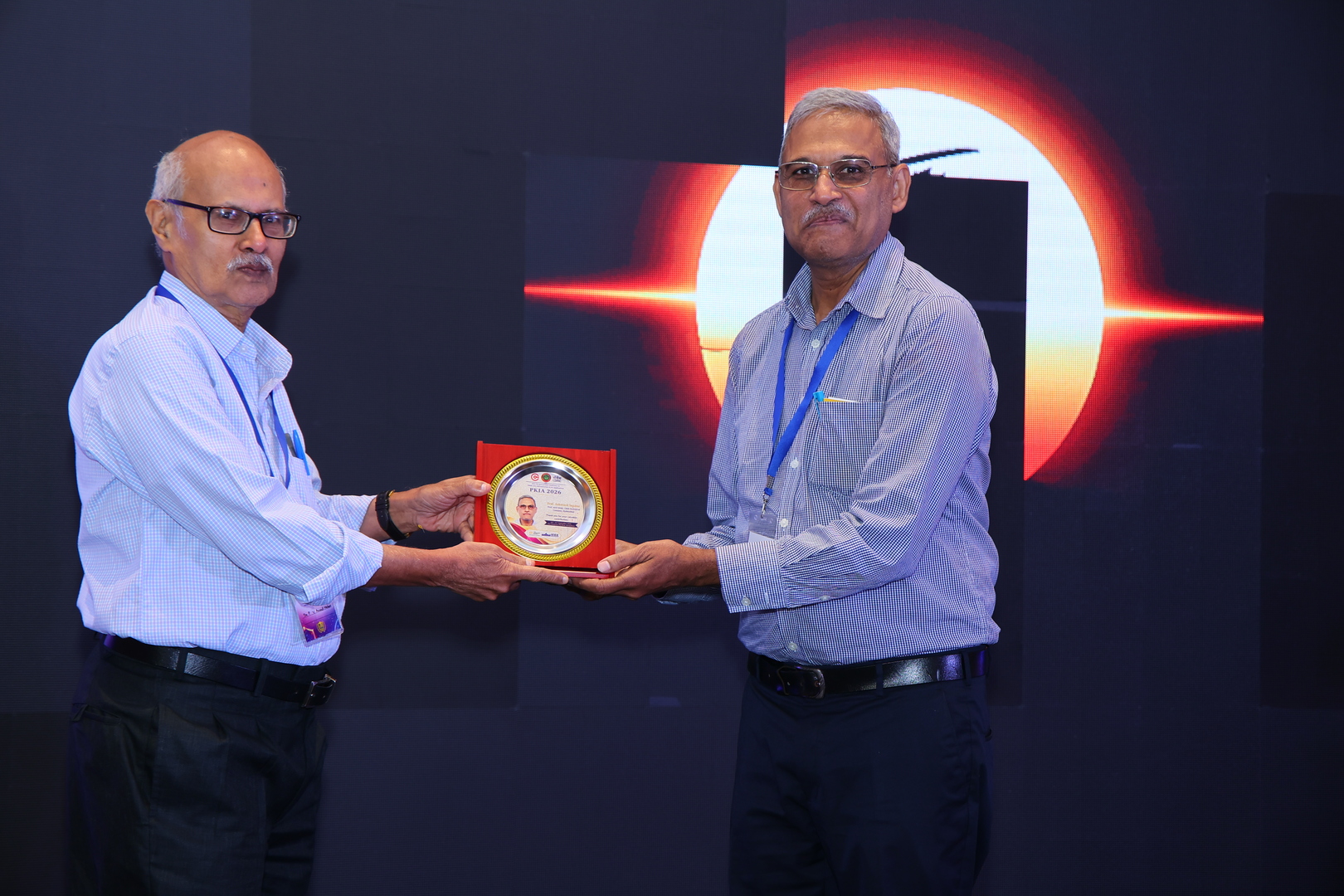
  • Felicitations
  • Closing Remarks

The Committee

Patron

  • Dr. Sanjay Bahl, Controller of Certifying Authorities and Director General, CERT-In
  • Shri Magesh Ethirajan, Director General, C-DAC

General Chair

  • Prof. R. K. Shyamasundar, IIT Bombay
  • Dr. S. D. Sudarsan, Executive Director, C-DAC Bangalore

General Co-Chair

  • Dr. Prasant Misra, Senior Scientist, TCS Research
  • Dr. Abhishek Appaji, Chair, IEEE CS Bangalore Chapter

Technical Program Committee

  • Dr. P. V. Anandamohan, Fellow IEEE (Chair)
  • Dr. Balaji R, Scientist 'F', C-DAC Bangalore (Co-Chair)
  • Dr. Apoorva Patel, Professor, IISc Bangalore
  • Prof. C. E. Veni Madhavan, IISc Bangalore
  • Dr. Nelaturu Sarat Chandra Babu, C-DAC
  • Prof. Ashutosh Saxena, Dean (R&D), CMRTC
  • Ms. Lakshmi Eshwari P R, C-DAC Hyderabad
  • Dr. Selva Kumar S, Associate Professor, BMSCE
  • Dr. Venkata Tulasiramu Ponnada, Collins Aerospace
  • Dr. Appala Naidu Tentu, Associate Professor, CR Rao Advanced Institute of Mathematics
  • Dr. Kunwar Singh, Associate Professor, NIT Trichy
  • Shri David Selvakumar, C-DAC Bangalore
  • Dr. Janaki Chintalapati, C-DAC Bangalore
  • Dr. R C Saritha, C-DAC Bangalore
  • Ms. Suganya Annadurai, SETS
  • Dr. Abey Jacob, C-DAC Bangalore
  • Dr. Kunal Abhishek, C-DAC Patna
  • Dr. Siva Hemanth Kolla, Sandia National Laboratories
  • Dr. Supraja, Visa Inc
  • Dr. Vishal Rathod, Zen Exim Pvt Ltd
  • Dr. Arpita Maitra, TCG CREST
  • Dr. Sangita Majumdar, C-DAC Bangalore
  • Dr. Ganesh Hegde, REVA University
  • Dr. Upendra Kumar Kagola, REVA University
  • Shri Ramesh Laveti, C-DAC Bangalore
  • Shri Gopinath P, C-DAC Bangalore
  • Ms. Surabhi Dwivedi, C-DAC Bangalore

Organizing Committee

  • Dr. Mohammed Misbahuddin, Scientist 'F', C-DAC Bangalore (Chair)
  • Mr. Gopal M M V, Manager (Marketing), C-DAC Bangalore
  • Mr. Jitendra Kumar, Scientist E, C-DAC Bangalore
  • Mr. Gopinath P, Scientist E, C-DAC Bangalore
  • Ms. Lavanya Palani, Scientist E, C-DAC Bangalore
  • Mr. Vishal Kumar Vaisya, Project Engineer, C-DAC Bangalore
  • Mr. Prathamesh Duryodhan Devkar, Project Engineer, C-DAC Bangalore
  • Ms. Julia Sam, Project Engineer, C-DAC Bangalore
  • Mr. Vishal Kumar, Project Engineer, C-DAC Bangalore

Publication Committee

  • Shri Anoop Kumar Pandey, Scientist 'E', C-DAC Bangalore (Chair)
  • Mr. Manish Apotikar, Project Associate, C-DAC Bangalore

Web Committee

  • Mr. Harsh Vardhan Singh, Project Engineer, C-DAC Bangalore

Venue

Date: 10-11th September 2026

Location: The Chancery Pavilion, 135, Residency Road, Bengaluru, Karnataka 560025, India

Partners

The Controller of Certifying Authorities (CCA) has been appointed by the Central Government under section 17 of the Act for the purpose of IT Act. The office of the CCA aims at promoting the growth of e-Commerce and e-Governance through the wide use of digital signatures. The CAs issues Digital Signature Certificates to the subscribers. The CCA certifies the public keys of CAs using its own private key, which enables user in the cyberspace to verify that a given certificate is issued by a licenced CA. For this purpose it operates, the Root Certifying Authority of India (RCAI). More information can be found here

Center for Development of Advanced Computing (C-DAC) is the premier R&D organization of the Ministry of Electronics and Information Technology (MeitY), for carrying out R&D in IT, Electronics and associated areas. C-DAC has today emerged as premier R&D organization in IT&E (Information Technlogies and Electronics) in the country working on strengthening national technological capabilities in the context of global developments. More information can be found here

Contact us

Contact Info

  • Centre for Development of Advanced Computing, #68, Electronic City, Bangalore - 560100 Karnataka(India)
  • pki[at]cdac[dot]in
  • +91-8028523300